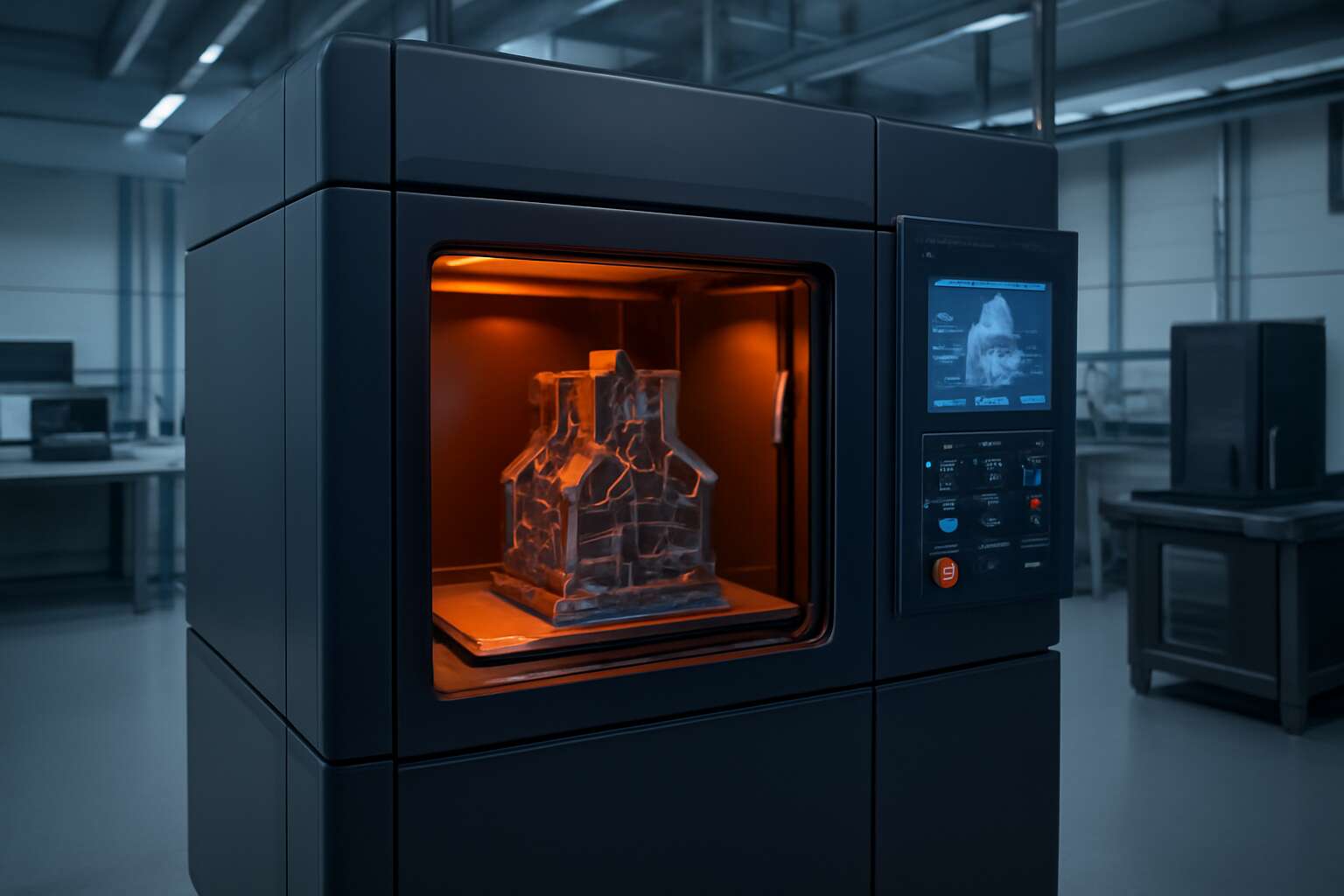
Global landscape of additive manufacturing
Market trends and growth drivers
From small prototyping benches to regional factories, the global landscape of the additive manufacturing industry unfurls with double-digit momentum, a whisper turning into a roar. Industry watchers estimate the market could surpass $60 billion by the end of the decade, propelled by faster design-to-part cycles and a surge in customization that traditional tooling can’t match.
Locally, South Africa is weaving these gains into automotive, aerospace, and healthcare ambitions, building supply resilience and skilled capacity. This momentum reshapes the additive manufacturing industry here, fueling collaborations between universities, startups, and established manufacturers.
Key growth vectors include:
- Localized production that reduces imports
- Material innovation expanding applications
- Digital twins and simulations accelerating validation
Regional adoption and growth opportunities
Global shipments rose 14% last year, underscoring a shift from prototyping novelty to production-grade capability. Across continents, manufacturers are blending design freedom with regional supply resilience, reworking how and where parts are made!
The global additive manufacturing industry is reconfiguring regional ecosystems, creating openings for operators who can pair design insight with local supply chains. In South Africa and surrounding markets, partnerships among universities, startups, and established manufacturers are turning pilots into scalable production.
- Policy incentives that encourage regional suppliers and workforce development
- Cross-border collaborations to share facilities, data, and standards
- Industry-led pilots in automotive, aerospace, and healthcare to validate new parts
For South Africa, this shift means local skills, faster part validation, and a more resilient manufacturing spine.
Key materials, technologies, and processes
Global shipments rose 14% last year, underscoring the shift from prototyping novelty to production-grade parts. The additive manufacturing industry is no longer a gadget; it’s a design discipline where material choice and process control determine cost, lead time, and risk. Across sectors, buyers demand repeatable performance from diverse materials and scalable workflows.
- Metals: stainless steel, titanium alloys, cobalt-chrome
- Polymers: nylons, polycarbonates, high-temperature resins
- Ceramics: silicon carbide, alumina
These families pair with technologies like selective laser melting (SLM), FDM, SLA, DLP, binder jetting, and EBM.
In South Africa, labs and manufacturers align to validate parts and shorten lead times, strengthening regional resilience. The global toolkit becomes practical local capability when design, quality, and data standards drive every step.
Investment, policy, and funding landscape
Global appetite for the additive manufacturing industry is shifting from tinker’s toolbox to boardroom staple. A record year of policy support and capital is nudging production-grade parts from concept to contract, with incentives that spark pilots into real orders. Governments and funders aren’t merely waving grants; they’re crafting ecosystems—standards, data governance, and export-friendly frameworks—so parts that were once prototypes pass QA with confidence.
- Grants for R&D and early production validation
- Tax incentives and depreciation schemes for equipment
- Public-private partnerships to de-risk scale-up
- National roadmaps and standards to harmonize data and quality
Across continents and in South Africa, policy pilots and regional funds align with corporate risk appetites, turning ambitious pilots into serial production. Local labs partner with suppliers to shorten lead times, while standards bodies push data interoperability so audits aren’t paperwork marathons.
Regulatory considerations and standardization
Global regulators are rewriting the playbook as production-grade parts move from prototypes to contracts. The additive manufacturing industry now hinges on formal standards, data provenance, and export-friendly frameworks that make QA traceable from design to delivery. ISO and ASTM committees are expanding test methods and terminology, while regulators tighten oversight of supplier qualifications and part certification. In South Africa, SABS and NRCS are aligning local specs with these global frameworks, smoothing cross-border trade and spurring compliant supply chains.
- Standardization work streams that harmonize data formats and quality metrics
- Certification and qualification pathways for materials, printers, and parts
- Export controls, IP protection, and cross-border compliance considerations
As standards multiply and data governance tightens, compliance becomes a shared language that accelerates safe, reliable parts across borders. The regulatory landscape remains dynamic, shaping cross-border collaboration and the march toward reliable, production-ready parts.
Applications across sectors
Aerospace, defense, and space
One design change can trim a kilogram from a wing without sacrificing strength. The additive manufacturing industry shows weight savings of 30–40% in critical components, turning fuel burn into measurable savings. Across aerospace, defense, and space, intricate geometries are now feasible without prohibitive tooling. In South Africa, clusters from Cape Town to Gauteng are translating these capabilities into competitive edge, delivering faster prototyping, lighter components, and tougher resilience!
- Turbine blades and heat exchangers that shave mass while enduring extreme temperatures.
- Airframe fixtures, brackets, and mission-critical fittings tailored to tight tolerances.
- Satellite structures and launch-vehicle components designed for rapid on-site fabrication and testing.
Here, resilience and innovation fuse, offering a modern dream—where speed, safety, and sophistication rise together.
Automotive and transportation
Across South Africa’s bustling workshops, the automotive and transportation landscape is being reshaped by the additive manufacturing industry. Engineers replace heavy fixtures with lighter, tailor-made parts that slice fuel use without compromising safety. From rapid prototyping to small-batch production, this tech folds agility into the supply chain, letting designers test ideas in days rather than months and bring ambitious concepts to the road with confidence.
From body-in-white accessories to drivetrain architecture, the potential unfolds in tangible parts:
- Lightweight brackets, housings, and interior components
- Custom drivetrain fixtures and engine-manifold supports
- On-site rapid prototyping for EV platforms and sensor housings
This blend of craftsmanship and digital precision keeps the industry nimble, compliant, and ready for the next evolution.
Healthcare and medical devices
Across 2024, the additive manufacturing industry touches hospital wards, turning patient-specific ideas into tangible relief. Implants and guides can be crafted with astonishing speed—up to 40% shorter lead times—giving surgeons a new latitude. “We tailor implants in days, not weeks,” a Cape Town surgeon affirms.
In healthcare and medical devices, the technology enables patient-specific models for pre-surgical planning, custom prosthetics, and sterilizable components. In South Africa, clinics embrace on-demand production to streamline supply and hasten approvals, while researchers explore biocompatible polymers and titanium alloys for implants, all under the umbrella of the additive manufacturing industry.
- Patient-specific surgical guides
- Custom prosthetics and orthotics
- On-site prototyping for devices and test fixtures
Industrial equipment, tooling, and consumer products
In 2024, the additive manufacturing industry rewired workshop tempo—industrial teams slashed tooling lead times by as much as 40%, turning ambitious concepts into production-ready parts with a single, decisive print. The effect is tactile: design freedom meeting quick, concrete results, a quiet revolution under fluorescent lights.
Applications across industrial equipment, tooling, and consumer products include:
- Jigs and fixtures that shave cycle times on assembly lines
- Custom grippers, housings, and tooling inserts tailored to unique processes
- On-demand spare parts and test fixtures that reduce inventory and obsolescence
From the field, South African shops bending to this capability tell a story of leaner supply chains and faster validation—proof that this industry is no longer a lab curiosity but a production reality.
Technology and process innovations
Powder bed fusion and directed energy deposition
In the last five years, the additive manufacturing industry has leaped from curiosity to core production, with metal printing capacity rising by over 150% in key sectors. Two stars in this revolution are powder bed fusion and directed energy deposition.
Powder bed fusion uses a laser or electron beam to melt powdered material layer by layer, delivering intricate geometries and fine surface finishes. Directed energy deposition builds with a focused heat source, allowing large parts, graded materials, and rapid iteration.
- Geometric freedom for complex lattices
- Material efficiency and waste reduction
- On-demand tooling and spare parts
For South Africa’s manufacturing landscape, these innovations translate into on-site capability, shorter supply chains, and bespoke tooling that meets local demand without compromising quality.
Material extrusion and binder jetting
The future isn’t static—it’s layered! In the additive manufacturing industry, South Africa’s manufacturers are turning prototypes into production runs, thanks to material extrusion and binder jetting.
Material extrusion builds parts by pushing thermoplastic or composite filaments through a nozzle, creating lightweight parts with complex geometries. Binder jetting layers a liquid binder over powder beds, enabling high-throughput production and easy color and material options.
- Faster prototyping cycles
- Design freedom for complex lattices
- Lower waste and material efficiency
In SA’s context, these technologies support on-site production and flexible supply chains.
Multi-material and hybrid manufacturing
“We’re turning prototypes into production runs,” a South African engineer says, and the shop floor is buzzing with it. In the additive manufacturing industry, firms here are pushing beyond single-material parts, pairing polymers with composites and weaving sensors directly into components. Hybrid manufacturing—where additive layers feed into in-situ finishing and metrology—lets on-site teams accelerate iteration, shrink lead times, and tighten supply chains.
Multi-material workflows let designers blend high-strength polymers with lightweight metals, while hybrid machines couple extrusion with subtractive precision and real-time metrology. The result is parts that perform in demanding environments, with fewer fasteners and less post-processing. In South Africa, this approach supports on-site production and demand-driven replenishment, turning flexible plants into a competitive advantage and expanding the role of local suppliers in a more resilient manufacturing ecosystem.
Post-processing, finishing, and surface treatments
The quiet revolution in the additive manufacturing industry wears a new sheen: a finish that lasts and performs. Early adopters report post-processing can dominate lead times, with some studies citing up to 70% of refinement time. Practical teams blend automation with craft, shaping texture to function and context.
South African makers are weaving advanced finishing into digital threads—using in-situ cleaning, laser smoothing, and controlled cooling to preserve material properties. A disciplined approach to surface treatments unlocks corrosion resistance, fatigue performance, and aesthetic quality without costly post-build steps. This shift strengthens the additive manufacturing industry here in South Africa.
- Bead blasting and media finishing for uniform texture
- Laser polishing and electropolishing for smooth surfaces
- Coatings and passivation for corrosion resistance
These innovations let the industry ship parts with reliable surface integrity and faster on-site deployment, turning finishing into a strategic differentiator rather than an afterthought.
Automation, metrology, and in-situ monitoring
In the additive manufacturing industry, automation, metrology, and in-situ monitoring are quietly rewriting the clock. “We print faster because we watch,” a South African shop manager quips, illustrating a shift from blind faith to sensor-led feedback.
Automation speeds workflows with closed-loop control, while metrology inserts precision at every layer. When sensors listen, engineers can nudge the process before waste becomes a headline.
- Automation for parts handling and build monitoring
- In-situ metrology for layer-by-layer verification
- Real-time anomaly detection and adaptive process control
South African teams are weaving these capabilities into local supply chains, turning insight into on-site deployment and durable performance.
Sustainability, standards, and risk management
Life-cycle assessment and environmental impact
Every layer counts, and the additive manufacturing industry is rewriting how we value waste and work. In South Africa, where power and water are precious, sustainability isn’t a luxury—it’s the design constraint that sharpens resilience and competitive edge.
Standards and risk go first as we scale. The environmental ledger grows with each build, so a crisp life-cycle assessment guides choices, and rigorous management of environmental impact keeps projects honest from design to end-of-life.
- Life-cycle assessment across design, production, use, and end-of-life.
- Standards alignment with ISO, SANS, and regional regulations.
- Risk controls include supplier audits and process validation to prevent disruptions.
Within the additive manufacturing industry, transparency and proactive stewardship build trust with customers, partners, and regulators across South Africa—and that trust compounds into measurable, almost alchemical, resilient performance.
Standards, certification, and compliance
In the additive manufacturing industry, resilience begins with responsibility. In South Africa, where power and water are precious, sustainability is not a luxury—it is the design constraint that sharpens resilience and edge. A compelling indicator shows that 1 in 4 manufacturers gain faster time-to-market when standards are woven into every build.
Standards, certification, and compliance anchor every choice from design to delivery. Align with ISO 9001, ISO 14001, and ISO 45001, while embracing regional SANS specifications and local regulations. Built-in controls—supplier audits, change control, and process validation—keep projects honest and auditable.
- ISO 9001 Quality Management
- ISO 14001 Environmental Management
- ISO 45001 Occupational Health and Safety
Transparency and proactive stewardship earn trust with customers, partners, and regulators across South Africa, turning compliance into measurable, resilient performance!
Workforce development and talent gaps
Across South Africa—from sun-drenched townships to coastal towns—the additive manufacturing industry is stitching resilience into everyday life. Sustainability no longer sits on the shelf; it guides material choices, energy use, and waste reduction. When power and water are precious, every build becomes a stewardship story.
Standards and risk management are not paperwork; they are design constraints that sharpen resilience. We weave environmental controls, quality checks, and safety considerations into the fabric of every project, keeping data transparent and processes auditable for customers, regulators, and communities.
Workforce development and talent gaps shape the horizon. We see three evolving focus areas:
- Operators and technicians who can run, monitor, and troubleshoot AM systems
- Design-for-additive minds that translate ideas into manufacturable realities
- Local training networks in rural and peri-urban areas that connect schools, industry, and mentors
Intellectual property, data security, and risk mitigation
In the additive manufacturing industry, sustainability stops being a buzzword and starts guiding every decision. Material choices, energy use, and end-of-life planning shape outcomes from the first CAD pass to the final part. A snapshot shows waste reductions of 25% when sustainability is treated as a design constraint. That shift is real!
Standards and risk management are not paperwork; they are guardrails that sharpen resilience. Intellectual property protection, data security, and risk mitigation weave into every blueprint, build, and audit trail — making processes auditable for customers and regulators alike. Transparent data flows foster trust with communities and partners.
- Intellectual property protection and licensing controls
- Data security measures across design, manufacturing, and post-processing
- Risk mitigation frameworks with traceability and incident response
Governance and workforce development keep risk in check and opportunity in sight. Protected design, production, and aftercare enable resilient growth from rural hubs to coastal towns.
Supply chain and ecosystem developments
Digital thread, data interoperability, and OT/IT convergence
In the additive manufacturing industry, resilience hinges on the digital thread that stitches design, production, and service into one living, responsive story. Early adopters report lead-time reductions of up to 40%, turning fragmented supply chains into nimble, customer-ready ecosystems.
Digital thread, data interoperability, and OT/IT convergence are no longer buzzwords. They connect design rooms with factory floors, enabling real-time visibility and smarter decisions.
- Unified data models and traceability
- Secure, interoperable data exchanges
Across South Africa, these developments nurture local ecosystems, reducing waste and supporting SMEs. For this industry, a shift from parts to connected, value-driven production is taking root.
Logistics, supply chain resilience, and after-sales support
Lead times in the additive manufacturing industry have fallen by up to 40% for early adopters, reshaping logistics and after-sales support. Across South Africa, digital thread and real-time visibility are turning fragmented supply chains into resilient ecosystems.
- Local partner networks and distributed production hubs reduce shipping distances.
- End-to-end traceability from design to service enables rapid root-cause analysis.
- Predictive maintenance and remote diagnostics tighten after-sales support.
For South Africa, the payoff is fewer stockouts, smarter spares strategies, and SME empowerment. This is how the sector delivers resilient supply chains and durable after-sales support.

0 Comments