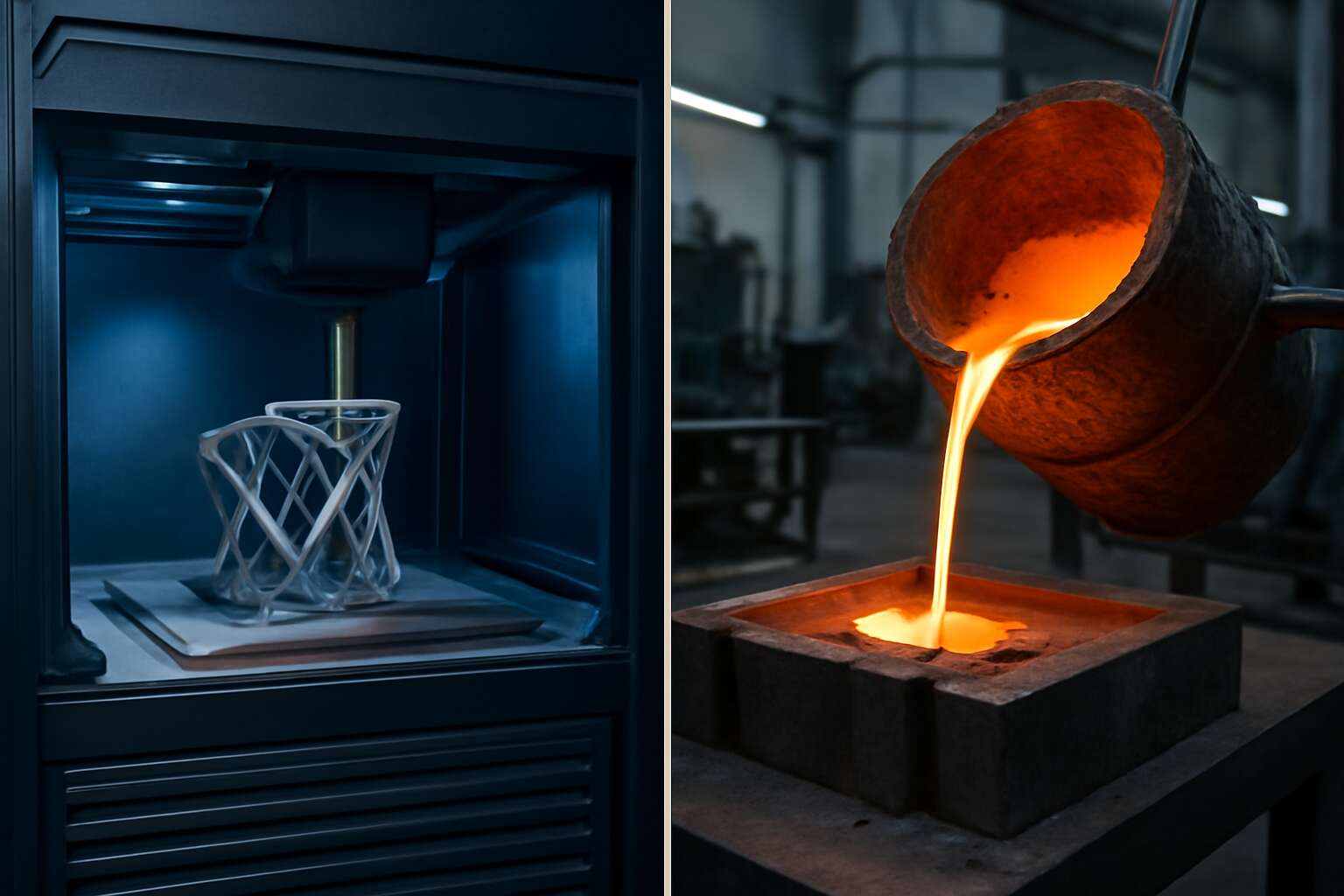
Overview and Context: Modern Manufacturing vs Traditional Casting
Key distinctions in workflow and philosophy
From Cape Town’s sunlit workshops to Gauteng’s steel-lit bays, progress hums louder than the anvil. In the debate of additive manufacturing vs casting, digital fluency replaces fixed molds. Prototypes that lingered now sprint to reality, and faster iteration leads the way.
Overview and Context: Modern Manufacturing vs Traditional Casting aren’t mere methods but mindsets. Here are the key distinctions in workflow and philosophy shaping decisions:
- Workflow: design-first digital threads, rapid iteration, no tooling delays
- Materialization: file-to-part production reduces lead times and inventory
- Quality control: in-process data, traceability, and post-cast checks
In South Africa, the advantage lies in flexibility for small runs, customization, and local supply resilience across mining, automotive, and tech. Casting keeps cost-per-part low at scale, while additive methods unlock lattice structures and lightweight designs tooling cannot easily reproduce.
Teams blend paths, letting digital twins and crafts share the stage and respond to the moment’s demand.
Economic considerations at a glance
Across South Africa’s manufacturing landscape, speed and resilience outrun tradition. In the debate of additive manufacturing vs casting, the economics hinge on batch size, customization, and risk, not just unit price. “Speed is the new currency in modern production,” an industry voice notes, and the implication is clear: the path chosen must fit demand volatility and local capability. Shorter lead times and the ability to pivot quickly matter as much as any single material choice.
Economic levers at a glance include:
- Tooling costs and amortization: molds and fixtures sit on balance sheets longer than they do on the shop floor.
- Lead time and inventory: digital files reduce stocking and speed part-throughput.
- Flexibility and local resilience: rapid redesigns align with SA supply chains and mining/auto needs.
Design for manufacturing implications
Overview and Context: Modern Manufacturing vs Traditional Casting Design sets the stage for how parts come to life in South Africa. A striking 62% of local manufacturers say speed trumps price when contracts hinge on lead times. The debate between additive manufacturing vs casting narrows to geometry, material behavior, and resilience under volatility. It’s not about cheaper; it’s about which path absorbs demand swings while keeping mining, auto, and infrastructure on schedule.
- Design for additive manufacturing emphasizes complex geometries and lightweight lattices
- Design for casting relies on tooling, seasoned processes, and batch predictability
- Local supply chains benefit from adaptable, rapid redesigns to cope with volatility
That balance shapes a modern factory’s playbook, where digital files reduce inventories and redesigns unlock value when markets shift.
In South Africa, clever integration—combining modeling, testing, and local fabrication—keeps questions of risk and capability in view above the noise.
Impact on supply chain and lead times
South Africa runs on time. A sizable 62% of local manufacturers say speed governs contracts more than price when lead times are tight. That urgency shifts risk away from offshore bottlenecks toward domestic capabilities. The choice between additive manufacturing vs casting then becomes a question of how quickly a plant can pivot to changing demand while keeping critical sectors online—mining, automotive, infrastructure.
- Reduced procurement cycles through local fabrication and digital workflows
- Fast redesigns reduce inventory and tech debt
- Better risk management in volatile markets
Integrated modeling and testing with local fabrication yields a nimble supply chain that stands up to volatility.
In this landscape, the choice of path—additive manufacturing vs casting—defines lead times as much as cost.
Process Capabilities and Differences
Geometry and feature capabilities
Across South Africa’s workshops, a striking fact is shaping decisions: additive manufacturing vs casting is a spectrum, not a rivalry. AM builds near-net shapes with minimal tooling, while casting excels at high-volume, proven geometries. The trick is knowing when to switch paths for performance and schedule.
Within this arena, geometry and feature capabilities diverge in telling ways:
- Complex geometries and internal channels: AM can realize lattice cores and conformal cooling; casting cannot easily replicate.
- Surface finish and tolerances: Casting often yields smooth surfaces for large forms; AM needs post-processing for precision.
From a South African manufacturer’s lens, the choice centers on lifecycle needs and volume. Weighing supply chain realities, additive manufacturing vs casting opens doors to rapid prototyping and on-demand spares, blending resilience with flexibility in today’s regional markets.
Materials and property considerations
South African shops know the truth: the fastest path to parts isn’t always the oldest trick in the book. In the debate of additive manufacturing vs casting, speed, tolerance, and post-processing reality decide the winner more often than tradition does.
Here are the levers that actually swing the build:
- Process stability and cycle times: AM enables rapid iteration; casting relies on molds and pour windows.
- Scale and geometry: AM handles complex internal channels; casting suits large, proven parts.
- Post-processing footprint: AM often needs machining and heat treatment; casting finishes can be smoother but still needs finishing.
Material choices range from metals and high-strength polymers to ceramics, each with trade-offs. AM parts can be anisotropic and stressed until heat-treated, while casting parts often arrive smoother but may require densification for peak performance. In South Africa, material access matters.
Production scale and throughput
Process stability and cycle times drive real outcomes; the clock doesn’t lie on the shop floor. In the debate of additive manufacturing vs casting, prototyping cycles can be up to 60% faster with rapid iterations, and that tempo often decides a project’s fate over tradition.
- Process stability and cycle times drive predictable productivity
- Scale and geometry unlock intricate channels or large, proven parts
- Post-processing footprint shapes overall lead times and costs
Across South Africa’s manufacturing footprint, production scale and throughput reveal practical trade-offs. Rapid prototyping and low-volume runs find their home in additive pathways, while casting continues to excel in high-volume, consistent outputs that demand solid, proven performance.
Process reliability and quality control
Routinely, the shop floor tells the truth. In South Africa, robust quality programs can cut scrap by up to 20% and lift uptime by 15%. When it comes to process reliability and quality control, numbers trump buzz. In the debate of additive manufacturing vs casting, predictable output wins the day, not just eye-catching prototypes!
Process capabilities hinge on three controllable levers:
- In-process monitoring and traceability
- Standardized post-processing and inspection
- Material batch certification and supplier quality control
Both paths demand disciplined data and clear metrics. In additive manufacturing vs casting, capability maps differ—build parameter windows, material behavior, and mold or thermal management all shape repeatability. The result is tighter tolerances, lower rework, and steadier lead times.
Cost, Lead Time, and Economic Impact
Capital investment and operating costs
Cost is where the tale begins, and it’s a fickle protagonist. In the comparison of additive manufacturing vs casting, tooling and mold fabrication can spike upfront, while on-demand production and reduced waste soften the sting over time.
Lead time follows a different rhythm. Prototypes spring to life in days with additive manufacturing vs casting that often hinges on mold fabrication. Yet, for larger runs, seasoned molds can accelerate production, weaving pipeline stability with demand.
Economic impact stretches beyond the shop, especially for South Africa’s manufacturers. The capital investment for additively manufactured parts sits beside ongoing operating costs—energy, inspection, and maintenance—that shape total cost of ownership. For some applications, nimble prints shorten cycles and lift return on investment.
Lead time, throughput, and delivery
Cost is the opening act, and the stage is different for additive manufacturing vs casting. Tooling and mold fabrication can spike upfront, while on-demand production and reduced waste soften the sting over time. The arithmetic favors flexibility and lower risk when volumes are uncertain.
Lead time follows a different rhythm. Prototypes spring to life in days with additive manufacturing vs casting that often hinges on mold fabrication. For larger runs, established molds can accelerate throughput, delivering predictable delivery windows and smoother planning.
In South Africa’s factories, the economic impact stretches beyond the shop floor. Energy, inspection, and maintenance shape total cost of ownership, while nimble prints can shorten cycles and improve ROI in a rising market.
Cost optimization by design and process
Costs sing like a smoky ledger on the shop floor. In the calculus of manufacturing, tooling for casting can spike, while additive manufacturing vs casting offers on-demand options that soften the sting over time. Cost optimization by design and process begins in the CAD and ends in the finished part, where flexibility becomes profit!
Lead time follows its own tempo. Prototypes spring to life in days with additive manufacturing, while casting hinges on mold fabrication. For larger runs, established molds can accelerate throughput, delivering predictable delivery windows and smoother planning.
- Prototype iteration velocity
- Mold fabrication timelines
- Throughput consistency
In South Africa, energy, inspection, and maintenance shape total cost of ownership, while nimble prints shorten cycles and improve ROI in a rising market. I watch the dialogue between cost, schedule, and risk reveal that design choices can yield substantial savings without sacrificing quality!
Industry models, pricing, and service options
Speed is the new capital, and South Africa’s factory floors feel the pressure in real time. In SA, energy, inspection, and maintenance shape total cost of ownership, while nimble prints stretch that cost over time. additive manufacturing vs casting signals a quiet revolution, turning on-demand production into a hedge against tooling spikes and obsolescence.
Lead time follows its own tempo. Prototypes can surface in days with additive manufacturing, while casting waits on mold fabrication. For larger runs, established molds can accelerate throughput and stabilize delivery windows. The right mix of services makes the difference.
- On-demand prototyping with functional validation
- Low-volume to mid-volume production
- Regional post-processing and inspection support
Economic impact and models: pricing and service options are evolving as networks grow and regional partners align with demand. Look for tiered pricing, pay-per-part arrangements, and scalable service levels that reflect risk, lead times, and quality requirements.
Applications, Industry Fit, and Case Studies
Aerospace and automotive use cases
In aerospace and automotive, design freedom matters. Complex channels, lattice cores, and lightweight structures are now practical. This is where additive manufacturing vs casting shows its edge, delivering rapid iteration from concept to test part. For South Africa, this means faster prototyping cycles and the ability to tailor parts to regional needs.
Industry Fit: The South African market benefits from digital workflows, local service, and shorter supply chains. OEMs can swap large, hard-to-procure castings for lighter, finish-ready parts produced on demand. For aerospace and automotive, this supports regional production hubs, spare-parts on demand, and resilience against global shocks.
Case studies: Aerospace and automotive use cases show the payoff. From turbine housings and fuel-system components to interior trim brackets, parts are lighter, cheaper to tool, and quicker to replace. In practice, the choice between additive manufacturing vs casting guides both performance and cost considerations, shaping regional value chains across SA.
Medtech, consumer electronics, and general manufacturing
Applications span Medtech, consumer electronics, and general manufacturing. In the conversation about additive manufacturing vs casting, the ability to tailor parts and shorten prototyping cycles stands out. From patient-specific surgical tools to compact enclosures, components can be lighter, easier to assemble, and produced on demand.
- Medtech: patient-specific tools or guides
- Consumer electronics: enclosures, heatsinks
- General manufacturing: jigs, fixtures
For South Africa, digital workflows, local service, and shorter supply chains unlock value. OEMs can replace large, hard-to-source castings with lighter, finish-ready parts produced on demand, enabling regional hubs and on-hand spare parts.
Case studies across Medtech, consumer electronics, and general manufacturing show the payoff: lighter assemblies, lower tooling costs, and faster replacements. This is where additive manufacturing vs casting shapes regional value chains and performance in SA!
Tooling, fixtures, and production aids
Applications span tooling and fixtures—areas where additive manufacturing vs casting excels at on-demand customization. Lightweight jigs, adaptable fixtures, and bespoke grippers can be produced with minimal setup, slashing changeover times and reducing assembly risk. Complex cooling channels and integrated interfaces become practical, enabling more automated lines with fewer suppliers.
Industry Fit: In South Africa, digital workflows, local service, and shorter supply chains unlock value. OEMs can replace large, hard-to-source castings with lighter, finish-ready parts produced on demand, enabling regional hubs and on-hand spare parts. This supports scalable manufacturing and rapid prototyping across regional clusters, aligning with local procurement goals.
Case studies across Medtech, consumer electronics, and general manufacturing show the payoff: lighter assemblies, lower tooling costs, and faster replacements. On-demand tooling reshapes spare-part strategies and reduces downtime, while the regional value, shorter lead times, and sustainable production cycles remain the throughline.
Rapid prototyping and product lifecycle management
Applications are shifting from fixed tooling to flexible manufacturing. In the debate around additive manufacturing vs casting, on-demand tooling, fixtures, and grippers unlock rapid adaptation with minimal setup. Lightweight assemblies and integrated interfaces become routine, slashing changeover and boosting automation.
- Lightweight jigs and fixtures
- Bespoke grippers and adaptors
- Complex cooling channels and integrated interfaces
Across South Africa, digital workflows, local service, and shorter supply chains deliver real value! OEMs can replace heavy, hard-to-source castings with lighter, finish-ready parts produced on demand, enabling regional hubs and on-hand spare parts that keep lines moving.
Case studies across Medtech, consumer electronics, and general manufacturing illustrate lighter assemblies, lower tooling costs, and faster replacements. Rapid prototyping and product lifecycle management accelerate refinement and help production teams reduce risk and iterations between design reviews and field deployments.
Design Strategies, Post-Processing, and Quality Assurance
Design optimization for manufacturability
Lead times are being rewritten by design. In the debate of additive manufacturing vs casting, design strategies can trim weeks from a project and salvage margins. I focus on modularity, minimal supports, and inspection-friendly geometry—especially for South Africa’s diverse suppliers and workshops.
- Design for minimal post-processing
- Modularity and standard interfaces
- Process-aware feature placement
Post-processing often sets the true cost and schedule. Plan deburring, heat treatment, surface finishing, and cleaning as part of the design brief. Align tooling, jigging, and automated handling to reduce drift, rework, and variability across materials and builds.
Quality assurance threads through every phase. Embrace traceability, in-situ monitoring, and rigorous metrology to translate design intent into consistent performance. When manufacturability is the goal, QA becomes a design constraint rather than an afterthought.
Post-processing workflows and finishing
Design Strategies steer the conversation in the additive manufacturing vs casting debate. Focus on design for minimal post-processing, modularity, and standard interfaces that slip together with common jigging. In South Africa’s diverse workshops, process-aware feature placement trims lead times and guards margins.
Post-processing workflows often determine true cost and schedule. Treat deburring, heat treatment, surface finishing, and cleaning as design requirements, not afterthought steps. Build in automated handling and consistent jigging to reduce drift across materials.
- Deburring and edge refinement
- Cleaning and surface preparation
- Heat treatment alignment and inspection
Quality Assurance threads through every phase. Embrace traceability, in-situ monitoring, and metrology to translate intent into repeatable performance. QA as a design constraint guides material choice, process parameters, and tolerance setting in the SA market.
Quality assurance and metrology
‘The finish is written in the design,’ a seasoned SA machinist likes to say. In the additive manufacturing vs casting debate, design for modularity and standard interfaces drives speed. Build parts that slip together with common jigging, so feature placement stays process-aware and away from post-production pain. In SA, this mindset trims lead times and guards margins.
Post-processing demands are not afterthoughts; they are design requirements. Deburring and edge refinement, cleaning and surface preparation, and heat treatment alignment and inspection shape how quickly a job moves from CAD to customer. Build in automated handling and consistent jigging to reduce drift across materials.
- Deburring and edge refinement
- Cleaning and surface preparation
- Heat treatment alignment and inspection
Quality Assurance threads through every phase. Embrace traceability, in-situ monitoring, and metrology to translate intent into repeatable performance. QA as a design constraint guides material choice, process parameters, and tolerance setting in the SA market.
Maintenance, reliability, and lifecycle considerations
Design strategies in the additive manufacturing vs casting debate are real-world and pragmatic. In SA shops, modular interfaces and common jigging speed up production, keep feature placement process-aware, and minimize post-build pain. This approach makes procurement and maintenance easier.
Post-processing can’t be left to chance. Deburring and edge refinement, cleaning and surface prep, and heat-treatment alignment dictate how quickly a part moves from CAD to customer. Build automated handling and consistent jigging to reduce drift across materials.
Quality Assurance threads through every phase. Traceability, in-situ monitoring, and metrology translate intent into repeatable performance. QA as a design constraint shapes material choice, process parameters, and tolerances in SA markets, reinforcing lifecycle reliability and long-term value.

0 Comments