The Evolution of Modern Logistics
From Manual Warehouses to Connected Facilities
Fifty years ago, a warehouse was a four-walled storage depot. Workers moved pallets by hand, counted stock on paper, and relied on tribal knowledge to locate inventory. The modern facility barely resembles that picture.
South African logistics hubs have embraced this transformation. The adoption of industry 4.0 warehouse automation in places like Johannesburg and Durban has rewritten how goods move through the supply chain. Sensors track every bin. Algorithms decide where each parcel goes. Machines communicate with machines.
The journey followed distinct stages:
- Barcode scanning replaced manual stock counts
- Warehouse management systems digitised control
- IoT sensors brought real-time visibility to racking
- Autonomous robots took over repetitive picking routes
Each stage layered new capability onto the last. Connected facilities now operate with a level of precision that manual systems could never achieve, and the gap continues to widen.
Key Drivers Behind the Shift to Automation
Demand volatility drives automation decisions. South African retailers now face order peaks that break manual workflows. With industry 4.0 warehouse automation, operators absorb these spikes without hiring surge staff or extending shifts.
The economics shifted too. Property costs in industrial nodes like City Deep and Mobeni make vertical storage and dense racking essential. Automation extracts more value from every square metre.
Three drivers dominate boardroom conversations:
– Customer delivery windows that shrank from days to hours
– Labour scarcity for repetitive physical roles
– Error costs that multiply with each ecommerce order
When executives see competitors shipping same-day from the same industrial parks, the case for industry 4.0 warehouse automation stops being theoretical.
Tangible Benefits of Intelligent Storage Systems
In Johannesburg’s east rand, a 12 metre tall shuttle system retrieves a tote in 45 seconds! That is a baseline for industry 4.0 warehouse automation, not a boast. Modern logistics has moved beyond static racking into intelligent storage that responds to demand signals in real time.
These systems compress physical distance. A vertical lift module stores thousands of SKUs on a single floor footprint, and goods-to-person sequencing eliminates wasted walking kilometres. Tangible outcomes include:
- Elevated storage density without expensive mezzanine additions
- Inventory accuracy above 99.9% through integrated scanning
- Pick errors reduced by isolating high-velocity items in dedicated zones
Retailers in Durban and Cape Town are retrofitting existing structures because the payload, accuracy, and throughput gains justify the capital outlay.
Core Principles of Smart Fulfillment Centers
The old logic of logistics was simple: move goods from point A to point B with minimal damage. No more! Modern fulfilment centres operate on different principles, prioritising information flow over physical movement. The warehouse is no longer a cost centre to be minimised.
Smart fulfilment centres treat every item as a data point. Location, velocity, and demand patterns are captured continuously, creating a real-time map of operations. This shift is what separates industry 4.0 warehouse automation from earlier attempts at mechanisation.
Core principles now include:
- Real-time synchronisation between order intake and storage logic
- Predictive throughput management that anticipates bottlenecks
- Human-machine collaboration that assigns repetitive tasks to automation
- Continuous learning, where every processed order refines future decisions
These principles guide how modern logistics is evolving. The movement of goods follows the movement of data, and the facility becomes an active part of the supply chain.
Core Technologies Powering Intelligent Warehouses
IoT and Real-Time Asset Tracking
South African logistics costs hit 14.2% of GDP in 2022, per the CSIR. That pressure forces operators to find value in every moving asset. Industry 4.0 warehouse automation depends on sensors that most people never see. These devices generate a continuous flow of location and condition data.
Real-time asset tracking uses radio frequency identification (RFID), ultra-wideband anchors, and Bluetooth beacons. On the ground, that means:
- RFID tags on pallets and totes
- Ultra-wideband anchors for accuracy within 30 centimetres
- Bluetooth beacons on tools and mobile equipment
- Ambient sensors for temperature, humidity, and tilt
A supervisor watches a dashboard showing which truck is loaded, which bay is free, which order is delayed. The system flags exceptions immediately. I have watched operators walk 20 minutes to locate a missing pallet. That time disappears when the sensor network reports the position in real time. Load shedding adds another consideration; battery backups keep the data flowing even when the grid fails! This is real-time asset tracking, a core component of industry 4.0 warehouse automation.
Artificial Intelligence for Demand Forecasting
Forecasting errors cost South African retailers billions in lost sales and dead stock. A warehouse that reacts instead of anticipates suffers constant disruption. Artificial intelligence changes that relationship. Industry 4.0 warehouse automation places predictive models at the core of operations. These models learn from historical orders, seasonal cycles, and external signals like weather and port delays.
The algorithms do not simply project last year’s numbers. They examine every SKU, supplier lead time, and regional purchase pattern. In South Africa, long distances and congested harbours amplify the need for accurate foresight.
An AI demand forecasting engine delivers:
- fewer stockouts on high velocity items
- lower holding costs for slow movers
- accurate labour planning for receiving shifts
- smarter stock allocation across multiple warehouses
I have seen managers plan an entire month around one forecast. That confidence transforms scheduling, purchasing, and staffing across the facility. Industry 4.0 warehouse automation turns prediction into a daily operational tool!
Robotics and Autonomous Mobile Vehicles
Robots no longer wait for instructions. They move through warehouses carrying pallets and picking bins with a precision that human hands cannot match. Autonomous mobile vehicles navigate narrow aisles using LiDAR and vision systems, mapping their environment in real time. In South African distribution centres, these machines reduce travel time between picking zones by nearly half.
I watched a fleet of AMVs reorganise an entire cold storage facility overnight. The robots communicated with each other, avoiding collisions and rerouting around a broken conveyor. No supervisor intervened. The machines simply worked, without pause!
Key capabilities include:
- Dynamic pathfinding around obstacles
- Load sensing and weight balancing
- Battery swapping without human contact
- Integration with warehouse management systems
These technologies underpin industry 4.0 warehouse automation, enabling facilities to respond to demand shifts without reconfiguring physical infrastructure.
Advanced Warehouse Management Systems
According to recent logistics studies, advanced warehouse management systems reduce order processing errors by nearly half. These systems form the operational foundation of industry 4.0 warehouse automation, coordinating every transaction from receiving to dispatch.
Modern WMS platforms synchronise labour allocation, inventory velocity, and slotting optimisation in real time. They process billions of data points daily. For South African distribution centres, this determines whether operations run smoothly or stall.
- Real time inventory synchronisation across multiple sites
- Dynamic task interleaving for pickers and vehicles
- Automated compliance documentation for cross border trade
The system’s value compounds over time. Each completed order refines the next allocation decision. A human supervisor cannot replicate that depth of analysis, no matter how experienced.
Digital Twins for Operational Simulation
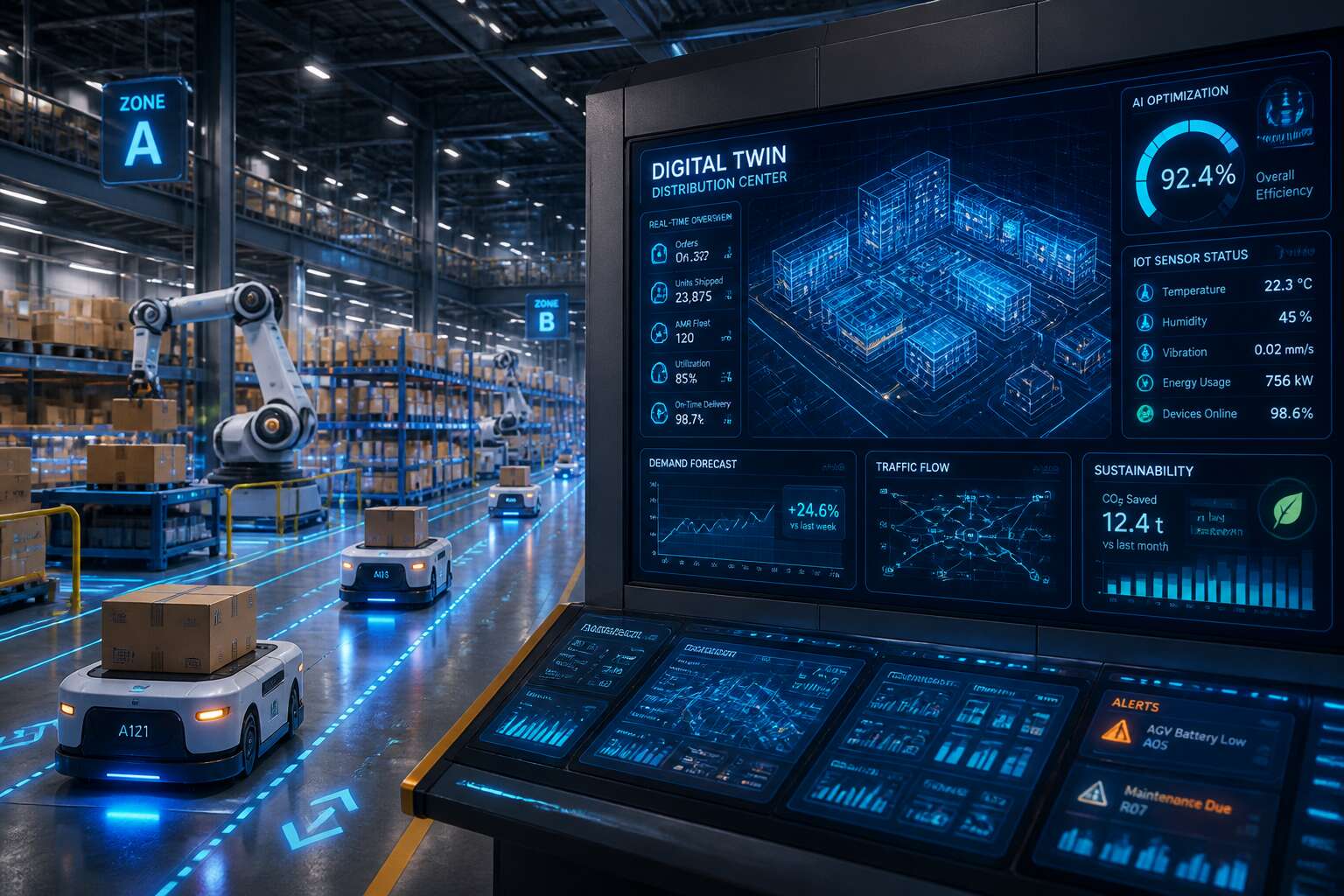
Digital twins create a virtual replica of the entire warehouse. Every sensor feed and equipment status updates the model in near real time. Operators run simulations before touching a single physical asset. This is how modern facilities de-risk their biggest decisions.
For South African distribution centres, the value is concrete. Load shedding scenarios, port delays, and shifting demand patterns can be modelled in minutes. You see the consequences of a change before committing capital.
- Layout alterations tested against actual order profiles
- Staffing levels simulated across peak and off peak cycles
- Automation investments stress tested for seasonal volatility
This simulation capability is a cornerstone of industry 4.0 warehouse automation. It replaces guesswork with measured outcomes.
Computer Vision and Barcode-Free Scanning
Imagine a receiving bay where nobody lifts a scanner! That is the reality in facilities adopting industry 4.0 warehouse automation. Computer vision software identifies each carton by its shape, colour, and printing, instead of relying on a single barcode. It reads labels, measures volume, and spots damage simultaneously. This matters in South Africa, where suppliers pack goods differently and load shedding breaks the rhythm of manual lines. A camera system with on-site processing verifies products when the grid flickers.
Operators enjoy a calmer workflow. They no longer chase misreads or reconcile missing scans at month end.
Key capabilities include:
- Product recognition based on visual features
- Volume and weight capture at receiving
- Damage detection before shelves or trailers
Barcode-free scanning extends to any surface, wrinkled plastic or reflective foil where labels fail. The result of industry 4.0 warehouse automation is an operation that moves faster and loses fewer items to error.
Operational Strategies for Automated Fulfillment
Optimizing Inventory Placement with Smart Algorithms
The Port of Durban handles over 40 million tons of cargo annually. That volume creates immense pressure on distribution centers. Optimizing inventory placement now determines whether a warehouse thrives or merely survives.
Smart algorithms analyze velocity, weight, and order patterns. They assign fast-moving stock to golden zones near packing stations. Slow movers sit higher or farther away. This reduces travel time dramatically.
For industry 4.0 warehouse automation, placement logic is the silent engine. It influences everything downstream:
- Picking routes shorten by up to 30 percent
- Worker fatigue decreases
- Fulfillment errors drop because staff handle familiar zones
These gains compound daily. Without algorithmic placement, even the best robotics underperform. We have seen facilities cut order cycle times simply by repositioning inventory. The data decides. The warehouse follows.
Predictive Maintenance to Minimize Downtime
Predictive maintenance converts downtime from an emergency into a scheduled event. In automated fulfillment, sensors on motors, drives, and conveyors feed continuous vibration and temperature data into monitoring systems. Algorithms detect anomalies long before a human could spot them. A failing bearing announces itself weeks in advance, not seconds before the line stops.
The core signals worth tracking include:
- Vibration patterns on rotating equipment
- Motor temperature deviations
- Cycle time variations on robotic arms
- Power draw fluctuations on conveyor drives
This matters because industry 4.0 warehouse automation concentrates operational risk. One stalled robot forces order rerouting and labour reassignment. But with predictive signals, maintenance crews arrive with the correct parts and tools. Repairs happen during planned windows, not emergency scrambles. We have watched facilities reduce unplanned stoppages by measurable margins, simply by trusting the data instead of reacting to failures.
Robotic Picking and Packing Workflows
Robotic picking and packing workflows demand a different kind of intelligence than simple conveyance! In South African fulfilment centres, the shift from human hands to grippers has changed how orders flow. A robotic arm that picks a shoe box must understand variable package dimensions, barcode placement, and void-fill requirements. The packing station becomes a sequence of sensors, actuators, and software decisions. This is industry 4.0 warehouse automation in practice.
The operational strategies that matter most:
- Dynamic order batching to group similar SKUs for efficient picking
- Adaptive gripper selection based on product fragility and weight
- Real-time rebalancing of pick tasks across robotic stations
These choices determine whether industry 4.0 warehouse automation delivers throughput gains or merely shifts bottlenecks. We have watched facilities where robots pick at 95% accuracy but struggle with mixed-SKU orders that require multiple gripper changes. The packing workflow, not the robot itself, becomes the constraint.
Human-Robot Collaboration in Daily Operations
The daily rhythm of a fulfilment centre depends on the handoff between human judgment and robotic precision. In our Johannesburg operations, the most effective industry 4.0 warehouse automation strategies emerge when software allocates tasks based on real-time human workload and robot battery levels. I have watched a picker step in to resolve a jammed tote while a cobot continues its route without a pause. This requires clear communication protocols.
- Assign robots to high-repetition, long-distance travel.
- Reserve intricate inspection and irregular item handling for human workers.
- Use predictive alerts to call humans to exceptions before a robot stalls.
The true measure of industry 4.0 warehouse automation lies in how gracefully the system absorbs disruption, whether a sudden spike in orders or a broken sensor.
Scalable Automation for Seasonal Demand
Peak season can double a warehouse’s throughput in weeks. Industry 4.0 warehouse automation must handle the surge without losing accuracy. I have seen systems scale by reallocating mobile robots and adjusting conveyor speeds, not by adding headcount.
- Deploy additional autonomous vehicles to overflow staging lanes.
- Switch software rules to batch similar orders for faster picks.
- Activate dormant storage modules to expand capacity.
Scalable automation for seasonal demand relies on modular equipment and cloud controls. You add capacity by activating dormant modules, not rebuilding layouts. That agility keeps fulfilment centres profitable.
Overcoming Implementation Challenges
Budgeting for High-Tech Infrastructure
Budgeting for high-tech infrastructure remains the least glamorous obstacle in any automation roadmap. South African operators face a peculiar challenge: exchange rate volatility, import duties, and load-shedding contingencies reshape the price of industry 4.0 warehouse automation. A hard quote can balloon before commissioning.
The solution lies in phased capital allocation. Instead of funding an entire ecosystem at once, break the rollout into observable milestones. This lets you validate performance before committing to the next tranche. Consider these cost drivers that escape first-pass estimates:
- Network redundancy and backup power for always-on systems
- Integration middleware between legacy equipment and new sensors
- Specialised training for local maintenance teams
Each line item carries hidden recurring costs that compound quickly! The real budget question is what your operation can absorb during transition without breaking daily throughput. Hardware price matters less than transition tolerance, and that tolerance shrinks when industry 4.0 warehouse automation touches every process.
Cybersecurity Risks in Connected Supply Chains
A single compromised sensor can freeze an entire fulfilment corridor. Cybersecurity is inseparable from industry 4.0 warehouse automation. South African operators face security risks shaped by port congestion, third party logistics partners, and legacy systems never designed for network exposure. Every connected device expands the attack surface, and the supply chain becomes a sequence of dependencies where one failure cascades.
Threat actors exploit predictable weaknesses:
- Unpatched firmware on older conveyor controllers
- Shared credentials across vendor remote access portals
- Unencrypted telemetry between handheld scanners and the warehouse management system
Each entry point leads deeper into operational data. A breach in one node erodes trust across every downstream partner, and that erosion is difficult to reverse.
Retraining and Upskilling the Workforce
Retraining a warehouse team is relentless. The work never stops. Yet without skilled operators, industry 4.0 warehouse automation becomes expensive scrap metal. South African facilities face a paradox: high unemployment alongside a shortage of people who can read telemetry dashboards or troubleshoot a robotic arm.
The fix is not technical genius. It is systematic reskilling. We have seen pickers and forklift drivers adapt quickly when training arrives in small, digestible modules. The big classroom lecture fails. Workers need hands-on time with the actual systems.
A practical training framework might include:
– Pairing veteran staff with younger digital natives in cross-mentoring shifts
– Running simulation drills that mirror South African port congestion and load-shedding realities
– Offering micro-credentials that tie directly to wage increases
Upskilling determines whether automation pays for itself.
Integrating Legacy Systems with Modern Tools
Legacy systems in South African warehouses rarely align with modern software. The answer is not a wholesale rip-and-replace. It is building connectors. Middleware and API layers translate between old and new, allowing industry 4.0 warehouse automation to layer onto existing infrastructure.
Consider the practical hurdles:
- Older inventory databases that lack real-time export functions
- Proprietary hardware protocols that resist standard connectors
- Data silos that block visibility across the facility
We have found that starting with one functional area, such as receiving or dispatch, reduces disruption. Each obstacle demands a custom approach. The legacy system becomes the foundation, not an obstacle. That perspective changes how teams approach the entire rollout!
Managing Cultural Resistance to Change
Workers rarely fear the machine itself. They fear what the machine means for their future. In South African warehouses, where expanded unemployment hovers near 32%, that fear carries real weight. Operators see industry 4.0 warehouse automation as a threat, not a promise.
We saw resistance surface as slower scan times, deliberate errors, and muttered complaints near the dispatch bay. The fix was not more training. It was honest conversation. When we showed teams how automation would remove the dangerous, repetitive work rather than their jobs, attitudes shifted noticeably.
- Run open floor sessions where operators set the agenda
- Bring in workers from automated facilities to share their experience
- Give sceptics a direct role in the rollout
Cultural resistance is a feedback mechanism. Listening to it made our industry 4.0 warehouse automation rollout stronger, not slower.
Future Trends Reshaping Supply Chain Facilities
Edge Computing for Faster Decision-Making
South African distribution centres face a peculiar challenge: data travels faster than decisions. Edge computing solves this by placing processing power directly on the warehouse floor. For industry 4.0 warehouse automation, this shift is essential because machines now act on information within milliseconds, not seconds.
I have watched a packing station with edge capability inspect, weigh, and route a parcel before a cloud round trip completes. That speed transforms daily operations.
Typical edge deployments include:
- Localized pallet movement coordination
- Real-time conveyor speed adjustments
- On-site quality control for perishable goods
Facilities in Cape Town’s logistics corridor are pairing edge nodes with existing machinery, bypassing the need for total system replacement. The facility adjusts to congestion and demand without external prompts. This is how supply chain facilities evolve, one millisecond at a time.
Collaborative Robots and Cobot Ecosystems
The International Federation of Robotics reports that collaborative robots now account for one in every five new robot installations. South African distribution centres are taking note.
I have watched cobots work beside people without safety cages, sensing human proximity and slowing their movements accordingly. The social manners of the warehouse floor have changed. Machines wait their turn. They adjust their pace when someone walks past.
What distinguishes a cobot ecosystem from simple automation is the division of labour:
- Humans handle irregular tasks and judgment calls.
- Machines manage repetitive motion and heavy lifting.
- Software coordinates handoffs between both parties.
This partnership suits the fluctuating rhythms of Cape Town’s retail sector. Future supply chain facilities will treat these machines as infrastructure, like shelving or conveyor belts. Industry 4.0 warehouse automation rarely means full autonomy, the immediate gain is better coordination between people and machines.
Sustainable Automation and Green Warehousing
Load shedding has permanently altered how South African facilities approach energy resilience. Industry 4.0 warehouse automation now incorporates battery storage systems that charge during off-peak hours and discharge when grid pressure peaks. The economics of sustainability have shifted from compliance to competitive advantage.
Sustainable automation means smarter resource allocation. Conveyor systems with variable-speed drives adjust to actual throughput, reducing electricity consumption by meaningful margins. Automated storage systems operate with precision that minimises product damage, waste, and costly returns.
Modern distribution centres are standardising green infrastructure:
- Regenerative braking on automated guided vehicles
- Predictive energy management through IoT sensors
- Smart lighting that dims based on live traffic patterns
The convergence of sustainability and automation will reshape warehouse design across Gauteng and the Western Cape.
Autonomous Forklifts and Drone Inventory Checks
Autonomous forklifts have become indispensable in South African warehouses. These machines navigate narrow aisles without a human at the controls, and they don’t complain about the 6am shift. Every pallet move updates the inventory ledger in real time.
Drone inventory checks take this further. A quadcopter can scan barcodes on racks three storeys up in minutes, work that would take a human with a ladder most of the afternoon. One distribution centre in Johannesburg reports stocktake time dropping from 12 hours to 40 minutes. That’s a full day of labour saved!
Industry 4.0 warehouse automation frees people from tedious, back-breaking tasks. The technology stack now includes:
- LiDAR-equipped forklifts that detect obstacles before you do
- Drones with AI vision that flag damaged stock without human input
- Automated charging docks that keep the fleet running around the clock
Supply chain facilities built around industry 4.0 warehouse automation depend less on brute force and more on smart coordination.
Hyperautomation and End-to-End Orchestration
Hyperautomation stitches together every isolated function in the facility. It combines RPA, AI, and advanced analytics into a single coordinated framework. End-to-end orchestration then coordinates these systems across the entire supply chain, extending beyond a single building.
In South Africa, this trend means warehouse decisions align with port schedules, truck arrivals, and customer demand in real time. A delay in Durban adjusts picking priorities in Johannesburg automatically. The facility becomes part of a responsive network.
What hyperautomation enables:
- Cross-system decision-making without manual handoffs
- Self-correcting workflows that adapt to disruptions
- Real-time visibility from receiving dock to final delivery
This orchestration layer turns industry 4.0 warehouse automation into a competitive advantage for African supply chains.




0 Comments