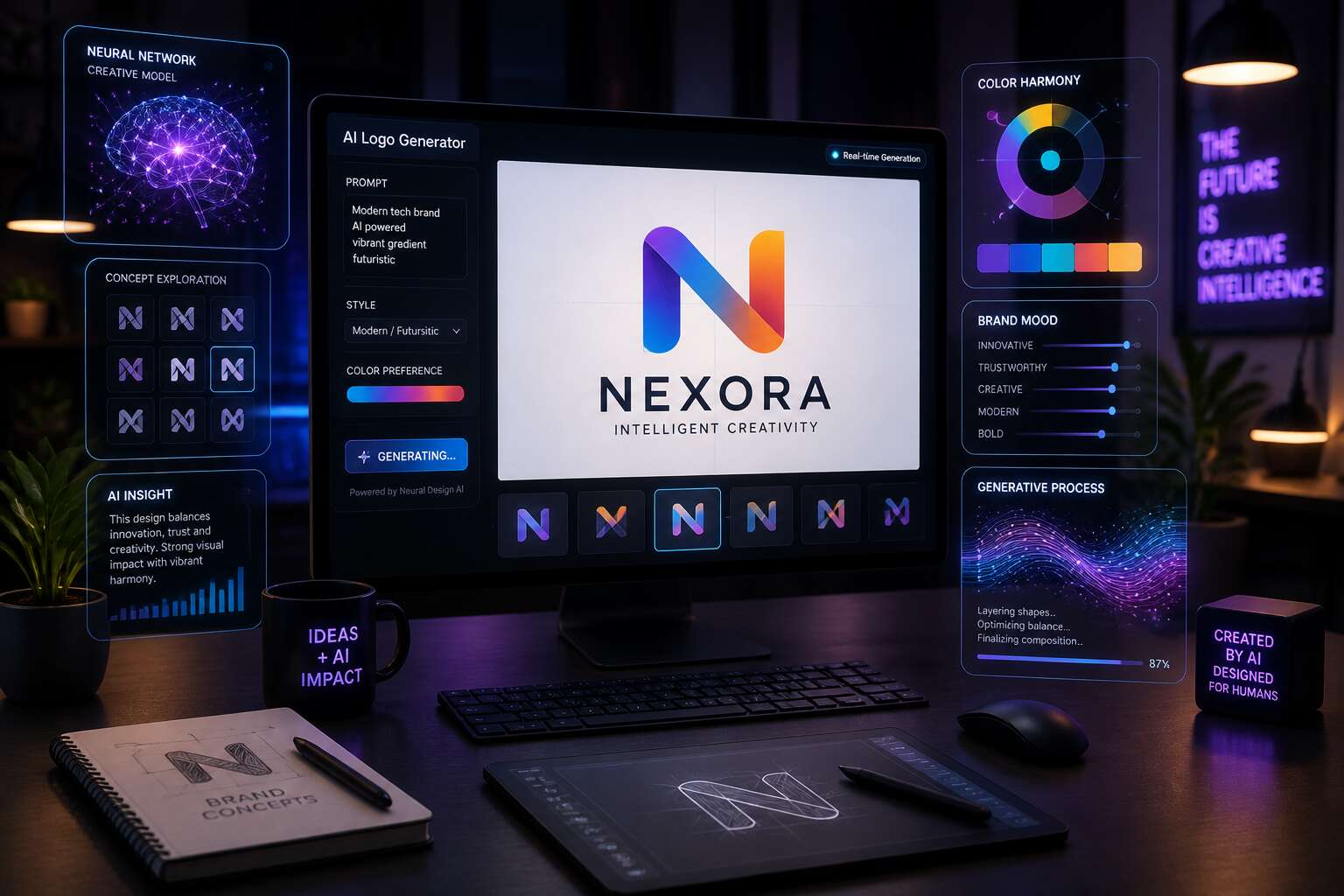
The Rise of Intelligent Branding Tools
From Manual Sketching to Algorithmic Design
The ledger of brand identity once demanded ink-stained fingers and hours hunched over tracing paper. Those days carry a certain romance, a whisper of the artist’s solitary ritual. Yet the modern South African entrepreneur now turns to a different kind of alchemy. The AI generated logo arises from code, born in the silent churn of neural networks rather than the scratch of a pen.
This shift is a quiet coup. Intelligent branding tools now parse consumer sentiment and market currents, distilling centuries of design language into seconds. Consider what the studio machine now understands:
- Colour psychology mapped to local purchasing behaviour
- Typography that echoes the brand’s unspoken temperament
- Geometric forms drawn from the client’s industry terrain
Each parameter hums with intent, offering an eerie precision that manual drafting yielded only through tedium. The designer’s hand has not vanished, but any AI generated logo now flows through a new conduit, merging human instinct with algorithmic patience.
What Changed in the Design Industry
The design industry no longer holds a monopoly on visual identity. Intelligent branding tools have inserted themselves into the workflow, altering the relationship between client, designer, and final asset. For the South African market, where agility matters, an ai generated logo provides a rapid prototyping layer that was unthinkable a decade ago! The cost barrier collapsed, and so did the waiting time.
- Design feedback now arrives in minutes, not meetings.
- Client revisions are driven by live data, not taste alone.
- The designer’s authority shifts from drawing to directing.
What truly changed is the feedback loop. Tools now measure brand resonance against consumer sentiment, offering data that a manual studio could never collect. This shifts the designer’s role from hands-on execution to strategic curation. I see the ai generated logo as a probe, not a monument.
The Technology Behind Automated Creativity
The rise of intelligent branding tools has introduced a new dynamic to South African business: machines that learn taste. I have watched this shift alter client expectations! These systems do not replace the designer’s eye; they interrogate vast libraries of visual culture, extracting latent patterns that elude human perception. The technology behind automated creativity relies on generative adversarial networks and diffusion models, refining an ai generated logo through iterative competition.
- A Johannesburg startup tests twenty distinct brand directions before lunch.
- A Cape Town agency validates colour psychology against regional consumer data.
The ai generated logo emerges from this machinery as a hypothesis, not a final verdict. Each iteration carries a trace of the data that shaped it, creating a visual artifact that evolves even after export. The implications extend to authorship itself.
Why Businesses Are Embracing Smart Logo Solutions
Speed and Efficiency Gains
A logo that once required three weeks of back and forth now appears in three minutes. That speed alters expectations. Procurement cycles shrink, and design approval becomes a single sitting. For a startup in Johannesburg or a retail chain in Cape Town, this speed enables market entry ahead of competitors.
The efficiency gains extend beyond clock time. With an ai generated logo, teams iterate through dozens of concepts before lunch. They test variations against brand constraints without incurring high freelance costs. The cost of exploration approaches zero, which invites bolder choices.
Consider what speed unlocks:
- Faster rebrands when strategy pivots
- Consistent output across collateral
- Reduced dependency on external agencies for initial drafts
Yet the real adoption driver is psychological. Waiting creates anxiety. A quick ai generated logo reduces the delay between intention and artifact, so stakeholders stay engaged. They see their feedback reflected immediately, which builds trust in the process.
Cost-Effective Branding Options
The price of a single brand workshop in Sandton can exceed the annual design budget of a small business. This gap explains the growing interest in smart logo solutions. An ai generated logo does not require a retainer or a discovery phase. It offers a predictable cost structure that aligns with cash flow.
Businesses in Johannesburg, Durban, and Cape Town are turning to algorithmic design for one reason: control over spend. They can allocate funds to other priorities while still securing a usable mark. Consider these cost-related advantages:
- No hourly billing surprises
- Unlimited variations within a set price
- Immediate ownership of the final file
These factors make the ai generated logo an attractive option for startups and established firms alike. The economic argument is straightforward! When the marginal cost of a new concept drops, the value of iteration increases. That is why the market is shifting.
Accessibility for Non-Designers
Most entrepreneurs in South Africa never studied typography or colour theory. They run bakeries, logistics firms, or fintech startups. When they need a brand mark, they face a language barrier with traditional agencies. An ai generated logo removes that barrier by letting people describe their vision in plain words.
This is not about artistic mastery. It is about practical control. The software behind an ai generated logo translates a brief into visual options. You do not need to know what a bezier curve is. You do not need to understand kerning. The system handles those technicalities while you focus on taste!
- Choose a style from simple menus
- Adjust colours without a designer’s guidance
- Download files ready for use
The result empowers owners who previously felt locked out of branding. They can iterate quickly and compare outcomes. That accessibility is why smart logo solutions are spreading beyond creative circles.
Consistency Across Platforms
Consistency is the quiet work of branding. A mark must echo across a smartphone screen, a shipping label, and a Cape Town storefront without losing its character. An ai generated logo responds to this demand by producing multiple resolutions and locked compositions from a single brief. The shape stays intact. No stretched fonts, no faded colours, no broken proportions.
This matters for a bakery in Durban and a logistics firm in Johannesburg alike. Every asset set arrives ready for the channel it targets:
– profile images for social platforms
– watermarked versions for invoices
– monochrome variants for packaging
Business owners apply the same identity without renegotiating design decisions each time. The system enforces rhythm. That reliability turns scattered customer touchpoints into one recognisable voice.
Overcoming Creative Blocks
Business owners often know their logo feels wrong but cannot articulate why. They stare at a blank canvas, or worse, at a template already visible on a competitor’s storefront. An ai generated logo removes that paralysis by offering a structured starting point, not a final answer. It presents visual directions that provoke a reaction, and from that reaction, a clearer identity emerges.
This is the quiet appeal of smart logo solutions. They do not replace judgment; they give it material to work with. A Cape Town founder juggling funding and hiring cannot afford to sit with a blank page. The tool removes that friction! It absorbs the small decisions that drain creative energy:
- colour palette hesitation
- typography pairing doubts
- uncertainty about scaling between digital and print
I have watched founders spend days agonising over a single letterform. An ai generated logo collapses that timeline into minutes, not because it knows the answer, but because it removes the fear of starting wrong. That fear, not technical limitation, is what stalls branding projects across South Africa.
Understanding the Mechanics of Machine Learning Design Platforms
Data Sets and Training Models
The training data for a single logo design platform may exceed ten million visual samples, but the path from raw pixels to an ai generated logo is anything but simple. This corpus, scraped from global brand registries, typography guides, and vector archives, forms the substrate. Without meticulous curation, the model learns noise. South African designers often notice how regional aesthetic preferences get diluted in these massive datasets.
Machine learning design platforms operate in two phases. First, they encode visual patterns into latent spaces. Second, they decode prompts into raster or vector outputs. The training models use contrastive learning to separate geometric shapes from semantic meanings. For instance, a chevron evokes speed or stability depending on adjacent elements.
Key mechanics I find surprising:
– Data augmentation applies random rotations, colour shifts, and scaling to prevent overfitting.
– Loss functions penalise outputs that deviate from prompt relevance and brand consistency.
The result of this pipeline is an ai generated logo that adapts to its context. Yet the model’s bias remains a hidden variable, especially when training sets lack African visual markers.
User Inputs and Customization Algorithms
A single text prompt might contain fewer than ten words, yet those words steer millions of latent parameters. The customization algorithms parse each token for semantic weight, then map it to visual features the model already understands. Sliders for colour, spacing, and complexity modify the output vector directly. I have noticed South African users triggering unexpected glyph associations when local brand names enter the prompt field, a quirk of the training corpus.
The interaction loop matters more than the initial prompt. Each adjustment you make, whether moving a saturation dial or swapping a font weight, sends a new signal through the neural network. The platform recalculates its probability distribution and regenerates the ai generated logo accordingly.
Common adjustments include:
- Changing colour palettes to match existing brand assets
- Adjusting geometric symmetry versus organic flow
- Selecting between raster previews and vector exports
The ai generated logo becomes a negotiation between your intent and the model’s learned aesthetics.
How Style Preferences Are Processed
Style preferences arrive at the model as weighted probabilities, not personal whims. A preference for rounded corners triggers a cascade of adjustments in the neural network, altering what the ai generated logo will look like before you finish typing.
When you select a specific palette or reject a candidate design, the platform records that response. I have watched this happen in real time during design sessions. The model compares your choices against thousands of similar sessions and adjusts its internal representations accordingly.
The processing involves several discrete operations:
- Tokenizing your input into semantic markers
- Aligning those markers with visual features in the training data
- Re-ranking the output probabilities
Each step feeds into the next, which is why two designers with identical briefs rarely receive identical ai generated logos.
Iterative Refinement Processes
Every rejection teaches the system something. When you request another variation, the platform does not shuffle the same elements. It reweights internal probabilities, nudging the next ai generated logo closer to what your eye is searching for.
This iterative refinement is the quiet engine of the whole process. The model tracks which details you keep and which you discard. It notices when you zoom in on a mark, when you reorder a palette, when you ask for a heavier typeface. Each action becomes a signal.
Consider what happens across several rounds:
- Your first prompt sets a broad direction.
- Your feedback narrows the visual space.
- Each new ai generated logo inherits that accumulated learning.
The result is a design that feels discovered rather than generated, a quiet dialogue between human taste and machine memory.
Practical Limitations and Creative Trade-Offs
Originality Concerns in Large-Scale Output
The quiet paradox of an ai generated logo lies in its volume. Large scale output produces thousands of options, yet every design borrows from the same training data. Originality becomes a rare outcome when algorithms reuse popular motifs. The result is a visual sameness that undercuts the promise of unique branding.
Practical limitations vary across contexts. A system cannot grasp local symbolism, such as the meaning of a protea or a springbok in South African markets. It also misses the human intention behind a mark.
- Repeated shapes from common datasets
- Weak differentiation among competitors
- Minimal capacity for narrative depth
Designers must treat each ai generated logo as a starting point, not a finished symbol. The trade off between speed and originality remains a live question in every automated creative process.
File Format and Scalability Constraints
Seventy two percent of small businesses expect one logo file to work across every channel. An ai generated logo usually arrives as a raster PNG, which performs admirably on a website but suffers visible degradation on a roadside banner. Vector formats such as SVG or EPS remain the industry standard for scalable marks, yet most automated tools skip them entirely.
- Raster images lose sharpness at scale
- Vector exports need manual verification
- Print production demands CMYK colour conversion
The quiet compromise is time. Generation happens in seconds, but the format requires a designer’s intervention. Every ai generated logo carries a scalability constraint that must be resolved before the brand ever leaves the screen.
The Importance of Human Oversight
An ai generated logo can mimic trends, but it cannot feel a brand’s history. The algorithm blends pixels from thousands of existing marks, which means the result often looks competent and forgettable at the same time. I have watched small business owners in the Karoo fall in love with a generated emblem, only to realise it has no story behind it.
That is where human oversight becomes essential. A designer can ask the questions an algorithm never will! What does this colour mean to your customers? Does this shape survive a township spaza shop sign or a Cape Town boardroom?
- Algorithms optimise for visual appeal, not meaning
- Trade-offs exist between uniqueness and familiarity
- A designer interprets context, while software only calculates
The practical limitation is not the output, but the intention behind it. An ai generated logo needs someone to guide it, otherwise the brand lacks a voice that customers can trust.
Selecting the Best Automated Branding Service for Your Needs
Assessing Your Brand’s Visual Needs
Choosing an automated branding service requires honesty about your visual identity. In South Africa, where small businesses compete against international players, the logo carries significance. An ai generated logo can meet that standard if you first define your brand’s visual needs. Start by cataloguing existing assets, colour preferences, typography habits, and the emotional tone of your industry. Some services specialise in minimalist marks, others in detailed illustration.
When I evaluate a platform, I check three factors:
- How the service interprets briefs beyond simple keywords
- The range of visual outputs offered before refinement
- The ownership terms for commercial use
These factors outweigh flashy demos. A service that produces an ai generated logo with weak vector output or limited file scalability will fail at the first print run. Assessing needs honestly determines whether the service fits the operational reality.
Evaluating Customization Features
There is a quiet tension embedded in every customization panel. Too many toggles create decision paralysis. Too few reduce the ai generated logo to a template wearing your name. Superior automated branding services treat the ai generated logo as a living asset, not a static file. They offer selective influence over shape geometry, optical spacing, and stroke weight, while holding colour psychology internally. When I evaluate a platform, I test customization features against a single question: does it perceive the brand’s emotional memory? A logo is not decoration. It is a repository of reputation. The features worth inspecting are few:
- Does the platform accept tonal briefs beyond raw keywords?
- Can you lock typography while iterating on iconography?
- Are colour adjustments grounded in perceptual models or simple hex values?
- Does the system explain what changed between refinement rounds?
These capabilities distinguish automated production from automated thoughtfulness. Good customization creates a dialogue; it never yields to a one-way command.
Budget Considerations and Pricing Models
Selecting the right automated branding service demands budget clarity before creative promises matter. Most platforms structure pricing around one of three models: one-time downloads, monthly subscriptions, or usage-based tiers. Each model changes how freely you can revisit and revise an ai generated logo later.
- One-time payments suit founders testing a concept
- Subscriptions reward teams that iterate constantly
- Usage tiers fit agencies managing multiple client brands
When comparing costs, weigh download resolution limits against future use cases. A logo locked inside a cheap plan may vanish behind a paywall when you need vector files for packaging. Read the licence terms. South African businesses often discover hidden export fees only after checkout.
The cheapest option is rarely the wisest. A mediocre ai generated logo will cost more in rebranding effort than a moderate investment saves. Match pricing structure to your actual revision appetite and the lifespan of your brand.
Reviewing Output Quality and File Options
An ai generated logo only earns its keep if the files survive real-world contact. South African businesses need more than a pretty PNG for their WhatsApp profile. They need print-ready vectors, transparent backgrounds, and colour profiles that hold up on packaging, signage, and merchandise. When reviewing output quality from any ai generated logo service, demand to see samples at different sizes. A mark that looks crisp on screen often turns muddy when scaled up.
File options matter more than most founders realise! I have watched clients lose entire campaigns to a blurry export. Check whether the service exports SVG, EPS, or PDF alongside the standard formats. Also verify if you own the source files outright.
- Request a mockup on a physical product before purchasing
- Test the logo on a dark background and a light background
- Confirm the AI can regenerate variations without degrading quality
These checks separate a useful tool from a costly mistake.
Comparing Popular Platforms
Selecting a platform is an exercise in self-awareness. Your tolerance for constraints defines which service feels liberating and which feels suffocating. Leading automated branding services each carry a distinct temperament. One leans heavily into template libraries. Another grows complex the moment you request granular control.
Some platforms anticipate your next move. Others demand you adapt to their logic. An ai generated logo produced through a service that respects your autonomy will differ from one that steers you through a rigid funnel. Test the platform’s behaviour when you take an unusual path.
- How quickly the service renders changes
- Whether the interface scales with your competence
- The community culture around each tool
These observations determine whether you have a durable partnership or a transactional download.
Testing Before Committing
Test the platform before you commit. Most people choose a service based on screenshots. I prefer to break things. The ai generated logo should respond to your unusual demands. If the interface freezes or the export fails, you have your answer.
- How quickly the software applies a custom colour palette.
- Whether the free tier shows true output quality.
- How the service handles a deliberately complex prompt.
South African business owners often overlook this trial phase. They pay for a subscription, then struggle with rigid controls. The best automated branding service offers a sandbox for experimentation. Take your worst-case scenario and run it through the tool. Observe the rendering speed and the final file structure. An ai generated logo that thrives under pressure will also handle your daily tasks with ease. That single afternoon reveals more than any marketing page. Choose a partner that feels natural when conditions are unpredictable.




0 Comments