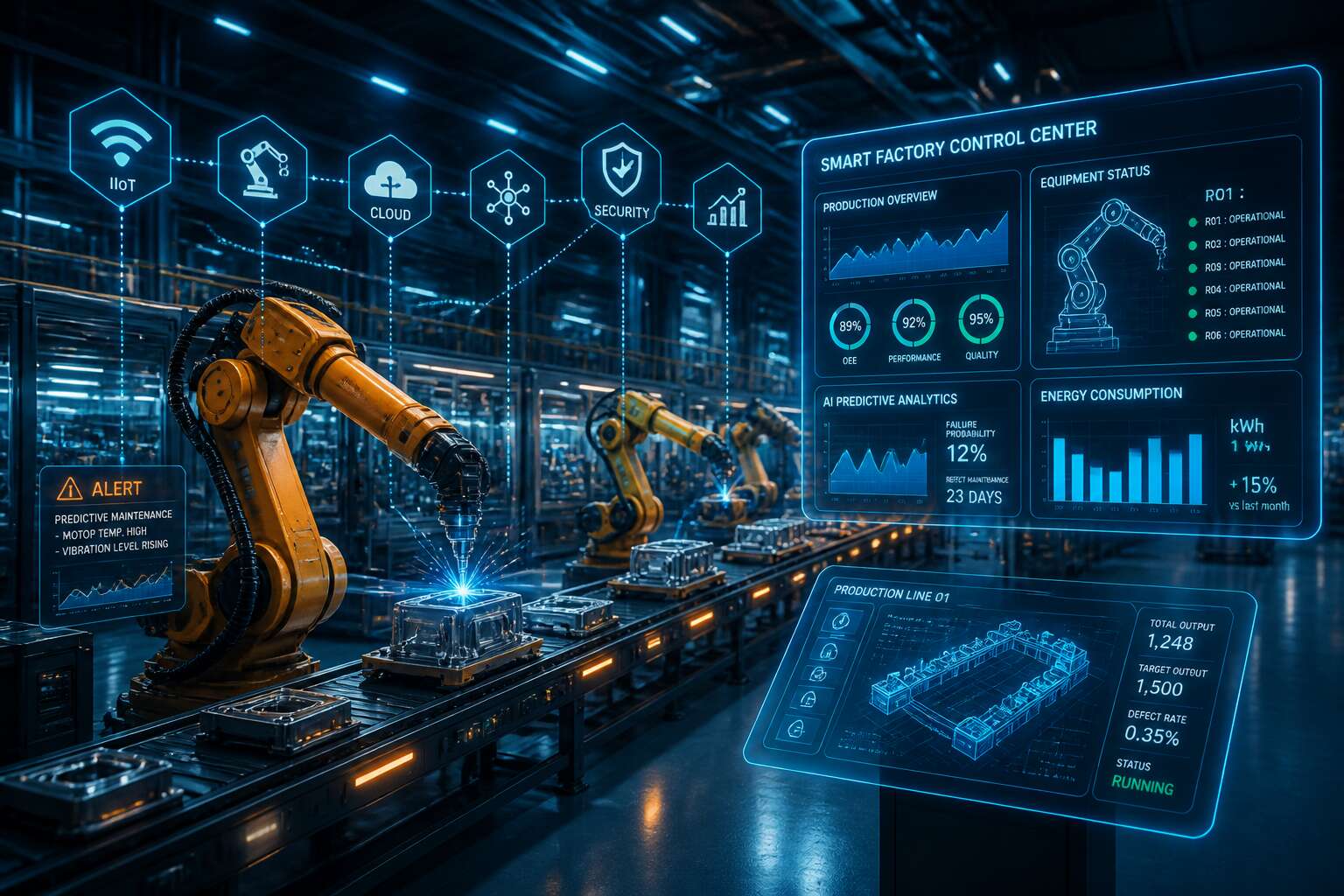
The Origins and Evolution of Industry 4.0
From Industry 1.0 to 4.0: A Historical Overview
The first industrial revolution harnessed steam and water power, replacing muscle with machinery. The second brought electricity and assembly lines, enabling mass production. The third introduced computers and automation, digitising the factory floor. The progression unfolded as:
- Industry 1.0: Mechanisation via water and steam.
- Industry 2.0: Mass production through electric power.
- Industry 3.0: Automation with electronics and IT.
- Industry 4.0: Cyber-physical systems and interconnectivity.
These transitions set the stage for today’s connected factories. To grasp what is industry 4.0 meaning, one must see it as the fourth wave, where machines communicate and make decisions using real-time data. This evolution matters in South Africa, where manufacturing seeks to leapfrog legacy constraints. The current shift compresses a timeline that once took centuries.
The German Government’s Role in Coining the Term
In 2011, three German engineers, Kagermann, Lukas, and Wahlster, presented a working paper at Hannover Messe. Their proposal, Industrie 4.0, became the German government’s official high-tech strategy. This was not a marketing exercise. It was a national directive to keep factories competitive.
For South African manufacturers, this history shapes current strategy. The initiative produced a shared vocabulary and a collaborative structure:
- Federal funding de-risked early research
- Industry bodies set common technical standards
- Universities trained the automation pipeline
To grasp what is industry 4.0 meaning, I examine how Germany structured it. The concept moved from a domestic agenda to a global benchmark. South African factories can adopt these protocols without reinventing them. The framework exists. Local execution requires adaptation.
The Fourth Industrial Revolution vs. Industry 4.0: Understanding the Difference
Some terms arrive softly and then refuse to leave. Industry 4.0 is such a phrase. It mutters through strategy papers and whispers from procurement decks. But what is industry 4.0 meaning, exactly? The origin reaches back to German engineering minds, yet the evolution spans continents. The Fourth Industrial Revolution is not the same construction. That revolution is the broader societal reordering, the rise of biotech, the reshaping of work and identity. Industry 4.0 is the industrial backbone, the connected machine, the data plucked from the factory floor. One is the atmosphere. The other is the weather you can touch.
For South African plants, I find the difference practical. Buy a sensor network and you are acting on Industry 4.0. Rethink how your entire value chain serves communities, and you are meeting the Fourth Industrial Revolution halfway. The evolution follows a grim logic:
– Computing power collapsed in cost
– Connectivity reached every workbench
– Data became the new ore
Understanding that sequence matters. Yet many confuse the map with the territory. Do not be one of them.
Why Industry 4.0 Matters for Global Manufacturing
The latest global automation spending figures suggest manufacturers are quietly betting on something that outlasts machinery. That something is a shift in agency, the ability for a plant to decide, react, and correct itself without a human holding its hand. This is where what is industry 4.0 meaning becomes a question of survival rather than vocabulary. It represents the transition from machines that follow instructions to machines that interpret conditions.
The evolution started in Germany, not as a consumer trend, but as a policy response to eroding competitiveness. It moved beyond mere digitisation into the realm of cyber-physical systems, where the digital twin of a production line exists alongside the physical one. For global manufacturing, this creates a delay that matters. A plant in Gauteng can spot a defect before the batch ships, not because a technician noticed, but because the system flagged the anomaly.
– The operating rhythm changes from weekly reviews to hourly adjustments.
– Maintenance shifts from scheduled downtime to predictive intervention.
– Inventory transforms from a buffer against ignorance to a metric of trust.
Why does this matter for a factory in Sasolburg or a workshop in Durban? Because global buyers no longer compare you to the plant down the road. They compare your data latency to a facility in Stuttgart. The pragmatism of what is industry 4.0 meaning for the South African floor is that it compresses the distance between finding a problem and fixing it. Every machine that reports its own strain is one less alarm you have to hear at midnight. The result is a sharper, leaner operation that competes on precision, not just price.
Core Principles and Technologies Driving Industry 4.0
The Cyber-Physical Systems Backbone
Every second, a factory floor generates terabytes of data that most plants ignore. That data powers cyber-physical systems, the backbone of Industry 4.0. To grasp what is industry 4.0 meaning, consider how machines now communicate across digital and physical domains without human input.
These systems fuse sensors, actuators, and embedded logic into an integrated network. For South African manufacturers, this principle drives real-time decisions, from predictive maintenance to adaptive scheduling. The core technologies form a clear pattern:
- Industrial Internet of Things (IIoT) linking every device
- Edge computing for instant local response
- Digital twins mirroring physical assets
Each element sustains the others. The outcome is a factory that learns and adjusts on its own. Understanding what is industry 4.0 meaning requires seeing this convergence as intelligence in motion.
The Internet of Things (IoT) and Smart Factories
The Internet of Things turns every sensor into a data source. A smart factory in Pretoria might run thousands of these sources. Each reports temperature, vibration, or throughput. To grasp what is industry 4.0 meaning, consider a production line that reroutes itself because one machine signals a fault. The system acts without a human command.
Three principles hold this together:
- Connectivity without hierarchy
- Visibility in real time
- Adaptation without human approval
Smart factories are not upgraded versions of old plants. They are environments where data flows become decisions. For South African operations, where load shedding and logistics disruptions are routine, this compresses recovery from days to minutes. The factory operates as a distributed intelligence system.
Artificial Intelligence and Machine Learning in Production
That distributed intelligence leans heavily on artificial intelligence and machine learning in production. Algorithms study data streams from thousands of sensors, detecting patterns far too subtle for human operators. A machine learning model might recognise that a bearing’s vibration signature shifts hours before failure. It schedules maintenance automatically, eliminating unplanned downtime.
For South African plants, the practical answer to what is industry 4.0 meaning emerges when AI reroutes production around a grid fault or trims energy consumption during load shedding. Our operations commonly use these systems to:
- Predict equipment failure before it stops a line
- Adjust quality parameters in real time from camera feeds
- Sequence orders around electricity availability
Each action happens without a single keyboard command. The machine learns, decides, and acts on its own!
Digital Twins: Bridging the Physical and Digital Worlds
Every machine on a South African production line now has a doppelganger. This digital twin records every vibration, every temperature shift, every moment of strain. The physical machine wears down. The twin does not. It accumulates knowledge instead of rust!
This is where what is industry 4.0 meaning gains practical weight. In our work with local plants, we see twins reveal what operators suspect but cannot prove. A twin allows interrogation without intrusion. Run a new production schedule, observe the ripple effects, discard the experiment if it fails. No physical risk. No wasted material. No downtime.
A practical twin draws on:
- Sensors feeding live telemetry
- Historical data for pattern recognition
- Visualisation layers for human oversight
- Simulation engines for predictive scenarios
Plant managers use these systems to test energy-constrained production during load shedding without endangering output. The twin replaces guesswork with calculation. Anxiety gives way to anticipation.
Edge and Cloud Computing Infrastructure
All that sensory data has to live somewhere. For South African plants, the answer splits in two. Cloud infrastructure handles the heavy analytical lifting. Edge computing handles the urgent decisions. This split is where what is industry 4.0 meaning translates into actual architecture.
Consider a bottling line in Gauteng. Latency decides whether a sensor reading prevents a jam or merely records it. That distinction saves real money. Edge devices process critical signals locally. The cloud stores historical patterns and runs large-scale analytics that no single machine could manage.
- Removing bottlenecks in data flow
- Balancing compute costs against response times
- Keeping production decisions close to the physical process
Load shedding forces plants to shift workloads between cloud and edge depending on available power. The infrastructure flexes because it was designed for exactly that. Calculation replaces panic when demand spikes.
Key Components of an Industry 4.0 Framework
Smart Manufacturing and Autonomous Robotics
To grasp what is industry 4.0 meaning inside a working plant, examine smart manufacturing systems that self-optimize production lines. These systems rely on real time sensor data to adjust machine parameters instantly, reducing waste and rework. Autonomous robotics takes this further. Mobile robots and robotic arms now handle material transport, precision assembly, and defect detection, coordinating with each other through central control software.
A practical framework for these technologies includes:
- Adaptive production scheduling based on live order demand
- Predictive maintenance triggers that flag equipment wear
- Collaborative robot safety zones for worker proximity
South African manufacturers adopting these components must integrate them with legacy machinery. The payoff is a floor that reacts to market shifts faster than manual teams ever could. That responsiveness defines what is industry 4.0 meaning at an operational level.
Big Data Analytics and Real-Time Decision Making
Every sensor on a production line generates telemetry: temperature, vibration, throughput. In a South African plant running three shifts, that data accumulates quickly. Big data analytics turns those raw signals into operational intelligence, and real time decision making acts on it before the next shift starts. I find the question of what is industry 4.0 meaning becomes clearer when you watch a control room respond to a quality anomaly within seconds, not after a weekly report.
- Streaming analytics that monitor machine state continuously
- Historical data lakes for pattern recognition across seasons
- Real time dashboards that surface anomalies to floor supervisors
Without these components, a factory collects data but never uses it. That distinction between data accumulation and data action is central to what is industry 4.0 meaning in daily operations.
Additive Manufacturing and Advanced Materials
Additive manufacturing changes how South African plants approach production. Instead of machining parts from solid blocks, machines build components layer by layer. This reduces material waste and allows geometries that traditional methods cannot produce. Advanced materials amplify these benefits. Alloys with tailored properties can now be printed with precision.
The question of what is industry 4.0 meaning often focuses on data, but physical processes matter equally. A 3D printer connected to a digital twin becomes part of the broader cyber physical network. Material selection and print parameters are recorded and optimised.
Practical uses include:
- Replacement parts printed on demand for mining equipment
- Custom tooling produced overnight instead of waiting weeks
- Lightweight components that reduce energy consumption in transport
These capabilities support a more flexible, resilient sector and tie directly to the same data infrastructure discussed earlier.
Cybersecurity in the Connected Enterprise
Every connected device in a smart factory is a potential doorway. Cybersecurity in the connected enterprise is not merely about installing antivirus software. South African manufacturers are discovering that the convergence of operational technology and information technology creates a new attack surface. A breach in a sensor network can halt an entire production line or compromise sensitive product designs. This is a business continuity issue, not just a technical one.
Security architecture now demands a layered approach that protects data from the edge to the cloud. Network segmentation is essential; it separates critical machinery from administrative systems. Access control must be granular, with each employee granted only the permissions their role requires. Regular security audits and threat monitoring are non-negotiable in this environment. Without these measures, the promise of what is industry 4.0 meaning gets undermined by vulnerability.
The core components of a robust framework include:
– Real time anomaly detection that identifies unusual behaviour in machine communications.
– End to end encryption for all data transmitted between devices and central servers.
– Strict device authentication to prevent rogue hardware from joining the network.
South African enterprises face a shortage of cybersecurity specialists. Training local talent is crucial for defending these complex systems. Furthermore, compliance with data protection regulations, like POPIA, forces companies to adopt stricter governance around their industrial data. The entire cyber physical backbone relies on this security foundation. A business must protect its digital assets with as much rigor as it protects its physical inventory. The genuine meaning of Industry 4.0 includes a recognition that security is the enabler of all other innovations.
Human-Machine Interfaces and Augmented Reality
An operator’s workstation in a smart factory bears little resemblance to the levers and dials of yesteryear. Human-machine interfaces now present only the data a worker needs at that moment. Augmented reality pushes this further. A technician looking at a gearbox can see temperature gradients floating over the metal, or receive visual torque specifications without opening a manual.
This is where what is industry 4.0 meaning makes itself felt. The human is not removed from production; the human is repositioned as system supervisor, the final arbiter when data and instinct disagree. Older operators often treat these interfaces with the suspicion once reserved for junior engineers with new theories. They are also the quickest to catch a faulty reading.
Designing these systems for South African conditions requires practical choices:
- Voice commands for gloved hands.
- Layered displays that avoid information overload.
- Offline augmented reality modes for facilities with intermittent connectivity.
Interoperability and Communication Protocols
Walk onto an older South African factory floor and you will find machinery from three decades. A German press, a Taiwanese conveyor, a locally built pump. None of them share a common communication standard. Interoperability changes that.
What is industry 4.0 meaning when applied to communication protocols? It means equipment shares data through standard frameworks like OPC UA and MQTT. Those protocols let a 1990s PLC send production counts to a cloud dashboard without manual translation. For South African facilities dealing with intermittent power, this reliability is essential.
Making it work requires deliberate choices:
- Retrofitting legacy machines with protocol gateways.
- Standardising on one messaging protocol per site.
- Testing degraded network behaviour before rollout.
Without these steps, a smart factory never functions as a single system. I have seen too many pilots fail at this exact point.
Real-World Applications and Industry 4.0 Use Cases
Automotive and Aerospace Manufacturing
To grasp what is industry 4.0 meaning on the factory floor, look at automotive plants in Gauteng and the Eastern Cape. Car bodies signal their position as they move down the line. Parts deliveries arrive at the correct station moments before they are needed, while robotic welders adjust for each unique body. The result is a single continuous flow assembling different models.
Aerospace manufacturing adds regulatory weight. Every component must maintain an unbroken documentation trail from foundry to final assembly. Specific practices include:
- Fastener robots record torque data for every bolt in an airframe.
- Optical scanners check turbine blades for micro-cracks after machining.
- Smart racks route parts to assembly bays based on flight schedules.
These principles restructure supplier networks, which matters for South African firms exporting into both industries.
Electronics and Consumer Goods Production
To grasp what is industry 4.0 meaning in electronics, observe a circuit board assembly line in Midrand. Machines place resistors and microchips with exacting speed, and the real work happens after soldering. Every board carries a digital record of temperature, pressure, and batch number. If a laptop fails weeks later, engineers trace the fault to a ten second window during reflow. This granular accountability keeps consumer electronics affordable and recallable.
Consumer goods factories apply the same logic to shampoo bottles and cereal boxes. A bottle receives a unique code at moulding, then again at filling and labelling. Cameras verify the label adheres at the correct angle. Machines adjust fill volumes based on viscosity readings from the prior batch.
- Sensors flag empty cartons before they jam a conveyor.
- Pressure monitors trigger automatic cleaning cycles.
- Ovens update recipes from cloud databases.
Pharmaceuticals and Life Sciences
Counterfeit medicines kill around one million people each year across Africa. In Cape Town, a serialisation line is fighting back. Every blister pack receives a unique digital fingerprint, verified at each checkpoint. This is what is industry 4.0 meaning in pharmaceuticals: the physical pill and its digital record become inseparable.
Clinical trials also benefit. Smart labels track temperature and humidity through every leg of the journey. Sponsors in Johannesburg monitor shipments in real time, no courier logs required.
- Patients receive authentic medication, verified at pharmacist level
- Recalls happen in hours, not weeks, when anomalies appear
- Regulators access tamper-proof evidence from production to bedside
The outcome is a supply chain that never sleeps, never loses paperwork, and never misplaces a batch.
Supply Chain and Logistics Optimization
For South African logistics, the question of what is industry 4.0 meaning shows up in every container passing through Durban or Cape Town. Smart pallets report their location and temperature in real time. Fleet managers in Johannesburg reroute trucks around port delays before they happen. I have watched a control room operator shift an entire delivery schedule in under a minute.
Consider the cold chain for exported fruit. Sensors monitor every packhouse, trailer, and shipping container. If a cooler fails, the system flags it immediately. That alert keeps a shipment worth millions from spoiling.
- Retailers cut stockouts by tracking demand at store level
- Mining firms monitor ore movements from shaft to harbour
- Warehouses test new layouts with digital twins
The old model relied on paperwork and guesswork. The new model uses data to decide when to dispatch, which route to take, and how to pack each load. For anyone asking what is industry 4.0 meaning, this is the answer.
Energy and Utilities Sector Transformation
Load shedding has taught South Africans to read the dark. The answer to what is industry 4.0 meaning lies in the grid itself. At the Kusile and Medupi plants, vibration sensors on turbines send data streams to control rooms that predict metal fatigue before it becomes catastrophic. I have seen a maintenance team in Mpumalanga fix a pump two days before it would have seized.
Smart meters now speak the language of demand. Municipalities in Gauteng use them to spot illegal connections and phase imbalances. The same infrastructure that flags a fault in Soweto can reroute power around it within seconds!
- Remote monitoring of wind farms in the Eastern Cape
- Solar plant yield forecasting driven by AI
- Automated load management for industrial customers
Where the old grid was blind and reactive, the new one watches, listens, and responds in real time.
Benefits and Challenges of Adopting Industry 4.0
Operational Efficiency and Productivity Gains
Manufacturers in Gauteng or the Western Cape often ask what is industry 4.0 meaning for their specific operations. The answer shows up in measurable ways: reduced cycle times, lower defect rates, and improved equipment utilisation. Adopting these systems also demands confronting legacy infrastructure that refuses to talk to new sensors.
The efficiency gains are real, but they come with a catch. Operational teams face abrupt learning curves, and the initial investment in compatible hardware can stall budgets. Still, the ability to shift production schedules in real time creates a competitive edge that static factories cannot match.
- Speeds up decision-making on the shop floor
- Exposes hidden bottlenecks in material flow
- Raises the stakes for data accuracy
We have watched plants achieve double-digit productivity improvements within a year! That only happens after addressing workforce resistance and data governance. Challenges like system interoperability and change management remain significant.
Mass Customization and Agile Production
Consider a Cape Town winery that must bottle a limited-run label for a European buyer. For that producer, what is industry 4.0 meaning is the ability to switch from standard pallets to a specialised batch in minutes. Reconfigurable machinery and real-time scheduling allow small order sizes at near mass-production speed. The benefit is clear: local firms can serve niche markets without sacrificing margins.
- Shorter changeover times between product variants
- Dynamic inventory adjustments based on live orders
- Direct feedback from customers to production planners
Yet agile production reveals weaknesses in older plants. Pneumatic systems and proprietary controllers often resist reprogramming, and workers need new skills to interpret dashboards. In our experience, replacing a single PLC can cost more than the immediate order justifies. The payoff comes from repeated small batches, not one-off jobs, so patience is essential. Without clean data across suppliers and logistics, mass customisation simply pushes complexity upstream.
Talent and Workforce Development Hurdles
For many South African manufacturers, what is industry 4.0 meaning becomes urgent when the talent gap surfaces. Smart machinery means nothing without skilled hands and minds to direct it. A production manager who once read pressure gauges must now interpret predictive analytics. That shift demands continuous upskilling, not a single annual workshop.
The hurdles are practical. Artisan training programmes lag behind deployed technology, and experienced electricians rarely encounter industrial network protocols. Companies compete for scarce automation and data science skills.
- Shortage of engineers comfortable with legacy control systems
- Scepticism from veteran operators facing unfamiliar dashboards
- Limited budgets for recurring certification and cross-training
What is industry 4.0 meaning for a mid-sized Johannesburg firm? It means investing in people before machines. Without a workforce development strategy, even the finest cyber-physical infrastructure sits idle.
High Implementation Costs and ROI Uncertainty
The promise of smarter factories raises a hard question when South African executives ask what is industry 4.0 meaning for their balance sheets. Upfront capital for sensors, robotics and network infrastructure is formidable. Payback periods stretch beyond planning horizons, creating hesitation. The value of interconnected systems depends on organisational readiness, which is difficult to quantify.
Operational benefits exist, such as reduced downtime and predictive maintenance. But pilot projects, legacy integration, and the risk of obsolete technology create a dilemma. When firms ask what is industry 4.0 meaning for their budgets, the answer is not reassuring. Budgets must cover:
- Licensing for analytics platforms and security protocols.
- Retrofitting production lines with sensor arrays.
- Hiring specialists who understand both shop floor and cloud systems.
CFOs require evidence, yet available data is often anecdotal. The challenge is not only financial. There is also the emotional burden of committing the company to a transformation whose returns remain partly speculative.
Standardization and Interoperability Issues
When South African manufacturers ask what is industry 4.0 meaning, they face a paradox. Standardization promises seamless data exchange between machines, sensors, and enterprise software. It promises plug-and-play flexibility, lower integration effort, and faster troubleshooting. Interoperability turns isolated cells into a coherent system. But the reality is messy.
No universal standard governs every layer. Vendors push proprietary architectures, while older equipment relies on outdated protocols. Factories end up stitching together mismatched interfaces, and that work consumes time and capital. The pressure to align grows with every new device added.
- Machine-level communication protocols
- Data formatting and semantic models
- Security frameworks for cross-vendor access
Without agreement on these layers, the connected factory stays fragmented. This slows progress for local plants, especially where legacy machinery dominates the floor.
The Future of Industry 4.0: Trends and Outlook
The Emergence of Industry 5.0 and Human-Centric Manufacturing
The steady march of automation now meets a shift: the rise of Industry 5.0, which places human creativity at the centre of production. This evolution does not abandon the cyber-physical systems of the past; it refines them. To grasp the change, revisit what is industry 4.0 meaning, because the future inherits its data flows and digital twins while adding a collaborative layer. Expect factories where robotic coworkers follow human judgment rather than rigid scripts. The outlook is less about replacing people and more about amplifying their expertise.
For South African operations, this trend offers a practical path. Limited skilled labour and volatile energy supply push firms toward flexible, human-led automation. Readiness depends on embracing these shifts:
- Upskilling operators for oversight roles
- Deploying adaptable stations that merge manual and automated steps
- Using sensor data to boost worker safety and product quality
The forward view is a balanced ecosystem, not a fully unmanned one, where human capability drives resilience, and what is industry 4.0 meaning becomes clearer as a foundation rather than a destination.
Sustainability and Green Manufacturing
South African manufacturers are learning that energy efficiency and data intelligence go hand in hand. When I walk through plants in Gauteng, the focus has shifted from simply tracking output to auditing every kilowatt. That shift reshapes what is industry 4.0 meaning for local operators. The digital layer not only streams production data, it also exposes waste that was previously invisible.
- Load-shifting heavy processes to off-peak hours
- Using predictive analytics to prevent equipment energy spikes
- Monitoring water usage with the same sensors that track quality
Green manufacturing becomes a daily practice through deliberate choices. These actions may seem modest, but they compound. For a country balancing environmental targets with competitive pressure, the future of Industry 4.0 is grounded in this pursuit of less waste and more insight.
5G and Advanced Connectivity
By 2030, private 5G networks will be standard on South African factory floors. The question of what is industry 4.0 meaning evolves when a plant manager in Ekurhuleni monitors robotic arms in real time as data flows at speeds older Wi-Fi cannot sustain.
The next phase depends on this advanced connectivity. Recent spectrum auctions gave South African enterprises the chance to deploy dedicated 5G networks, and early adopters report startling gains! These networks deliver latency under ten milliseconds, which matters when a machine vision system must stop a press before it crushes a faulty component.
In my work with local plants, I see these trends gaining momentum:
- Private 5G slices reserved for time-critical production control
- Cellular coverage extending into underground mining operations
- Sensor meshes that reconfigure themselves as layouts change
For South African operators, 5G neutralizes the challenge of remote locations. Reaction speed no longer depends on control room distance.
How to Prepare Your Business for the Fourth Industrial Revolution
The future of Industry 4.0 in South Africa depends less on purchasing technology and more on rethinking operational logic. What is industry 4.0 meaning for a business that still relies on manual data entry? It means the gap between data collection and decision making will decide competitiveness. Connectivity no longer limits what a plant can achieve.
Preparation starts with an honest audit of existing bottlenecks. Training workers to interpret live data matters more than adding sensors. By 2030, successful factories will treat connectivity as infrastructure, not an upgrade. Maintenance schedules, quality control, and inventory management will shift toward predictive systems. Start with one production line, measure the results, and scale only what demonstrates value.

0 Comments