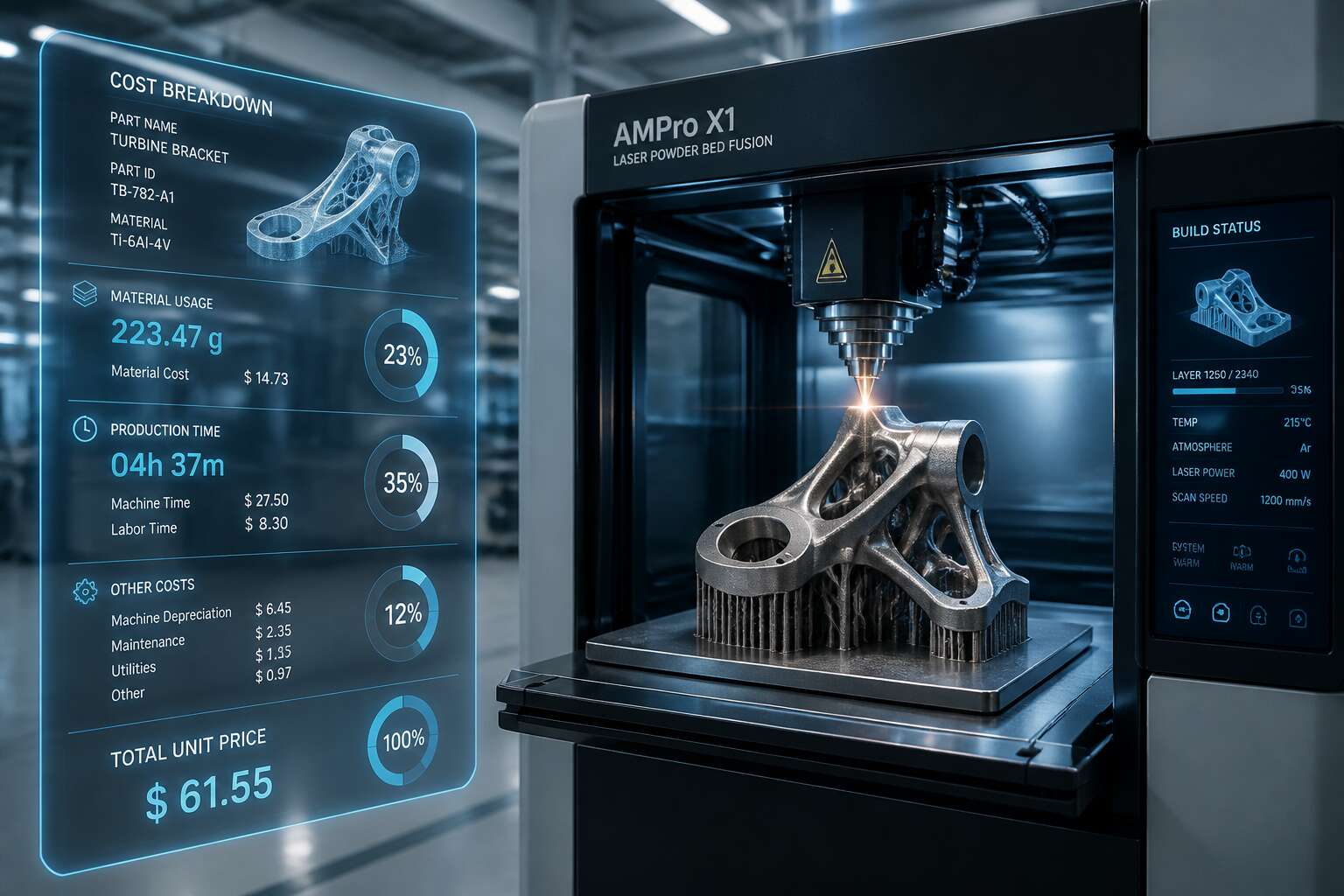
Understanding the Price Landscape
Factors Influencing Machine Costs
The average industrial facility now spends over R1.2 million just to secure a basic entry level system. That figure alone makes the purchase decision feel like a high stakes gamble. Understanding the factors behind the additive manufacturing machine price is more like deciphering a complex code than comparing simple retail tags. The hardware is only the beginning of the financial narrative.
The core technology determines the baseline cost more than any other variable. A polymer based system using fused deposition will always sit far below a metal powder bed fusion unit. The laser systems, inert gas chambers, and precision optics in advanced machines require a supply chain that is inherently expensive. Furthermore, the build volume acts as a multiplier. Larger platforms need heavier gantries and more powerful heating elements, which directly inflates the price.
Beyond the hardware, the level of automation integrated into the system drives a significant portion of the quote.
– Calibration systems that adjust for thermal drift.
– Automated powder sieving and recycling loops.
– In-process monitoring cameras and melt pool sensors.
– Post-processing modules for stress relief.
These features consistently increase the machine cost. However, they also reduce the need for manual labor and decrease the margin for error. The provenance of the unit also matters. Machines sourced through local South African distributors often carry a premium for immediate service access. In contrast, grey market imports might offer a lower sticker price, but they come with hidden logistics costs and potential downtime.
Material compatibility is the final piece of the puzzle. Machines capable of handling reactive materials like titanium require specialized safety enclosures, which are costly to certify. You are not just buying a printer; you are buying a certified production cell. The quoted figure is often a starting negotiation point, not the final destination. Every additional safety module or software unlock pushes the additive manufacturing machine price upward, making the initial budget seem like a mirage.
Entry-Level vs. Industrial Machines
The price of an additive manufacturing machine is often the first question asked, yet it is rarely the most important one. A seemingly affordable desktop unit and a towering industrial system serve entirely different purposes, and their price tags reflect that chasm. Entry-level machines, typically using fused filament fabrication, can be acquired for under R50,000. They are excellent for prototyping and educational environments.
Industrial systems, however, are a different class of investment. These machines, which often utilise laser powder bed fusion or electron beam melting, frequently exceed R5 million. This cost difference goes beyond mere size. It represents a significant leap in part accuracy, material properties, and repeatability.
For South African manufacturers, the calculation involves more than just the initial capital outlay. The true value lies in the total cost of ownership. An entry-level machine might have a lower barrier to entry, but it often comes with slower production speeds and limited material options. This can constrain your ability to take on lucrative, high-specification contracts.
Industrial systems justify their higher additive manufacturing machine price through several tangible advantages:
– Automated process control: Closed-loop systems monitor every layer, reducing the risk of failed builds.
– Advanced material handling: Enclosed chambers manage reactive powders safely, unlocking materials like titanium and aluminium.
– Integrated post-processing: Many systems offer inline solutions, reducing manual labour costs.
The gap between these two tiers is also narrowing. The rise of professional-grade machines, priced between R500,000 and R2 million, has created a middle ground. These units offer a bridge, providing many industrial features without the full factory footprint. When evaluating your needs, consider your production volume and quality requirements carefully. The right machine should fit your workflow, not just your budget. The quoted price is a starting point for a conversation about your specific production goals.
Market Trends and Price Fluctuations
The pricing of industrial equipment is rarely static; it exists in a state of perpetual churn, influenced by global supply chains and local economic pressures. In South Africa, the additive manufacturing machine price is particularly sensitive to currency fluctuations, as most systems are imported. A weakening rand can shift the goalposts between a quotation and a final invoice, adding a layer of fiscal unpredictability to your capital planning.
Despite this volatility, the market is experiencing a peculiar form of price resilience. While entry-level units are subject to aggressive discounting and frequent promotional cycles, the value proposition for industrial systems tends to hold firm. This is not a function of artificially fixed pricing, but rather a reflection of the sustained demand for high-throughput, metallurgical capabilities. The acquisition cost often remains tied to the software sophistication and the calibration fidelity of the hardware.
To discern the current trajectory, one must observe the secondary market and the flow of refurbished units entering the region. The trends are telling.
– Logistics costs and freight insurance premiums are modulating final landed prices.
– The availability of local technical support is softening the price depreciation on older models.
– Exchange rate hedging strategies are becoming a standard part of procurement discussions.
– Service contract inclusions are increasingly used as a bargaining chip to stabilise the effective purchase price.
Looking forward, the price war is shifting toward the consumables and the proprietary software licenses, rather than the hardware chassis itself. This places the buyer in a powerful position to negotiate. The current landscape rewards those who track import duties and monitor global commodity prices for raw powders, as these are often the first indicators of a shift in the overall additive manufacturing machine price. The market is complex, but for the astute observer, it is also transparent, offering clear signals for those patient enough to read them.
Key Cost Drivers
Technology Type (SLA, SLS, FDM, and Beyond)
When I priced my first SLS unit, I nearly dropped the phone! Technology type alone can shift the additive manufacturing machine price by several multiples. SLA systems rely on resin vats and UV lasers, while FDM uses simple heated nozzles. SLS adds powder beds and fiber lasers, and metal printing like DMLS raises costs further. Each technology demands distinct optics, thermal controls, and material handling. What sits inside these machines?
- SLA: laser, scanning mirror, resin tank.
- SLS: high-power laser, powder spreader, preheating element.
- FDM: filament extruder, motion platform.
These components explain why a desktop printer costs a fraction of a production-grade SLS unit. In South Africa, workshops see the same build volume carry wildly different price tags, purely based on the chosen technology.
Build Volume and Precision Specifications
Precision is the silent killer of budgets. A machine that holds a 50-micron tolerance costs far less than one locked to 10 microns, and that gap directly drives the additive manufacturing machine price. The internal mechanics dictate this spread. Ball screws versus lead screws, closed-loop servos versus stepper motors, and the rigidity of the frame all determine how tightly the nozzle or laser can hold a dimension. For engineers, this means the component’s application dictates the spend. A prototype bracket rarely needs aerospace-grade accuracy, but a production jig for a medical device absolutely does.
Build volume also plays a role that most buyers underestimate. Doubling the X, Y, and Z axes often triples the cost because the gantry system needs heavier rails and the heated chamber requires more power. I’ve seen workshops in Johannesburg and Cape Town purchase large-format machines, only to realize the operational overhead outstrips the initial investment. The specifications that affect the additive manufacturing machine price most significantly include:
– Layer resolution capabilities (from 100 microns down to 16 microns)
– Positioning accuracy measured in microns per axis
– Repeatability figures that ensure part-to-part consistency
– Maximum bed temperature and thermal uniformity
The danger lies in chasing specs that sound good on paper. A machine boasting a 5-micron repeatability might still fail if the Z-axis leadscrew has thermal drift during a six-hour print. When you compare quotes, look at the axis kinematics rather than just the marketing sheet. The true value emerges from how the motion system delivers that precision under sustained load.
For South African buyers, the exchange rate amplifies every specification decision. A machine priced in Euros with high-end linear guides will experience a different cost reality than one sourced locally with standard components. The trade-off between precision and price becomes a strategic calculation about the parts you intend to sell. Push the machine harder than its specifications allow, and you will pay for it in failed builds and material waste. The additive manufacturing machine price reflects real engineering effort, so a bargain often signals compromised internals that will surface during complex geometry.
Material Compatibility and Automation Features
The range of materials a machine can process often dictates its price ceiling more than any other factor. A printer limited to basic polymers carries a different price tag than one that can switch between nylon, carbon-fiber composites, and flexible resins. That flexibility requires a hardened hot-end, a more robust extrusion system, and often a heated chamber. Each of these upgrades increases the additive manufacturing machine price, but it also expands the potential return on investment through access to engineering-grade production parts.
Automation represents another cost layer that many first-time buyers overlook. The true cost of a machine goes beyond the initial purchase; it includes the labor required to operate it. Features like automatic bed leveling, nozzle cleaning, and filament run-out sensors can significantly reduce the hours spent on manual intervention. A machine with a 3D scanning system that detects print failures in real time may seem like a luxury, but it prevents wasted material and expensive downtime. When you compare:
- A semi-automated system that requires constant monitoring and manual part removal
- A fully automated cell that queues multiple jobs and clears the build plate independently
The gap in productivity becomes obvious. The automated option commands a higher upfront price, but it pays for itself through reduced labor overhead and consistent output quality. Conversely, a manual machine with a lower sticker price can become the more expensive choice over a two-year period if it demands a full-time operator. The deciding factor is your existing workflow. A workshop with skilled technicians already on staff might integrate a manual machine seamlessly. A lean operation, however, often finds that the premium automation commands is actually the more economical route. Understanding where your labor costs sit will guide you toward the correct balance between machine capability and operational expenditure.
Price Ranges Across Categories
Desktop 3D Printers for Hobbyists and Startups
Let’s cut straight to the chase. The additive manufacturing machine price for desktop units has shifted dramatically, making entry more accessible than ever before. You can now secure a reliable workhorse for your garage or startup without mortgaging your future, though the choices can feel overwhelming at first glance.
For true hobbyists, the sweet spot sits between R5,000 and R15,000. These machines deliver solid prints with PLA and PETG, and they handle the learning curve gracefully. However, if you are running a small business where uptime directly translates to income, you will want to look slightly higher. The prosumer bracket, ranging from R20,000 to R60,000, offers features that save you hours of frustration:
– Auto-bed leveling that actually works on uneven surfaces
– Enclosed chambers for temperature-sensitive materials like ABS
– Direct-drive extruders for flexible filaments
– Quieter stepper drivers, which matter if you are working in a shared space
That transition from hobby to professional is rarely about speed. It is about reliability and material diversity. A cheaper machine might print a prototype overnight, but a mid-range unit prints it correctly the first time. When you calculate the cost of failed prints, the higher upfront investment often pays for itself within a few months. The additive manufacturing machine price should always be weighed against your own time, which is a resource you cannot simply buy more of.
Professional and Mid-Range Systems
Between R150,000 and R500,000, the additive manufacturing machine price reflects a fundamental shift in capability. You are no longer buying a gadget; you are acquiring a production tool. These systems typically feature enclosed chambers, which maintain stable temperatures for engineering materials like nylon and polycarbonate. The mechanics are heavier, the motion systems are stiffer, and the tolerances are tighter. For a South African engineering firm, this bracket eliminates the need to outsource functional prototypes, shortening development cycles from weeks to days.
Consider a machine like the Prusa MK4 or a Creality CR-10 Max. At this level, the software integration becomes seamless, allowing for remote monitoring and print farm management. The components are industrial grade, designed for continuous operation. We are talking about linear rails, direct drive extruders, and hardened steel nozzles as standard features. You can reliably produce jigs, fixtures, and end-use parts that withstand real-world stress. The return on investment is often calculated in months, not years, especially when you compare the cost against the hourly rate of an external service bureau.
The true value, however, lies in the workflow. These machines offer:
– Advanced print failure detection through AI and LiDAR sensors.
– Auto-calibration that compensates for minor bed variations automatically.
– Network connectivity with secure queuing for multiple users.
– The ability to print with exotic filaments such as PEEK and carbon-fiber composites.
What does this mean for your daily operations? It means a technician can set a complex job in the morning and return to a finished component with verified dimensional accuracy. The additive manufacturing machine price is reflected in the reduction of failed prints and material waste. When you factor in the cost of a failed prototype on a cheaper machine, the mid-range option pays for its premium quickly. This is the segment where 3D printing transitions from a hobbyist curiosity to a serious manufacturing methodology.
For businesses in Johannesburg or Cape Town dealing with power fluctuations, you can invest the surplus into an uninterruptible power supply (UPS) that protects a R300,000 machine. With a standard FDM printer, the failure mode is a ruined part. With an industrial-grade system, a power cut triggers a smart resume function that saves your progress and power-cycles cleanly. The bottom line is efficiency. The additive manufacturing machine price here is an investment in operational resilience. You are purchasing the ability to manufacture on demand, without the volatility of shipping delays or import costs. This is the sweet spot for growing businesses that need professional output without the corporate price tag of a true industrial system.
Large-Format and High-End Additive Systems
At the top of the range, large-format and high-end additive systems begin around R1.5 million and climb well beyond R20 million. The additive manufacturing machine price here buys more than hardware. It buys statistical process control, closed-loop temperature management, and repeatability measured in microns.
Consider a pellet-fed system with a build volume of one cubic metre, or a metal powder-bed fusion unit producing certified aerospace components. In my experience, these machines serve industries where one failed part costs more than the machine itself. South African tooling and mining operations use them to create injection moulds and critical spares, shrinking replacement timelines from months to days.
- Multi-laser configurations that speed up sintering.
- In-situ monitoring that validates every layer as it forms.
- Automated powder handling that removes operator risk.
For the buyer, the equation shifts from cost per machine to cost per production hour.
Specialized Machines for Metal and Ceramic Printing
Metal powder bed fusion machines carry an additive manufacturing machine price that begins near R2.4 million in South Africa. These units operate under argon atmospheres with fibre lasers that melt each layer. Ceramic printers work differently, often using binder jetting or stereolithography with slurry materials.
For dental and medical sectors, the available systems shrink in size but not in cost. A compact ceramic printer with a 200 millimetre build envelope still demands R1.5 million. Thermal controls and post-processing furnaces add significant expense.
- High-temperature build chambers for alumina and zirconia.
- Automated debinding and sintering workflows.
- Closed-loop powder sieving for reactive metals.
I have watched these machines operate in Johannesburg labs. The price reflects the precision required, not the physical footprint.
Hidden Costs and Financial Considerations
Installation, Calibration, and Training Expenses
The quoted figure is a starting point, not a total. Installation and calibration in South Africa commonly add 10% to 15% to the purchase amount. That cost becomes tangible when a misaligned axis wastes an entire build. Training adds more. Specialized systems demand hands-on practice with slicing software, material handling, and safety routines.
Budget for these items:
1. Delivery and rigging for large-format machines
2. Calibration consumables and test runs
3. Technician travel and accommodation
4. Operator training hours, often three to five days
Each line item shifts the true additive manufacturing machine price. Overlooking them causes downtime and scrapped parts. Savvy purchasers plan for these expenses from the first quotation.
Maintenance, Consumables, and Replacement Parts
The sticker price of a machine is only the beginning. Most South African buyers focus on the upfront quote, but the real financial picture emerges over the first year of operation. Ownership costs often exceed the initial capital outlay, and ignoring this reality leads to stalled projects and idle assets.
Maintenance is the largest variable you will control. A poorly maintained printer turns a profitable job into a loss. Regular cleaning of build plates, lubrication of linear rails, and proper filter replacement are non-negotiable. Skipping these steps does not save money; it accelerates wear. Calibration drift is the silent killer of accuracy, and accuracy is the only thing your client pays for.
Consumables are the second major category. Resin, filament, and binder are the obvious ones, but the hidden costs are in the details. FEP films for vats, nozzles for extruders, and build plate adhesives all have a finite lifespan. You will buy these repeatedly, and their cost adds up faster than most quotes suggest.
Replacement parts are where budgeting gets tricky. A print head assembly can fail with no warning. A power supply unit might die during a surge, which is common in certain South African industrial zones. If you do not have a spare on the shelf, you face downtime. Downtime is a cost you cannot bill to anyone.
– Spare hotends and nozzles
– Optical sensors and limit switches
– Mainboards and stepper drivers
– Heated bed components
These are the parts that fail on a schedule. When you calculate the additive manufacturing machine price on paper, add a buffer of at least 15% for these components. Machines imported from abroad also carry import duties and longer lead times for spares. Local suppliers might not stock the specific part you need, forcing you to wait weeks. That wait is a cost, too.
The final hidden factor is software and firmware updates. Paid maintenance contracts, licensing fees, and training for new software versions are recurring expenses. They are not optional if you want to keep the machine running with optimal efficiency. In the end, the additive manufacturing machine price is a floor, not a ceiling. The savvy buyer budgets for the full lifecycle, not just the invoice.
Financing, Leasing, and Rental Options
The initial capital outlay for industrial equipment often triggers a reflexive flinch. However, the additive manufacturing machine price tag represents only the first chapter of a longer financial story. Smart procurement strategies rarely involve paying the full sum upfront. Instead, they match the payment structure to the expected cash flow of the business, preserving working capital for materials and skilled operators who will drive the return on investment.
Financing through local South African banking institutions remains a common path, but the terms differ significantly from traditional equipment loans. The depreciation curve for 3D printing technology is steep, which influences interest rates and residual values. Leasing offers a compelling alternative for companies uncertain about long-term production volumes. This approach converts a massive capital expense into a predictable operational cost, allowing you to upgrade to newer models as the technology evolves without the headache of selling obsolete machinery.
Rental agreements provide the ultimate flexibility, particularly for prototyping bureaus testing new service lines. These short-term arrangements let you validate market demand before committing to a permanent asset. The decision matrix boils down to your company’s tax position, expected utilisation rates, and appetite for technological risk. Depreciation schedules, Section 12B allowances, and the opportunity cost of tied-up cash all factor into the true cost calculation. Before signing, scrutinise maintenance clauses and software subscription fees carefully.
Consider these practical options:
– Asset-based finance through specialist vendors offering tiered repayment plans
– Operating leases that bundle service and support into a single monthly fee
– Third-party rental pools for short-term peak production demands
The ultimate goal is matching the financial vehicle to your specific production reality. A machine sitting idle due to an inappropriate loan structure delivers no value. A rental that keeps your floor space flexible might justify a slightly higher monthly rate. Weigh the administrative burden of ownership against the agility of leasing. The right answer hinges on your forecasted order book, not just the sticker price. Explore local suppliers who partner with financing houses to simplify the process. Your accountant should model multiple scenarios before you commit to any single approach.
Software and Post-Processing Equipment Costs
The quote on the screen rarely represents the full financial footprint. For many South African operations, the additive manufacturing machine price is the entry ticket, but the journey involves several subtle, recurring costs that determine the true return on investment. These expenses often catch new buyers off guard, particularly when they are calculated in a volatile currency environment.
Calibration and environmental control are the first silent partners in your expenditure. A machine needs a stable, dust-free environment with precise temperature management to produce consistent parts. This often requires HVAC upgrades or dedicated floor space that was not part of the initial plan. Software also plays a role; professional slicing and simulation packages often carry annual license fees, separate from the hardware rental or purchase agreement.
Consumables extend far beyond the polymer or metal powder itself. The ancillary items, such as build plates, filters, and inert gases, create a steady drain on the budget. Here are the usual recurring necessities:
– Build platform adhesives and release agents
– High-purity wash and cure solutions
– Replacement nozzles, wipers, and liner sheets
– Calibration probes and thermal imaging tools
Maintenance protocols for industrial units are strict. Preventative service contracts are not optional if you want to avoid catastrophic downtime. These agreements, plus the cost of spare parts that wear out faster under continuous use, can add a significant percentage to the operational budget. For a business evaluating the additive manufacturing machine price in South Africa, these hidden variables often carry more weight than the purchase price itself, making a thorough cost analysis essential before signing any lease.
Evaluating the Total Cost of Ownership
Calculating Return on Investment and Payback Period
The initial purchase price of an additive manufacturing machine often tells a seductive lie. It whispers of capability, yet conceals the true cost of ownership through its lifetime. Evaluating the total cost of ownership demands you account for every hour of operation, every kilowatt consumed, and every kilogram of material that vanishes into support structures. These recurring expenses shape the true additive manufacturing machine price more than the invoice ever will.
Calculating return on investment requires a grim ledger of productivity gains against operational expenditure. You must measure each part produced, not just for its material value, but for the labour it replaces and the inventory it eliminates. The payback period emerges from this calculus, revealing when the machine finally earns its keep. For many South African operations, the variables shift dramatically with local power reliability and logistics costs.
Consider what must be quantified before you commit:
– Annual maintenance contracts and their escalation clauses
– Consumable consumption rates for your specific production volume
– Operator wages adjusted for the training level required
– Scrap and failure rates for the materials you intend to use
– Floor space, ventilation, and environmental control expenses
Each variable carries its own weight, conspiring together to extend or shorten your path to profitability. The payback period becomes less a promise and more a prediction, one that demands honesty about your actual usage patterns rather than optimistic projections. I have watched promising investments crumble under the weight of underestimated downtime, and I have seen modest systems deliver exceptional returns when paired with disciplined maintenance schedules. The numbers do not lie, but they will punish those who ignore their quiet warnings.
Comparing Quotes from Multiple Suppliers
Comparing quotes across suppliers requires a certain level of paranoia. The additive manufacturing machine price on a quotation is rarely the final number you pay. Suppliers structure deals differently. One might offer a lower machine cost but inflate the installation fee, while another hides calibration costs within the annual maintenance contract.
You must scrutinize what is excluded as much as what is included. Freight insurance, import duties, and cranage for delivery are common omission points. A cheaper quote from Johannesburg that excludes local service response times from a different province can cost you weeks of downtime later. I have seen businesses purchase on headline price alone, only to discover the foundation requirements and vibration isolation pads were extras.
When you are evaluating tenders, demand a complete cost breakdown. Request a list of deliverables to compare directly:
- Shipping and customs clearance responsibilities
- Operator training hours and certification standards
- Initial tooling and build plate quantities included
- Remote diagnostics and software update policies
- Decommissioning and disposal liabilities at end of life
The additive manufacturing machine price becomes clearer when you force suppliers to compete on total outcome rather than just the hardware. A slightly higher initial figure, paired with a local spares holding and a guaranteed response technician, often proves cheaper than a bare-bones offering. Be ruthless in your comparisons. The cheapest quote is a trap unless the full lifecycle costs align with your operational reality.
Assessing Upgradability and Resale Value
The initial purchase price is merely the opening chapter of your investment story. Evaluating the total cost of ownership requires you to look well beyond the invoice, particularly when considering how the machine will serve you in three or five years. An additive manufacturing machine price can seem justifiable today; however, the true metric of value lies in the system’s capacity to evolve alongside your production needs without demanding a full reinvestment.
You must assess the upgrade pathways available for the specific model. Some manufacturers lock you into a closed architecture, forcing a complete replacement for even minor technological advancements. Others offer modular updates, such as enhanced laser optics or new material deposition heads. Before signing, verify the availability of firmware updates and whether they come at an additional cost. A machine that accepts new features keeps your operations current and mitigates the risk of rapid obsolescence.
Resale value acts as the final arbiter of a prudent purchase. Industrial buyers often overlook this financial return, yet it directly offsets the total expenditure. Machines from reputable brands with a wide installed base retain a higher percentage of their worth. To safeguard this asset, consider the following factors:
– Maintain meticulous service records to prove the machine’s condition.
– Choose standard, widely available components over proprietary parts to ease future ownership transfer.
– Document the actual production throughput to demonstrate operational efficiency to prospective buyers.
A locked-in ecosystem also damages your future negotiating power. If the proprietary software requires specific resins or powders, your operational costs remain tied to a single vendor. This dependency diminishes the machine’s appeal on the secondary market, as the next owner inherits the same restrictions. An open platform invites competitive material pricing and enhances the machine’s longevity.
The calculation extends further when you factor in the timing of your exit. Technology shifts rapidly, and a machine purchased during a peak cycle might face a steep depreciation curve. Evaluate the manufacturer’s roadmap and their history of supporting older models. Ultimately, the smartest financial strategy involves purchasing a machine not for what it does today, but for what it can become tomorrow. The true cost of ownership is defined by the machine’s evolution and its eventual resale, not the initial sticker price alone.
Considering Scalability and Future Expansion Needs
Securing production capacity for tomorrow’s orders means evaluating how a system adapts when demand outgrows its footprint. The additive manufacturing machine price reflects today’s capabilities, yet a machine that reaches its ceiling within two years forces an expedited replacement. South African manufacturers face a meaningful choice between scaling horizontally, adding more units, or vertically, upgrading within one platform.
Ask targeted questions about expansion:
- Can the build chamber be extended?
- Does the software support additional modules?
- Will maintenance downtime scale evenly with usage?
A machine enabling incremental investment, adding features when needed, protects the buyer from overpaying upfront. The additive manufacturing machine price matters less than the per-part cost trajectory as volume increases. Matching capability to the production roadmap ensures the system becomes a long-term asset, not a temporary expense.
Warranty, Support, and Service Level Agreements
When you finally settle on an additive manufacturing machine price that fits your budget, the real conversation should pivot to what happens after the invoice is paid. The sticker price is the entry fee, but the lifetime cost is where the true financial picture emerges. This is especially true in South Africa, where service response times and access to qualified technicians can vary dramatically depending on your location.
A machine that sits idle because a warranty dispute drags on for weeks is a liability, not an asset. The fine print in your contract will dictate how quickly you get back to production, so reading every clause before signing is essential. What is the response window for a critical failure? Are replacement parts held in local inventory, or will they need to be shipped from another continent? These details will determine whether your investment stays productive or becomes an expensive paperweight.
Service level agreements often distinguish between the manufacturers that understand industrial production and those that simply sell hardware. A well-structured SLA should cover preventive maintenance schedules, software updates, and priority access to technical support. Without those guarantees, your team may find themselves troubleshooting complex systems with nothing more than a manual and a prayer. For businesses running continuous shifts, even a minor delay translates directly into missed deadlines and lost revenue.
Beyond the contract, consider the human side of the support equation. Is there a local partner who understands the specific conditions of South African manufacturing? Dust, humidity, and unstable power grids in certain regions can challenge even the most robust systems. A support team that knows these realities will offer practical advice, often going beyond the scope of their official obligations. The relationship you build with your service provider can be the difference between a system that always runs and one that always needs attention.
A proactive maintenance plan can reduce unexpected breakdowns and extend the useful life of your equipment. Rather than waiting for a component to fail, scheduled service visits can identify wear patterns before they become catastrophic. These plans usually involve:
– Regular calibration checks to ensure print accuracy
– Replacement of consumables like filters and nozzles at set intervals
– Firmware updates to improve stability and add new features
– Annual inspections to maintain warranty compliance
Weighing the additive manufacturing machine price against these long-term support needs changes the calculation entirely. A slightly higher upfront cost from a supplier with robust local infrastructure may prove far more economical than a cheaper unit with thin support. The value lies not in the machine itself, but in the uptime it delivers consistently over several years.
The true cost of ownership also factors in training and documentation. A vendor that offers comprehensive onboarding for your engineers will reduce the learning curve and get you to first part faster. Compare that with a supplier that hands over a dense manual and disappears. The former saves you weeks of trial and error, while the latter leaves your team vulnerable to costly mistakes.
Ultimately, any evaluation of an additive manufacturing machine price must account for the worst-case scenario. Should a critical system fail, how quickly can you be operational again? That answer lives in your warranty, your SLA, and the strength of your local support network. It is better to know before you buy, because after the point of purchase, the only number that matters is how many parts you are able to ship at the end of each month.

0 Comments