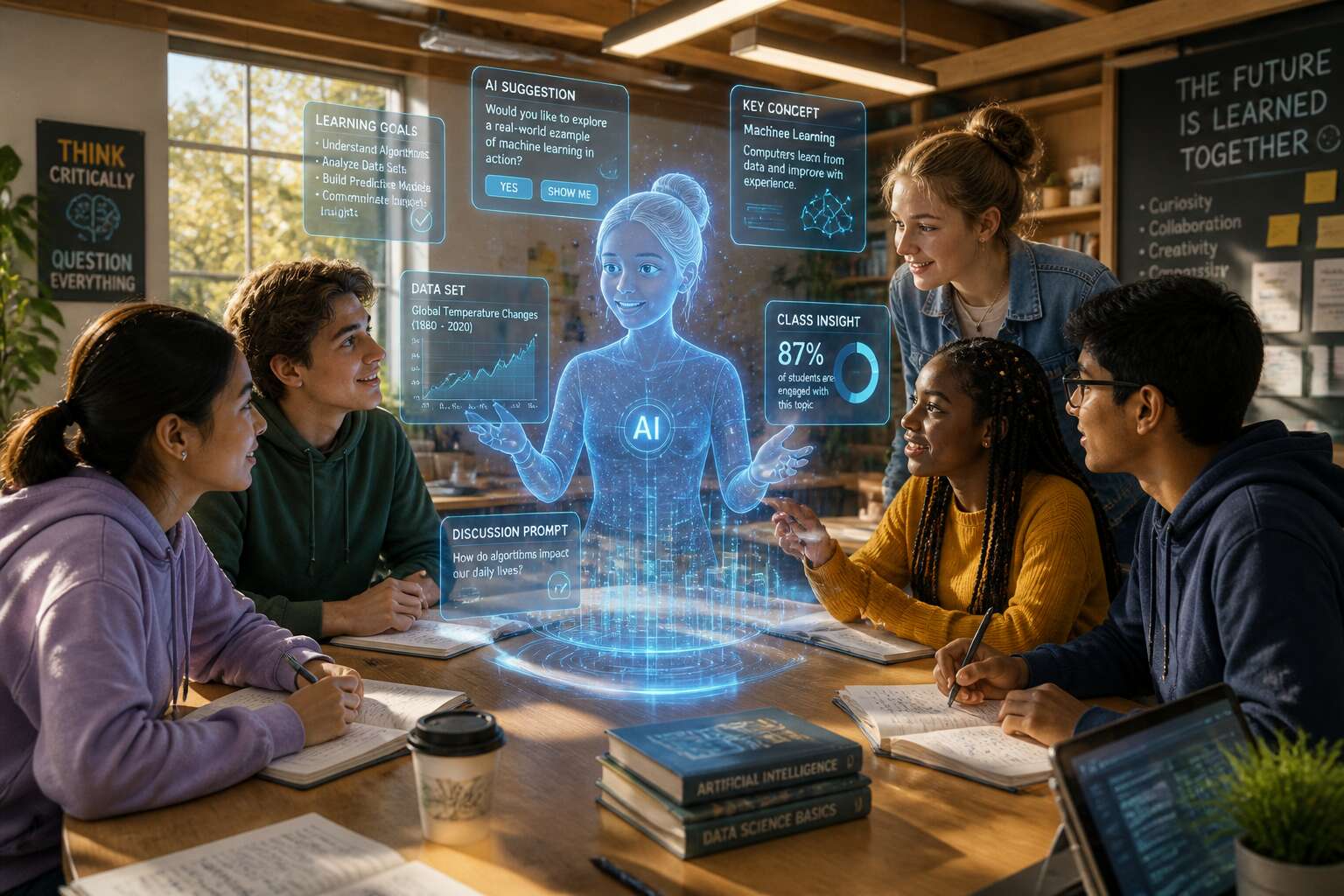
Benefits of AI in Education
Personalized Learning Paths
Imagine a classroom where every lesson adjusts to the student’s pace. That is the promise of AI in education. Instead of a one size fits all approach, intelligent systems analyze performance in real time. This creates personalized learning paths that target specific gaps while allowing strengths to flourish.
Consider South African learners. AI balances large class sizes and limited resources. It offers immediate feedback, adaptive exercises, and content in the learner’s home language. A struggling student might get extra visual examples, while an advanced reader receives more complex texts.
The benefits are concrete:
- Tailored remediation for weak areas
- Acceleration for gifted students
- Reduced administrative burden on teachers
Personalized learning paths do not replace the teacher. They give educators a clearer window into each child’s journey. With AI in education, the dream of truly individualised instruction moves from theory to everyday reality.
Immediate Feedback and Assessment
Waiting weeks for test results teaches students nothing. AI in education collapses that delay to a moment. A learner answers a question and the system responds instantly, showing the exact error and suggesting the correct reasoning. This rapid assessment measures progress and builds it.
For teachers in overcrowded classrooms, this is a release. The automated marking of quizzes and short answers means more time for direct instruction. The system flags struggling learners early, allowing intervention before failure becomes a pattern.
- Immediate feedback on every attempt
- Continuous assessment without extra paperwork
- Detailed error analysis for each learner
I have watched a student reattempt a maths problem three times in one session. Each attempt generated new feedback. That cycle, repeated daily, creates resilience. In South Africa, where class sizes strain human attention, this tireless assessment removes guesswork from teaching.
Enhanced Student Engagement
The first rule of teaching is that learners have limited attention. In a Johannesburg classroom, I have seen attention drift before the register is complete. The promise of ai in education is to make the lesson hard to ignore. Engagement becomes a byproduct of design, not a result of charisma.
Interactive modules let learners drive the narrative. Consider these engagement tools:
- Immediate choices, such as selecting a historical alliance or solving a puzzle, create ownership.
- Leaderboards provide social comparison.
- Adaptive scenarios track what captures interest and adjust difficulty accordingly.
I recall a quiet student who emerged as a fierce strategist in a trading simulation. That same student rarely spoke during class discussions. The technology did not change her; it simply gave her a way to engage.
Teacher Workload Reduction
Across South African classrooms, the administrative burden is relentless. Marking stacks, lesson planning, data capture. These tasks consume hours that should be spent on human connection. Ai in education offers a practical solution to this exhaustion. It can generate worksheets, grade routine assessments, and compile learner progress reports in minutes rather than evenings. The teacher’s role shifts from clerk to facilitator. That shift matters psychologically. It returns agency. It creates space for work that does not scale: noticing a learner who is struggling, offering encouragement, adjusting a lesson on the spot. Technology does not replace the teacher. It removes what dilutes her attention. The result is less fatigue and more presence. This is not efficiency for its own sake. It is about protecting the energy required to teach well.
Data-Driven Curriculum Insights
In South Africa, schools generate vast amounts of learner data, yet most of it sits unused in spreadsheets. The gap between what we collect and what we understand is a silent brake on progress. This is where ai in education transforms raw numbers into a strategic asset. Instead of relying on annual results to spot trends, educators can see patterns emerge in real time.
AI systems can analyze assessment sets to reveal whether a particular concept, say fractions or trigonometry, consistently underperforms across Grade 9 classes. This shifts the focus from individual blame to systemic improvement. It also allows schools to compare their internal data against provincial benchmarks, which can expose subtle inequities in resource allocation.
The value extends beyond test scores. These tools can track how learners interact with digital materials, showing which content formats are being skipped or skipped over. For curriculum advisors, this detail is gold dust. It informs resource design and professional development plans with evidence, not intuition. Consequently, curriculum planning becomes a responsive loop rather than an annual guess. Educators are finally able to ask the right questions of their own data.
Challenges and Concerns
Data Privacy and Security Risks
In 2023, a single breach at a South African school district exposed 45,000 learners’ home addresses, medical records, and disciplinary files. That incident is not isolated. AI in education depends on continuous data streams, which makes them irresistible targets for cybercriminals. Every login, assignment, and behavioural note becomes a potential vulnerability.
The danger multiplies when schools outsource to third party vendors. Many contracts lack clear data retention limits. Some vendors store information on servers outside South Africa, bypassing local protections. A quick look at common risks:
- Unencrypted student databases accessed through weak passwords
- Biometric data harvested from classroom cameras or fingerprints
- Ransomware locking school systems just before exams
Parents and educators rarely see the full picture until after a breach. By then, the damage is permanent. AI in education must operate with strict oversight, not silent trust. That is the only way to keep the promise of safer learning intact.
Bias in AI Algorithms
A single biased model, trained on skewed data, can quietly derail a learner’s future. In a recent trial, a well known system in Pretoria flagged students from one postal code as high risk, despite identical test scores to their peers. The algorithm learned from historical results that mirrored past inequalities, not present potential. These hidden biases transform the promise of ai in education into a mechanism for perpetuating old divisions.
The failure points are numerous and often invisible to educators.
– Voice recognition software that misinterprets South African accents.
– Predictive analytics that penalise learners with irregular attendance due to transport issues.
– Automated essay scoring that favours certain cultural references or writing structures.
Each flaw creates an unfair cycle. The system identifies a learner as low potential, the system offers that learner less challenging content, and the learner falls behind, which validates the original prediction. Without rigorous local testing and continuous scrutiny, the technology amplifies the very gaps it claims to bridge. Bias in ai in education is a design flaw with human consequences, not an abstract technical problem. Schools must demand transparency from vendors, but they must also build diverse review teams to audit outcomes. The algorithm cannot see the child’s potential if the data only reflects the past.
The Digital Divide and Equity
In a country where fewer than one in five schools have reliable internet access, the promise of ai in education stumbles before it starts. A learner in Khayelitsha may hold a smartphone with no data. A teacher in Limpopo might have a projector but no signal. The algorithm waits on a server that these classrooms cannot reach.
Equity demands more than software licences. It demands infrastructure. Consider what a connected classroom requires:
- Stable electricity, not unpredictable load shedding.
- Affordable data bundles that do not compete with food money.
- Devices students do not have to share among siblings.
Without this foundation, ai in education widens the gap between the connected and the forgotten. The technology is only as equal as the network that carries it.
Over-Reliance on Technology
In South African classrooms, the tablet can replace thinking before it supports it. When learners expect answers from a screen, they stop building the reasoning that mathematics and language demand. Over-reliance on technology weakens problem-solving, not through failure but through convenience.
The cost appears in small moments. A learner guesses instead of calculates. A teacher pauses to reboot instead of reteach. The system rewards speed over judgement.
- Learners copy answers without understanding.
- Teachers lose the habit of direct instruction.
- Classrooms struggle when the network fails.
ai in education should assist, not replace human judgement. The machine cannot feel confusion. It cannot see the learner who nods without comprehending. Balance requires discipline.
Practical Applications and Tools
AI-Powered Tutoring Systems
In South Africa, where class sizes often exceed forty learners, AI tutoring addresses a pressing need. AI-powered tutoring systems are practical tools that provide consistent, on-demand assistance. They use natural language processing to engage in adaptive dialogues, breaking down complex problems into manageable steps. These systems sense confusion and pivot instantly, offering focused support where it matters most.
Socrative questioning is a hallmark of these systems. They pose targeted questions to draw out understanding, rather than simply providing answers. Their practical applications span many subjects:
- Guiding learners through mathematical proofs step by step
- Simulating historical debates for social studies practice
- Building language fluency through conversational drills
ai in education benefits greatly from such systems, especially in underresourced schools where individual attention is scarce. These tutoring tools adapt to each learner’s pace, yet they remain aids, never replacements.
Adaptive Learning Platforms
Adaptive learning platforms offer practical tools for South African classrooms. These systems use data to adjust content in real time. For instance, a learner struggling with fractions receives additional exercises, while a peer advances to new problems. Teachers access dashboards that show class progress instantly. Tools like Siyavula and FoondaMate integrate AI to support local curricula. Also, offline-capable apps address connectivity challenges in rural areas. Consider these applications:
- Automated marking of assignments
- Personalized revision schedules
- Language translation for multilingual learners
These tools empower educators to focus on instruction rather than administration. In fact, ai in education becomes most effective when paired with teacher guidance. Adaptive platforms are not replacements but partners in learning.
Automated Grading and Administrative Tasks
Automated grading turns the drudgery of marking into a background task. ai in education can score multiple choice questions, spot recurring errors in essays, and even generate draft comments. Teachers then review the output, adding judgement where machines fall short. Administrative tasks such as attendance logging and report cards also become less painful.
South African classrooms often run large. Manual marking consumes hours that could go to lesson planning or helping a learner stuck on a concept. Automation steps in as a useful assistant, not an overseer. You stay in charge of final decisions.
What can be handed over?
- Sorting assignment submissions
- Tracking late work patterns
- Compiling term summaries
These tasks drain energy. ai in education gives teachers more time for actual instruction. The goal is sanity, and that is worth a lot!
Intelligent Content Creation
A lesson plan that once took an evening now takes minutes. Intelligent content creation drives this change. ai in education can generate reading passages, practice exercises, and discussion prompts in seconds. A teacher might ask for a text about the Cape Floral Kingdom at a specific reading level, and receive a draft that matches the curriculum.
Some tools build slide decks or quiz banks from a single topic prompt. Others turn existing notes into study guides with headings and summaries. For South African schools with limited textbook budgets, this matters! Teachers can adapt materials to their learners’ contexts without building resources from scratch.
Language Learning Assistants
Learning a new language requires more than memorising vocabulary. It demands conversation, repetition, and the confidence to make mistakes. In a classroom of thirty five learners, a single teacher cannot offer that level of individual speaking practice. This is where ai in education introduces a patient, tireless companion.
Conversational AI allows students to practice isiZulu, Afrikaans, or English dialogue without fear of judgment. The software listens, corrects pronunciation gently, and adapts to the student’s pace. It turns a quiet study period into an interactive session that mirrors real life. Imagine a learner rehearsing a job interview with a digital coach that never gets tired, or a shy pupil finally speaking aloud because the pressure of peers is gone.
Language tools also provide immediate, multilingual support. A student reads a history passage and clicks on an unfamiliar word. The AI offers a definition in English, or a local language explanation. It builds a bridge between the learner’s home tongue and the language of instruction. This support is crucial in classrooms where learners switch between multiple languages daily.
Tools such as voice-based chatbots and pronunciation guides fill the silence that often limits language acquisition. They listen, respond, and adapt to each learner’s unique pace. Consider how an AI conversation partner functions:
– It provides unlimited practice sessions at any hour.
– It can slow down or speed up its speaking rate.
– It offers a non-judgemental space for making errors.
The beauty is in the accessibility. A smartphone can carry a virtual language partner into a township classroom that has no library. It gives every learner a chance to speak, listen, and improve. This is not about replacing the human teacher. It is about giving that teacher a powerful assistant to handle the repetitive drilling, freeing them to focus on creative and expressive lessons. The result is a generation of graduates who are not just literate, but truly communicative. The quiet learner finally has a voice. That voice is the future of ai in education.
Virtual Reality and AI Simulations
Virtual reality and AI simulations take learners beyond the textbook. A history class can stage a virtual Truth and Reconciliation hearing, with AI playing witnesses who respond to each learner’s questions. A science learner in Upington can mix chemicals in a VR lab that would destroy a real classroom. The simulation adjusts difficulty, offers hints, and records progress.
Practical tools are already appearing:
- VR field trips to Robben Island or the Cango Caves.
- AI-driven science labs that work on smartphones.
- Role-play simulations for life orientation, from job interviews to conflict resolution.
These tools give learners in rural provinces the same practical exposure as those in wealthy urban schools. The real value of ai in education is this kind of low-stakes, high-impact practice.
Future Trends and Predictions
The Rise of Lifelong Learning Companions
By 2035, the average South African professional will navigate a series of job transitions that each demand new skills. The next wave of ai in education will produce the lifelong learning companion, a persistent presence that stays with the learner through every career shift. It does not teach a unit and disappear. It remains.
This is not a typical tutor. The companion observes how a person overcomes setbacks across years, noticing the working habits their own mind has forgotten. Early iterations will likely:
- recognise a spatial skill learned in site engineering and connect it to needing warehouse logistics later in life;
- flag the exact moment a beloved competency begins to fade from lack of use;
- weave old exasperations into a new period of study or difficult union.
The patient value of ai in education shifts. Rather than restarting with every course iteration or wording, the learner will carry a steady thread. The test becomes continuity, not the fresh start.
Ethical AI Frameworks in Schools
By 2030, every school district in Gauteng will employ a data ethicist. Their sole mandate is to audit how ai in education treats learner information, flagging subtle biases before they harden into routine decisions. This role emerges from necessity, not novelty. Municipalities already face parent coalitions demanding transparent algorithmic governance, and the courts are listening.
Future frameworks will centre on shared accountability across provinces. Expect these core commitments:
- public registers for every ai tool deployed in classrooms
- independent audit trails that learners can access
- clear sunset clauses for data retention
The shift carries real weight. Schools that fail to codify these standards will lose both funding and public trust. Ethical design becomes the baseline, not the aspiration.
Human-AI Collaboration in the Classroom
Teachers will orchestrate the learning environment, not simply deliver content. The role transforms into a curator of experiences, interpreting the nuanced outputs of intelligent systems and making real-time pedagogical decisions. This synthesis of human judgement with data-driven insight is where the true value of ai in education will be found.
Imagine a classroom where the teacher focuses on Socratic dialogue, emotional support, and complex problem-solving. The AI handles the repetitive diagnostics and drills. This division of labor is not about replacement, it is about augmentation. The teacher becomes a mentor and a strategist, using the analytical power of the machine to identify the precise moment a student needs a different explanation or a moment of encouragement.
The physical space will also evolve to support this partnership. Flexible zones for collaborative projects will exist alongside quiet pods for focused, AI-guided practice. Teachers will need robust professional development to navigate this shift. The focus will move from managing behavior to fostering curiosity and critical thinking, creating an environment where the human touch remains the most essential component of the classroom. These new learning ecosystems will shape a generation of students who are comfortable directing their own intellectual growth, aided by the silent, capable presence of ai in education.


0 Comments