Understanding 4IR: The Fourth Industrial Revolution Explained
Defining the Fourth Industrial Revolution
You cannot drive through Johannesburg’s industrial belt without noticing the shift. Machines communicate without human intervention. The 4ir full meaning describes a systemic change where cyber-physical systems, artificial intelligence, and the Internet of Things converge.
For South Africa, this transformation carries promise and peril. Mining, once dependent on human labour underground, now faces autonomous drills. Western Cape textile factories compete with automated micro-factories overseas. Understanding this shift helps communities prepare for the changes already underway.
- Artificial intelligence and machine learning
- Big data analytics and cloud computing
- Additive manufacturing
- Advanced robotics
- Biotechnology
These elements compound one another, straining regulations and labour frameworks. Grasping this concept lets South Africans anticipate which industries will thrive and which will struggle.
Origins and History of the 4IR Concept
Professor Klaus Schwab first framed the notion in 2016 at the World Economic Forum. He argued that the speed and scope of this shift differ fundamentally from the previous three industrial revolutions. Those earlier eras were defined by steam, electricity, and computing. This one is defined by the fusion of the physical, digital, and biological worlds. The 4ir full meaning therefore extends beyond simple automation. It represents a velocity of change that is rewriting entire economic systems.
The concept grew from observations in global manufacturing hubs, not from academic theory. Think of a rural farmer in Mpumalanga receiving soil data on a basic phone. That is the reach of this revolution. The history of the idea is short, but its roots lie in decades of research into machine learning and network connectivity.
To appreciate the origins, consider the key technologies Schwab identified in his foundational work:
- Artificial intelligence and machine learning
- The Internet of Things
- Autonomous vehicles and drones
- Advanced robotics
For South Africans, the term gained traction as a way to describe the rapid digitisation of the finance sector in Sandton and the automation of port logistics in Durban. The history is not about the past. It is about a future that arrived before policy could catch up. Understanding where the idea came from helps us track where it is taking the workforce next.
From Industry 1.0 to Industry 4.0
Industry 1.0 harnessed steam and mechanical production. Industry 2.0 introduced electricity and assembly lines. Industry 3.0 brought computers and early automation. Now Industry 4.0 embeds cyber-physical systems into every layer of production.
The 4ir full meaning becomes clearer when you trace this lineage. Each shift changed how value is created, but the fourth collapses the distance between decision and action. A machine in Gauteng can predict its own failure, order a replacement part, and reschedule maintenance without human input.
Key distinctions stand out:
- The speed of adoption across sectors
- The fusion of operational and information technology
- The scale of data generated every second
For South African industries, the linear model of factory floors is giving way to networked ecosystems.
Why the Acronym Matters Today
Across South African boardrooms, the acronym 4IR arrives with the weight of a verdict. The 4ir full meaning is not a footnote to industrial progress. It is the architecture of what comes after automation. Those four characters describe a world where machines no longer wait for instructions. They sense, decide, and act on their own. This matters because the space between human intention and execution is dissolving. A cold room in Cape Town adjusts its temperature before a load spoils. A mine shaft in the Free State flags its own strain before a collapse is possible.
The acronym compresses a transformation that once took centuries into a single working lifespan. That compression changes who holds power. Boards, unions, and policymakers use the term to claim ground or concede it. Whoever defines 4IR today shapes the contracts, the skills, and the regulation of tomorrow. That is the full meaning of those four characters. It is leverage disguised as a name.
Core Technologies Driving 4IR
Artificial Intelligence and Machine Learning
Artificial intelligence and machine learning form the operational core of the fourth industrial revolution. In South African ports, predictive algorithms reroute cargo before delays occur. In Johannesburg hospitals, neural networks flag anomalies on radiology scans hours before a human radiologist reviews them.
These systems learn from patterns, then act without waiting for human instruction. The 4ir full meaning extends beyond automation into autonomous decision-making. Consider where this already runs quietly in daily operations:
- Demand forecasting for municipal power grids in Gauteng
- Predictive maintenance for deep-level mining equipment
- Fraud detection in mobile banking transactions
Each application generates data that trains the next model iteration. That continuous loop between data, learning, and action separates 4IR from previous industrial shifts.
Internet of Things and Smart Connectivity
The 4ir full meaning becomes tangible when a sensor on a Cape Town substation sends a failure warning before the lights flicker. Internet of Things devices form the underlying data layer of this revolution, transmitting information from physical infrastructure to central platforms without human prompting. South African industries already rely on this connectivity for daily decisions.
Consider how smart connectivity changes port logistics, utility management, and agriculture:
- Container tracking beacons at Durban harbour transmit dwell times to terminal operators
- Smart water meters in Gauteng alert municipalities to leaks within minutes
- Weather stations on Free State farms adjust irrigation valves automatically
Each transmission feeds analytic systems that refine operations. To understand the 4ir full meaning, follow these data points. They accumulate into predictive models, enabling decisions that once required weeks of manual inspection. The Internet of Things, paired with reliable networks, turns scattered devices into a coordinated whole.
Robotics and Advanced Automation
On a Pretoria production line, a robotic arm identifies a hairline fracture in a gearbox housing within milliseconds. Human inspectors once needed entire shifts for such audits. This is the physical layer of the 4ir full meaning: machines that perceive, decide, and act without a human operator.
- Autonomous haul trucks in Mpumalanga coal mines navigate GPS corridors, cutting fuel use by 12 percent.
- Collaborative robots in Cape Town breweries adjust pasteurisation temperatures in real time.
- Vision-guided systems in Durban packaging plants sort irregular produce by shape and blemish.
These systems refine their own tolerances through millions of operations. That servo motor tightening a flange at Sasolburg embodies the 4ir full meaning with every rotation. Precision like this was unthinkable a decade ago!
Blockchain and Data Integrity
In South Africa, blockchain is the ledger that makes the 4ir full meaning tangible for agriculture and logistics. Every citrus pallet packed in Letsitele carries a unique digital record. Every fuel transaction at a Gauteng depot records itself immutably. This is data integrity as infrastructure.
Consider the practical layers:
- Smart contracts that release payments only when temperature thresholds are verified.
- Distributed ledgers that trace a diamond from Kimberley to Antwerp without a single paper certificate.
- Hash-linked audit trails that expose tampering in pharmaceutical cold chains.
These mechanisms turn sensor outputs into provable facts. Without them, trust cannot be verified. Trust in the Fourth Industrial Revolution is a cryptographic property, not a reputation.
Cloud and Edge Computing Infrastructure
When a Mpumalanga mine loses network connectivity, centralised systems fail. This is why the 4ir full meaning rests on edge computing as much as cloud infrastructure. Edge nodes process critical data where it is generated. They keep operations running when connectivity drops. The cloud handles aggregate workloads, deep analytics, and the machine learning models that require heavy compute resources.
Here is how that division works in practice:
- Edge devices monitor underground air quality and trigger ventilation instantly.
- Cloud systems analyse geological data across multiple shafts over months.
- Edge gateways compress and filter sensor data before sending it to the cloud, reducing bandwidth costs.
We often forget that bandwidth in South Africa is neither cheap nor guaranteed! That reality shapes the 4ir full meaning. Edge processing keeps critical decisions local, while the cloud coordinates the wider operation.
How 4IR Is Transforming Business and Industry
Smart Factories and Digital Twins
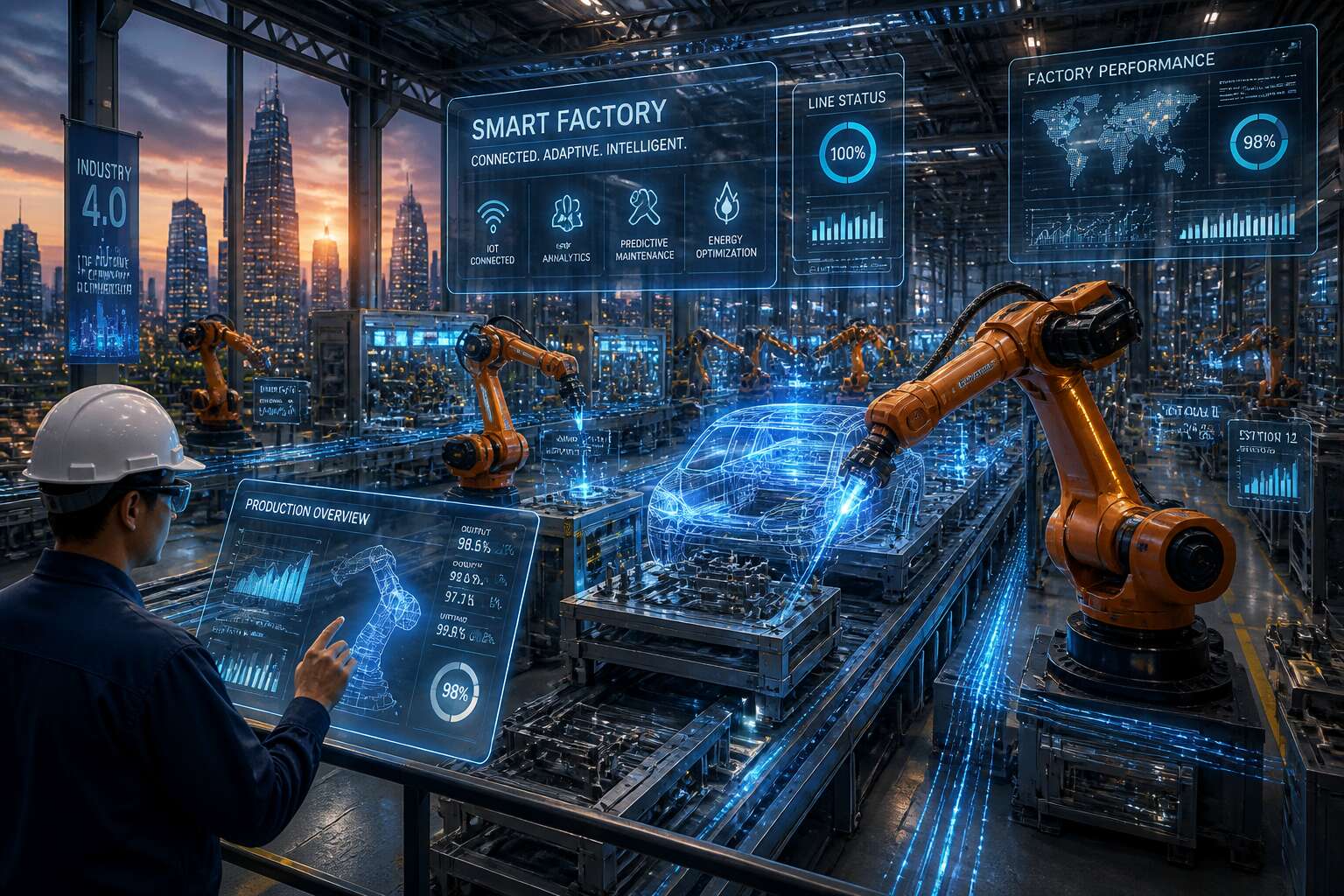
To grasp how the 4ir full meaning translates into daily operations, look at South Africa’s manufacturing floors. Smart factories are emerging where interconnected machines communicate instantaneously, adjusting production in real time. This shift reduces downtime, improves quality, and lets teams make decisions based on live data.
Consider a typical assembly line: sensors feed information into a central system, and machine learning algorithms predict failures before they occur. The result is a leaner, more responsive plant. In fact, smart factories shorten lead times by up to 30% in some sectors.
Digital twins take this further. A digital twin is a virtual replica of a physical asset, process, or system. Engineers simulate changes without halting production. For example, a mining operation can test new conveyor configurations digitally, avoiding costly stoppages. This approach is particularly valuable in South Africa, where capital costs are high and downtime carries steep penalties. As these technologies mature, what was once abstract becomes tangible: efficiency, resilience, and adaptability across industries.
Supply Chain and Logistics Reinvention
Supply chains in South Africa face a brutal test: port congestion, fuel spikes, and unreliable freight routes. The 4ir full meaning becomes visible here, where data flows faster than goods. Sensors on trucks and cargo containers transmit live locations, temperature, and handling conditions. Logistics teams see problems before they escalate, not after.
Predictive analytics now reroutes shipments around bottlenecks, cutting delivery windows from days to hours. Managers compare live costs across rail, road, and air, choosing the cheapest viable option in minutes. Warehouses are equally transformed:
- Autonomous forklifts move stock without human intervention
- Voice directed picking cuts error rates sharply
- Demand forecasting prevents overstock and empty shelves
The Role of Big Data in Strategic Decisions
Every minute, South African businesses generate terabytes of operational data, yet most executives still make strategic calls on intuition. The 4ir full meaning becomes tangible when this raw data transforms into a decision-making engine. Big data analytics uncovers patterns invisible to human observation, from customer churn signals to pricing inefficiencies.
Consider how retailers adjust procurement. Historical sales data, weather patterns, and social sentiment converge into predictive models that flag risks weeks in advance. Executives no longer wait for quarterly reports. They interrogate live dashboards showing margin erosion or emerging demand spikes.
- Customer behaviour clustering reveals micro-segments with distinct preferences
- Anomaly detection exposes fraud before losses compound
- Scenario modelling tests strategic moves without financial exposure
This shifts power from gut feel to evidence. The 4ir full meaning ultimately rests on converting raw signals into decisive action, and that conversion happens faster than any annual strategy review ever allowed.
Impact on Manufacturing and Production Lines
In South African factories, the 4ir full meaning is not an abstract concept. It is the tangible shift from sequential, machine-driven processes to interconnected, data-informed operations. Production lines now use sensors and real-time analytics to detect micro-fluctuations in output quality, adjusting parameters instantaneously. This reduces waste and energy consumption without human intervention, altering the fundamental economics of local manufacturing. The transformation moves beyond simple automation into a realm of cognitive operations where equipment anticipates maintenance needs. The result is a production floor that functions on throughput and predictive precision, not reactive firefighting.
Here is how production lines are evolving in practice:
1. Real-time quality control statistics that flag deviations immediately.
2. Predictive maintenance schedules that prevent costly downtime.
3. Dynamic routing of materials to eliminate bottlenecks on the fly.
These changes build a resilient industrial base that competes on intelligence and agility, which is the 4ir full meaning in action, layered onto the production line itself.
New Workforce Skills and Job Roles
The 4ir full meaning now defines who gets hired and who gets retrained. South African businesses are posting roles like automation coordinator, data steward and digital twin manager. These titles demand a blend of technical literacy and contextual judgement.
Workers have moved from repetitive tasks to exception handling. They monitor systems and intervene when algorithms require human nuance. Training programmes prioritise practical competencies. A typical curriculum includes:
- Data interpretation and pattern recognition
- Oversight of collaborative robotics
- Cybersecurity awareness for operational technology
The workforce becomes more adaptive with each project cycle, shifting from manual repetition to cognitive responsibility.
Digital Transformation Roadmaps for Companies
For South African enterprises, the 4ir full meaning has shifted from a theoretical framework to a practical business imperative. Companies are no longer asking whether to digitise, but how quickly they can restructure operations around data driven decision making. The roadmap often begins with an audit of legacy systems, followed by phased integration of interoperable platforms.
A Johannesburg retail group I consulted prioritised customer data unification before automating any backend processes. That sequencing mattered. A digital transformation roadmap requires clarity on which processes generate revenue and which generate risk. Most plans follow a recognisable pattern:
- Assess current technology debt and skill gaps
- Identify high impact processes for pilot automation
- Scale only after measurable efficiency gains appear
Digital transformation roadmaps keep the 4ir full meaning grounded in tangible outcomes rather than abstract promises.
Societal and Global Implications of 4IR
Economic Shifts and the Future of Employment
The global economic map is redrawing, and the 4ir full meaning has become a stark fiscal reality. For South Africa, this creates a mismatch between algorithmic speed and the slow pace of existing labour contracts. I see the widening gap between data streams and social welfare, with three concrete manifestations:
- Fiscal systems fail to capture intangible capital flows, straining budgets.
- Value chains re-anchor near energy-rich hubs, ignoring lower wages.
- Connectivity silos now define a fresh kind of spatial segregation.
These shifts restructure economies from the inside out. One hub captures premium global capital flows, while another inherits the fragmented reality of gig work. The future of employment rests on a collective renegotiation, but the closing window is dangerously short. That acronym now carries the weight of this unbundling into every decision.
Ethical Dilemmas and Regulatory Needs
South Africa’s constitutional promise of dignity is tested by datasets that classify without consent. The 4ir full meaning extends beyond technology into questions of accountability. Who answers when an automated system denies a social grant? Algorithms inherit historical inequality, yet our legal frameworks still treat software as neutral.
Machine ethics cannot be an afterthought. We need regulatory instruments that bind private and public actors alike. The global nature of these systems demands cross-border cooperation, but national legislatures remain fragmented. Without clear liability structures, the burden falls on ordinary citizens.
Consider the emerging fissures:
- Automated decision making that lacks transparency.
- Data governance that prioritises profit over personhood.
- Legal systems unprepared for autonomous actions.
These are not technical glitches. They are policy voids.
Sustainability and Environmental Opportunities
Data centres now consume as much electricity as entire nations, a fact that demands attention. The 4ir full meaning includes this hidden environmental cost, not just shiny gadgets. But the same smart systems can cut waste across industries. Automated grids balance renewable energy, while sensors prevent overwatering on farms. Those are genuine sustainability wins.
Globally, the 4ir full meaning varies. Developing countries face e-waste accumulation, while developed ones export their electronic waste. Yet opportunities abound for leapfrogging into clean infrastructure. Digital twins improve building efficiency, and blockchain tracks carbon credits with precision. The challenge is ensuring these tools serve everyone, not only the privileged.
Here are three environmental openings worth watching:
- Smart agriculture that uses water sparingly
- Predictive maintenance to extend equipment life
- Peer-to-peer energy trading between solar households
These are practical shifts that redefine sustainable development in the 21st century.
Bridging the Global Digital Divide
One billion people still lack reliable internet access. The 4ir full meaning, for South Africa, must account for this gap. Our townships have smartphone penetration, but bandwidth and electricity remain uneven. Without addressing these basics, the fourth industrial revolution will deepen existing inequalities rather than resolve them.
Yet mobile money and solar-powered community Wi-Fi show what leapfrogging can achieve. Villages bypass copper cables entirely. Free public access points in libraries and taxi ranks connect those who cannot afford data.
- Expanding digital literacy in local languages
- Reducing data costs through regulatory pressure
- Supporting community-owned network infrastructure
These actions put the 4ir full meaning into practice. The goal is straightforward: automation and connectivity must serve the majority, not only metropolitan elites. That is how South Africa bridges the digital divide.
Overcoming 4IR Challenges and Preparing for What’s Next
Infrastructure Gaps and Investment Barriers
South Africa’s digital backbone remains a patchwork of promise and neglect, with only 30% of municipalities having reliable broadband for industrial use. Overcoming these infrastructure gaps requires grasping the 4ir full meaning as systemic resilience, not gadgetry.
We see investment barriers persist because risk perception outweighs returns, yet private capital is available. To move forward, I believe stakeholders must address:
- Energy security for connected factories
- Fibre reach beyond metropolitan hubs
- Maintenance skills for edge computing nodes
Each bottleneck sits within a regulatory framework that rewards short-term gains. Without coordinated funding models, the divide between early adopters and marginalised regions widens. The next phase demands shifting from project-based funding to continuous ecosystem investment. That is the real test for South African industries!
Education Systems and Skill Development Gaps
Education systems in South Africa still measure success through memorisation and examination results. The 4ir full meaning demands something different. It demands cognitive flexibility, the capacity to unlearn and relearn repeatedly. I have seen bright graduates struggle not because they lack intelligence, but because their training never taught them to question inherited frameworks.
Skill development gaps appear early and compound over time. Primary schools lack computational thinking. Technical colleges lack equipment that matches industry standards. Universities produce theory-rich graduates who cannot troubleshoot a broken sensor on a production line!
- Digital literacy must become a foundational subject, not an elective
- Teacher training requires continuous upskilling in emerging technologies
- Industry partnerships should drive curriculum design, not government alone
The psychological dimension matters too. Many workers fear automation because no one has shown them how to work alongside intelligent systems. Confidence comes from competence. Competence comes from repeated exposure. The 4ir full meaning cannot be realised if we treat education as a phase of life rather than a lifelong practice.
Policy Frameworks for Responsible Innovation
Policy makers often treat the fourth industrial revolution as a technology problem. That misses the 4ir full meaning. It is a social and economic shift that demands new rules for data ownership, algorithmic accountability, and worker protection. Without these, innovation runs ahead of public trust.
Responsible innovation requires policy that adapts as quickly as the systems it governs. It needs clear standards for transparency, cross-department coordination, and real penalties for misuse.
South Africa can start by:
- Auditing existing regulations for digital-era blind spots
- Funding independent oversight bodies
- Requiring public impact assessments for major automation projects
These steps will not slow progress. They will make it sustainable.
Practical Steps for Individuals and Organizations
The 4ir full meaning becomes clearer once the hype recedes. What remains is unglamorous work. Individuals must learn to question outputs from automated systems instead of trusting them blindly. That means checking anomalies, understanding bias in training data, and knowing when to overrule a recommendation. Organisations must treat implementation as an ongoing discipline, not a launch event. They need feedback loops that catch failures early and reward employees who surface them.
Consider where most efforts actually stall:
– Handoffs between departments that never function smoothly
– Data that exists but cannot be accessed by the people who need it
– Procurement rules written for a world without software subscriptions
The gap between ambition and reality is rarely technical. It is organisational. People who grasp this know that preparing for what is next means fixing these ordinary failures first.

0 Comments