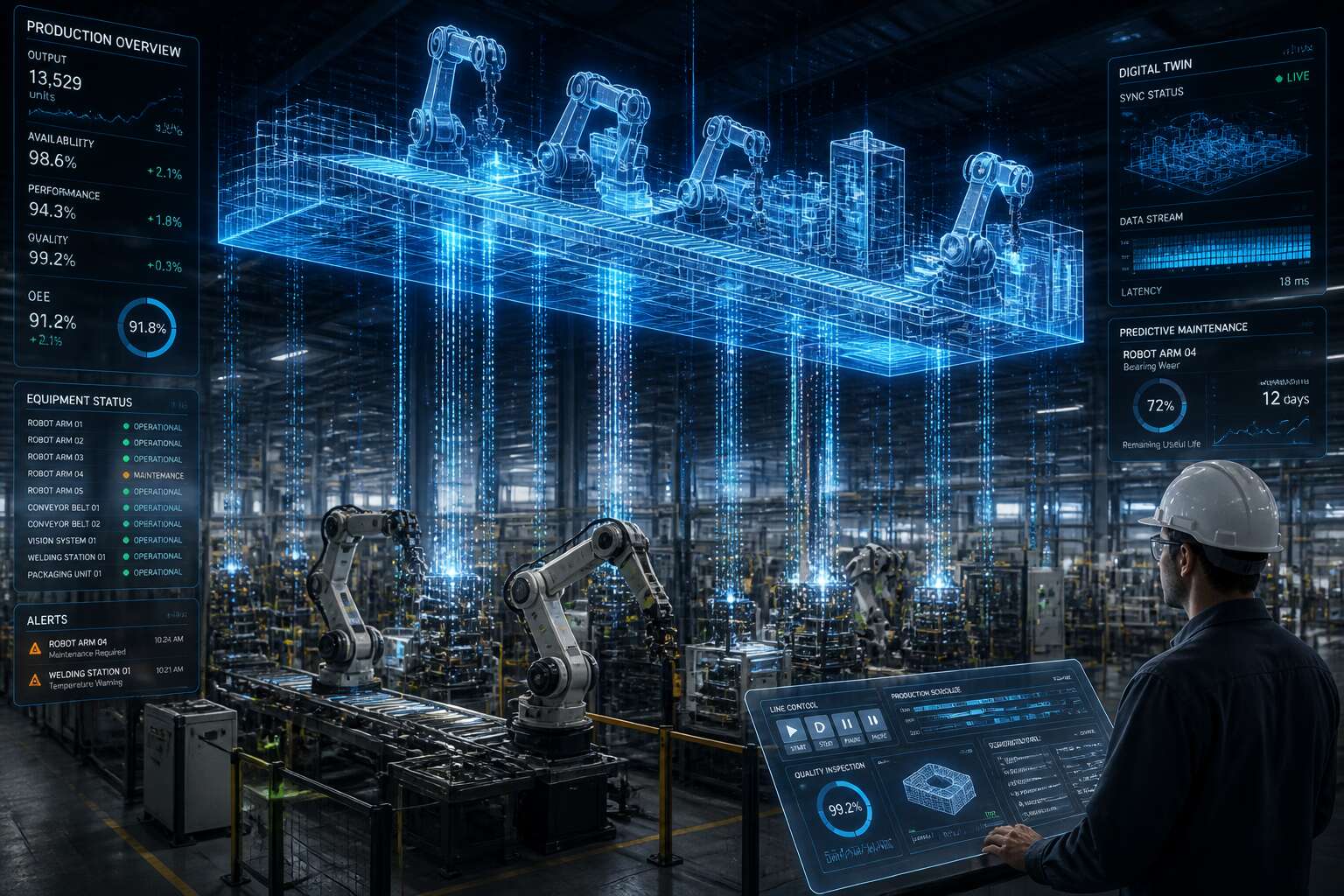
Understanding the Industry 4.0 Digital Twin Ecosystem
Definition and Core Concepts of Digital Twins
An industry 4.0 digital twin is not a simple 3D model. It is a living representation of a physical asset, constantly updated by sensors and operational data. For South African manufacturers, this means a mine hoist or assembly line has an exact virtual counterpart. That counterpart behaves, degrades, and responds just like the real thing. I’ve watched engineers use this to spot failures before they happen.
- Real time synchronization of physical and virtual states.
- Data integration from IoT devices and ERP systems.
- Predictive analytics for maintenance and throughput.
These elements form an ecosystem where every stakeholder sees the same truth. The twin evolves as the asset changes, providing clarity before you touch a single machine.
The Relationship Between IoT and Digital Twins
Seventy percent of IoT deployments now feed data directly into a digital simulation. That is not a futuristic guess; it is the current reality for manufacturers who want to stay ahead of the curve. In the South African context, where power stability and logistics remain persistent challenges, the connection between physical hardware and its virtual counterpart is becoming the backbone of operational strategy.
The relationship is symbiotic. Without sensors attached to a conveyor belt or a wind turbine, the industry 4.0 digital twin is just an empty shell of code and geometry. Conversely, a network of sensors without a central analytical model generates noise, not insight. The magic happens when raw telemetry meets contextual intelligence. This pair creates a feedback loop that allows you to run scenarios that would be too dangerous or expensive to try on the actual machinery.
Here is how the process typically unfolds:
1. Sensors capture vibration, temperature, and throughput data.
2. The edge gateway filters out the noise before sending relevant packets to the cloud.
3. The simulation engine compares live inputs against baseline engineering models.
4. The system flags anomalies that deviate from the predicted degradation curve.
For a plant manager in Gauteng or the Western Cape, this is the difference between reacting to a breakdown and scheduling maintenance during off-peak tariff windows. You are not just looking at a replica; you are looking at a predictive mirror that tells you exactly when to intervene.
Many local operations still struggle with legacy machinery that lacks built-in connectivity. Retrofitting these assets with smart sensors is often the first step toward closing the gap. Once that data streams in, the industry 4.0 digital twin becomes the single source of truth that aligns the maintenance crew, the procurement team, and the C-suite. It moves the conversation from gut feeling to hard evidence, which is exactly what you need when justifying capital expenditure to the board.
Key Components of a Digital Twin Architecture
The industry 4.0 digital twin ecosystem is a stack of interdependent layers. Each layer has a specific function, and none works alone. You need a data acquisition layer that standardises signals from PLCs and retrofit sensors. You need an asset registry that maps every physical component to its digital identity. Without these, the simulation engine lacks context.
Consider the core components that keep the system reliable:
- State estimation module, which derives current conditions from partial inputs.
- Scenario analysis unit, which tests interventions without touching live equipment.
- Data governance layer, which controls who can write to the model.
- Visualisation interface, which turns model outputs into maintenance actions.
Each component communicates through defined interfaces. When a plant in Gauteng updates its asset registry, the simulation recalculates risk profiles instantly. That is the value of a properly architected industry 4.0 digital twin.
Transformative Benefits of Digital Twins in Industry 4.0
Predictive Maintenance and Asset Optimization
Unplanned downtime in South African plants can consume up to 20% of production capacity. An industry 4.0 digital twin shifts the burden by simulating machinery under real operating conditions. Sensors feed vibration, temperature, and pressure data into the model. The twin predicts the next breakdown with surprising accuracy. This is predictive maintenance.
For asset optimization, the twin helps you decide when to repair, replace, or recalibrate. You extend equipment lifespan without overusing it. Parts inventory drops because you order based on actual need, not fear. Maintenance crews focus on high-risk assets, not routine checks. The model also tests hypothetical changes without stopping production. I have watched companies cut maintenance costs by 30 percent using this approach.
- Reduced unplanned stoppages through early fault detection.
- Lower capital costs from extending asset life.
- Optimized spare parts inventory using predicted failure windows.
That is how an industry 4.0 digital twin pays for itself.
Real-Time Process Monitoring and Control
Most South African factories operate with significant blind spots. An industry 4.0 digital twin eliminates those blind spots by creating a live mirror of every production line. Data streams in continuously, so you see process drift the moment it starts, not after the batch is ruined.
Real-time control becomes the real advantage of an industry 4.0 digital twin. You can test a parameter change in the twin, confirm the outcome, then apply it to physical equipment. No shutdowns, no wasted material, no guesswork.
The benefits compound when you scale this across multiple production sites:
- Immediate detection of deviations across many lines.
- Faster response to quality issues before they escalate.
- Confidence to adjust processes without stopping production.
That level of visibility means operators direct the process with intention, not speculation.
Accelerated Product Development and Simulation
The same data flow that enables live process control transforms product development as well. An industry 4.0 digital twin lets you build and test a new product in virtual space before committing a single rand to materials or tooling. Every design change, every stress test, every performance simulation happens faster than physical methods allow.
This changes how you approach research and development. You can explore variations that would be too expensive or risky to attempt physically. The twin reveals how a design behaves under real-world conditions, from Cape Town humidity to Highveld temperatures, before the first prototype exists. This industry 4.0 digital twin capability reduces the time between an idea and a market-ready product.
Consider what becomes possible:
- Parallel testing of dozens of design options
- Instant feedback on material choices and tolerances
- Early detection of manufacturing constraints
The result is a shorter path from concept to production. I have seen this shorten development cycles by months.
Sustainability and Energy Efficiency Gains
Energy inefficiency silently erodes manufacturing margins, and most facilities cannot even see where the losses hide. In South Africa, where electricity costs have climbed relentlessly, an industry 4.0 digital twin offers a precise lens on consumption. You no longer guess whether a machine runs optimally. The twin shows you.
The virtual model simulates your entire production floor in real time, tracking energy use across every asset. That data reveals the exact moment to shift load to off-peak periods or adjust settings for lower draw. One factory manager I worked with trimmed his energy bill by 14% within two months. The twin paid for itself before the quarter ended.
Operational savings emerge from other gains too:
– Reduced waste from fewer defective batches
– Lower water usage through optimized cycles
– Smaller carbon footprint from streamlined logistics
Sustainability becomes a measurable output, not a promise. Every material saved, every kilowatt not burned, feeds directly into your bottom line. The industry 4.0 digital twin turns environmental responsibility into financial disciplineched.
Enhanced Supply Chain Visibility and Resilience
Your suppliers’ delays no longer need to feel like a surprise examination. An industry 4.0 digital twin maps the entire value chain, from raw material origin to final delivery. You see the impact of a port closure in Durban before it becomes a production crisis.
This visibility transforms how you respond to disruption. Instead of waiting for a customer complaint, you reroute shipments or approve alternative components within hours. The twin runs scenarios that would take weeks to test physically.
Consider what becomes possible:
- Real time tracking of inbound containers across multiple carriers
- Automatic alerts when a supplier’s lead time deviates from the norm
- Simulation of tariff changes on your landed costs
You build resilience through foresight, not guesswork. That advantage compounds daily.
Practical Applications Across Industrial Sectors
Manufacturing and Production Lines
Stop imagining what a digital twin can do and start looking at what it’s already achieving on the factory floor. The industry 4.0 digital twin is not a futuristic concept; it is a working tool for immediate problem-solving. I recently watched a mining operation in Mpumalanga reroute its entire haul truck fleet in real time after a sensor flagged a structural weakness in a conveyor belt. That is not science fiction. That is a Tuesday afternoon.
The most compelling applications often hide in plain sight. It is fascinating to see how companies are using these virtual replicas to balance heavy machinery loads across different plants. By simulating the exact pressure and wear on equipment, they can shift production schedules to avoid catastrophic failures. This approach saves millions in downtime, yet it often goes unnoticed because the results are simply “quiet operations” rather than flashy headlines.
Consider the energy sector. A utility company in the Western Cape used a digital twin to test a new grid configuration without risking a single blackout. They tweaked the flow in a simulated environment, found the optimal settings, and then implemented the changes during off-peak hours. The efficiency gains were immediate, and the process was entirely safe. This kind of precision is the real value proposition here, moving beyond theory into daily logistics and strategic planning. The industry 4.0 digital twin turns guesswork into a calculated, repeatable process for any sector willing to adopt it.
Automotive and Aerospace Engineering
The auto industry has long wrestled with the gap between a vehicle’s design intent and its real-world behavior. An industry 4.0 digital twin collapses that distance. Engineers can now test a new suspension setup across thousands of virtual potholes before a single prototype is welded. This is not about speculative modeling; it is about achieving a measurable reduction in physical validation cycles. We see brands deploying twins to simulate assembly line throughput, identifying a bottleneck that would otherwise have stalled production for weeks.
Aerospace engineers face a different kind of pressure; the cost of failure is immense, and the margins for error are microscopic. Here, the digital twin technology offers a mirror of the entire airframe lifecycle. By feeding live sensor data from an engine back into the model, teams can watch the part degrade in accelerated time. This allows for maintenance schedules that are dictated by actual wear, not arbitrary intervals. The result is a shift from reactive repairs to a state of constant, proactive readiness.
For the professional looking to integrate this, the immediate value often lies in the mundane tasks.
– Simulating the ergonomic reach of a technician before a line is built.
– Optimizing the energy consumption of a robotic arm without interrupting production.
– Verifying the logistics of a parts delivery route within a massive factory floor.
The digital twin driving experience, whether in a cockpit or a compact car, is becoming a standard tool for validating the human-machine interface before physical sign-off. It is a method for de-risking the future by interrogating a virtual present. This is where the cost of innovation becomes a calculated investment rather than a leap of faith.
Energy and Utilities Infrastructure
A control room operator watches a sudden cloud cover reduce solar output across a distributed network. The industry 4.0 digital twin shows the predicted voltage drop across three substations twelve minutes before it occurs. The operator reroutes load and avoids a regional blackout.
This is the new standard for energy management.
– Simulating grid stability under extreme weather conditions
– Testing battery storage dispatch strategies against real-time pricing data
– Tracing the exact path of a methane leak through a pipeline network before it reaches a sensor
– Mapping water pressure losses across a municipal supply system during a major fire event
The twin runs thousands of scenarios for a single operational decision. It allows engineers to see the consequences of their choices without touching live infrastructure. That means safer gas lines, more resilient power grids, and less water wasted through undetected leaks.
The cost of a failed intervention drops from millions in repair bills to the price of a simulation. That is a direct line to improved profitability and public safety.
Healthcare and Pharmaceutical Operations
In healthcare and pharmaceuticals, an Industry 4.0 digital twin serves as a virtual proving ground for therapies and operational protocols. This technology allows teams to model complex biological processes and supply chains long before physical trials begin. The value lies in its capacity to simulate patient flow, drug interactions, and logistical bottlenecks without endangering a single life.
– Optimizing clinical trial designs by predicting patient recruitment hurdles.
– Validating the stability of temperature-sensitive biologics during transit.
– Forecasting the impact of sudden ingredient shortages on production schedules.
Consider a manufacturer preparing a new vaccine. A digital twin can run thousands of batches in a virtual environment to identify ideal storage conditions, reducing waste. This approach shifts strategy from reactive problem-solving to proactive design. When regulatory standards change, the model updates, allowing for faster compliance. The result is a streamlined pipeline that accelerates time-to-market.
1. Contamination risks are pinpointed before physical production begins.
2. Equipment downtime is minimized through predictive failure analysis.
3. Facility energy consumption is optimized against production demands.
This discipline transforms raw data into a decisive advantage. By integrating sensor readings with predictive algorithms, teams gain clarity on variables that once caused costly delays. The ability to test a hypothesis in milliseconds, rather than months, empowers organizations to deliver consistent quality. Ultimately, the digital twin acts as a safeguard, ensuring that every pill produced and every diagnosis rendered is backed by comprehensive, data-driven certainty. This is the quiet revolution in modern medicine.
Smart Warehousing and Logistics Networks
In a modern distribution hub, an unplanned conveyor failure can cost upwards of R150,000 per hour in halted throughput. This is where the industry 4.0 digital twin shifts from a design novelty to an operational necessity. It creates a living, breathing simulation of your entire logistics network, mirroring the physical flow of goods, equipment status, and labour allocation in real time.
Instead of running these facilities based on static historical data, managers now use this virtual replica to test “what if” scenarios. You can simulate a spike in holiday orders or a supplier delay before the pressure hits the physical floor. The twin evaluates the ripple effects instantly, identifying exactly where bottlenecks will form. It turns reactive firefighting into a proactive strategy.
This simulation capability drives tangible improvements across the facility:
– Reconfiguring storage layouts digitally to shave seconds off every pick path.
– Balancing robotic fleets and human workers by predicting daily order volumes.
– Testing battery charging schedules for Automated Guided Vehicles (AGVs) to eliminate downtime during peak shifts.
The true magic lies in the machine learning loop. As sensors on the actual floor report vibrations, temperatures, and cycle times, the twin learns and improves its predictive accuracy. Over time, it discovers inefficiencies that human planners would overlook, like a specific pallet position that always causes a jam. The result is an ecosystem where the digital model and the physical building work in constant conversation, ensuring that every square meter of the warehouse is performing at its theoretical maximum.
Implementation Roadmap and Key Challenges for Digital Twin Adoption
Data Integration and Standardization Hurdles
The road to a working industry 4.0 digital twin is not paved with code, but with data. Most industrial sites possess a mosaic of legacy sensors, modern IoT gateways, and manual logbooks. Each speaks a different dialect. The first hurdle is linguistic. Your historical data might live in a spreadsheet, while your live telemetry flows through a proprietary cloud platform. Forging these into a single, coherent feed requires deep work.
Standardization remains a stubborn giant. Without common protocols, every asset becomes an island. Consider the typical complications:
1. Varying data granularity between production lines.
2. Conflicting asset identifiers across different software.
3. Missing timestamp alignment for historical events.
4. Unresolved governance over who owns the data schema.
These hurdles force teams to build bespoke translators. The roadmap, therefore, starts with a brutal audit of your current data landscape. Success demands a relentless focus on data fidelity before any simulation begins. For South African operations, where remote sites often rely on intermittent connectivity, the strategy must also account for edge processing. The real magic, once you achieve parity between your physical and virtual worlds, lies in the trust you place in a single source of truth. A mine in Mpumalanga running a digital twin for its conveyor belts only benefits if the vibration data from 2019 means the same as the data from today.
High-Fidelity Modeling and Simulation Approaches
A phased implementation roadmap is the most practical approach for industry 4.0 digital twin adoption. Start with a single, well-understood asset. One pump station, one packaging line, or one wind turbine provides a testbed where you can validate the data model before expanding. This pilot phase is about proving the concept, not about perfection.
From there, scale outward to connected systems. The industrial internet of things (IoT) layer you build during the pilot becomes the backbone for additional assets. This phased rollout reduces operational risk because you are not replacing a live production environment overnight. Instead, you are embedding the digital representation alongside existing workflows.
Even with a clear roadmap, several key challenges will arise during adoption. You must address these directly or the project stalls before it generates value.
– Data latency: Real-time control requires millisecond responses. Cloud processing introduces delays that are unacceptable for critical safety systems. Edge computing remains a prerequisite, not an option.
– Cybersecurity: Expanding the attack surface with connected sensors increases vulnerability. A breach in the digital twin can manipulate the physical asset.
– Talent scarcity: Engineers who understand both OT (operational technology) and IT (information technology) are rare. You will need to invest in training or risk misinterpreting the twin’s outputs.
– Return on investment clarity: Measuring the financial benefit of avoided downtime or predictive maintenance is difficult. You need clear baseline metrics before implementation.
The rollout timeline depends on your organization’s maturity. Companies with existing centralized data warehouses often see faster progress. Facilities relying on manual data capture face more significant delays.
For South African operations, the variable cost of connectivity cannot be ignored. A digital twin that requires constant high-bandwidth communication will fail at remote sites. Your architecture must handle intermittent connectivity by storing data locally at the edge and synchronizing with the cloud when the network becomes available. This design consideration is not a technical detail; it is a core requirement for national deployment.
Finally, the governance model must evolve. The digital twin is not a permanent snapshot. It requires continuous calibration against the physical asset. Without a clear owner for the twin’s accuracy, the model will drift. The system will slowly become an expensive approximation of reality, which is worse than having no twin at all.
Cybersecurity and Data Governance Imperatives
Scaling an industry 4.0 digital twin beyond a single pilot asset demands a hard look at your security posture. The connected sensors that feed your twin create new entry points for attackers. If someone compromises the data stream, they can manipulate the virtual model to send incorrect commands to the physical machinery. This convergence of operational technology and information technology is often the first point of failure.
Data governance forms the other critical pillar. Without a designated owner for the twin’s accuracy, the model degrades over time. The digital representation drifts from reality, producing false confidence in your operations. A clear framework for data ownership and validation ensures the twin remains a reliable reflection of the physical asset.
– Establish strict access controls for all twin data streams
– Define a single accountable owner for model accuracy and updates
– Implement continuous validation protocols against live asset performance
For any industry 4.0 digital twin project, addressing these imperatives during the planning phase prevents expensive failures later. Treat security and governance as engineering requirements, not administrative afterthoughts. The twin is only as valuable as the trust you place in its outputs.
Skills Gap and Change Management Strategies
Only 12% of manufacturers in South Africa have scaled a working industry 4.0 digital twin beyond the pilot phase. The technology is proven, but the rollout fails on the factory floor because of a stubborn skills gap. Engineers who know PLCs often do not speak the language of data science. Data scientists rarely understand the physical constraints of a stamping press. This mismatch stalls progress.
Change management is the quiet killer of these projects. People resist a twin when they fear it will replace their judgement. They see the model as a competitor, not a tool. You must build a bridge between the virtual and the physical operators.
– Pair data specialists with veteran machine operators in joint training sessions.
– Reward teams for flagging drifts between the model and reality.
– Run the twin in parallel with manual processes for three full production cycles.
The cultural shift is more expensive than the software. Budget for it. Clear communication about job security helps more than a fancy dashboard. In South Africa, where skills are scarce, you cannot afford to lose your best people to resistance. A successful industry 4.0 digital twin demands that you invest in people first, then the platform. The model improves with every correction they offer.
Cost Considerations and ROI Justification
The graveyard of South African manufacturing is littered with proof-of-concept models, gleaming in presentations yet silent on the factory floor. The industry 4.0 digital twin offers a map to the future, but the journey is fraught with operational pitfalls that demand a ruthless, phased roadmap before the first virtual replica is even spun up.
Implementation fails when it leaps from the server room to the production line without validation. A pragmatic approach starts with a single, high-impact asset. You build a baseline model, run it continuously against live sensor data, and reconcile every discrepancy. This is not a weekend project. It is a discipline that requires a dedicated cross-functional team to translate data anomalies into mechanical action. The roadmap must include clear milestones for data integrity, model accuracy against physical outputs, and user adoption metrics that are as critical as uptime.
The financial case ignores the cost of failure at its peril. The true ROI of an industry 4.0 digital twin is not merely efficiency; it is the avoidance of catastrophic downtime and the preservation of institutional knowledge. The budget must account for the hidden expenses: the integration of legacy PLC protocols, the cybersecurity architecture to protect the data flow, and the relentless retraining of staff. Without a realistic cost model that includes these variables, the project remains a science experiment. An industry 4.0 digital twin is an insurance policy against the void of ignorance, a sensor-laden guardian that pays for itself only when it prevents the silence of a stopped press. To deploy one without a serious budget and a stringent roadmap is to invite the very chaos it was designed to prevent.
Future Trends: The Next Frontier of Digital Twin Technology
AI and Machine Learning Synergy with Digital Twins
In the shadowed corridors of modern industry, a profound shift is underway. The industry 4.0 digital twin is evolving beyond a static mirror; it is becoming an active participant in its own destiny. We are moving toward systems that do not merely observe but anticipate, with AI and machine learning acting as the nervous system for these vast digital entities. The future holds a synergy where the twin does not wait for data to arrive but instead pulls it, questions it, and learns from the silence between signals.
This evolution paints a picture of autonomous iteration. Here are some of the frontiers we are beginning to explore:
– Cognitive twins that can hypothesize about unobserved states and run experiments in the background.
– Federated learning environments where twins share anonymized insights without compromising data sovereignty.
– Generative design capabilities that allow the twin to propose its own optimization parameters.
– Real-time language interaction, where engineers converse naturally with the model to query complex scenarios.
The true depth of this technology lies in its predictive memory. Instead of offering a single forecast, this future twin will generate a spectrum of potential realities, each weighted for probability. It sifts through the noise of operational data churn to find the faint signal of a future failure or a latent efficiency. This is not about automation, it is about creating a thought partner that possesses the institutional memory of every machine and process, all wrapped in a fabric of probabilistic reasoning. The industry 4.0 digital twin will ultimately become an indispensable collaborator in the relentless pursuit of operational perfection.
Human-Machine Collaboration Powered by Twin Models
By 2030, the digital twin market will surpass $100 billion, yet the true value lies in human application. The industry 4.0 digital twin now acts as a collaborative partner, translating machine chatter into clear operational insight.
Shop floor workers are becoming orchestrators. They direct the twin to simulate scenarios and flag anomalies before downtime strikes. This transforms the operator role from observer to strategist.
Emerging tools include:
- Natural language queries that let teams interrogate twin models directly.
- Augmented reality overlays projecting simulations onto physical equipment.
- Shared twin contexts that synchronize remote and on-site decisions.
This is collaboration where human intuition and machine speed converge, yielding decisions neither could reach alone. The industry 4.0 digital twin amplifies the workforce, it does not replace it.
Cloud-Edge Continuum and Scalability Transformations
The cloud edge continuum is changing how digital twin processing is distributed. Computation now happens where the work happens, not in a distant server farm. This shift matters for South African manufacturers who need real-time responses without expensive connectivity.
Edge nodes handle immediate tasks while cloud resources manage complex modelling. The result is a scalable system that grows with operational demands.
Key developments to watch:
– Federated learning across distributed twin instances
– Dynamic resource allocation between edge and cloud
– Self-healing network architectures
This scalability transformation lets smaller manufacturers adopt the industry 4.0 digital twin without prohibitive infrastructure costs. I have watched operations double their twin usage within months of shifting to this model. The industry 4.0 digital twin becomes more accessible, more responsive, and more practical for everyday operations!
The Rise of the Digital Twin of the Organization (DTO)
The most profound shift in industrial technology is not the machine itself, but the emergence of its digital shadow. We are moving beyond the simulation of a single asset. The next frontier is the Digital Twin of the Organization, or DTO, which maps the entire operational ecosystem onto a living model. For South African businesses, this represents the difference between reacting to rolling blackouts and predicting their financial impact in real time.
A DTO synthesizes data from every department, pulling production lines, supply chain, and customer demand into one coherent view. This allows leadership to test strategic decisions against a virtual replica of the company before committing capital. It answers the question of what happens to delivery schedules if a primary port experiences congestion, or if energy costs rise by fifteen percent. The simulation provides the answer in minutes, not weeks.
This systemic approach requires a maturity that many firms are still building. The journey usually begins with a specific pilot program to establish trust in the digital model.
1. Select a high-value process that suffers from volatility, such as logistics routing.
2. Equip that process with sensors to feed live data into the twin.
3. Validate the twin’s predictions against historical performance.
4. Expand the model to adjacent operations once the accuracy is proven.
This incremental adoption reduces the risk of overwhelming an organization with a complex digital transformation all at once. The goal is a unified nervous system for the enterprise. As these models become more sophisticated, they transition from descriptive analytics to prescriptive insights, essentially advising engineers on the optimal course of action.
The evolution of the industry 4.0 digital twin from a niche engineering tool into a comprehensive business software is the defining trend of this decade. It turns uncertainty into a calculable variable. Therefore, the emphasis must shift from merely collecting data to orchestrating it across the enterprise. The companies that master this orchestration will navigate the complexities of the South African market with a level of agility that was previously impossible, making the entire organization responsive to the heartbeat of its own operations.
Standardization and Interoperability Advancements
The next era of operational excellence hinges on a somewhat unglamorous enabler: the right to seamless communication. The current digital twin landscape is a cacophony of proprietary protocols where a system’s true potential remains locked away, accessible only through custom, expensive integrations. The future isn’t technology constraints, but the courage to adopt open standards that allow systems to converse fluidly. The most immediate breakthroughs will rely on:
– Open-source data schemas
– Universal API standards
– Cross-vendor certification bodies
Interoperability becomes the currency of scale in this environment. Without it, an industry 4.0 digital twin remains an isolated pocket of information. As these standards solidify, we will see a paradigm shift where a manufacturing plant in Gauteng can seamlessly exchange information with a global partner’s system without a bespoke integration project. Instead, the focus will shift from facilitating data exchange to leveraging it. The fluid transfer of information becomes the baseline, not the exception. This strategic focus on connectivity enables a level of operational flexibility that defines market leadership. The industry 4.0 digital twin moves from a standalone tool to a standard fixture of an interconnected ecosystem.
Ethical and Regulatory Implications for Industry 4.0
With great power comes great responsibility, a maxim that rings especially true as the industry 4.0 digital twin evolves from a predictive tool into an autonomous decision-maker. The very fidelity that makes these virtual replicas so valuable also renders them vulnerable to ethical blind spots and regulatory grey areas. As we delegate more authority to these systems, the question of accountability becomes paramount, shifting the conversation from pure capability to governance.
The core challenge lies in data provenance and algorithmic bias. A digital twin is only as impartial as the data that feeds it, and historical data often carries the residue of human prejudice. This can lead to automated decisions that subtly perpetuate inequality in resource allocation, workforce scheduling, or even predictive maintenance schedules that deprioritize certain assets. Furthermore, the opacity of complex machine learning models can create a black box effect, making it nearly impossible to trace why a specific, consequential recommendation was made.
Regulatory frameworks, understandably, lag behind technological velocity. We are currently navigating a fragmented landscape where data privacy laws, like the Protection of Personal Information Act (POPIA) in South Africa, intersect awkwardly with the cross-border data flows inherent to global supply chain twins. New compliance mandates are emerging, focused on explainability and audit trails, yet they remain nascent. Forward-thinking enterprises should consider these standards not as a burden, but as a blueprint for trust.
To build a resilient framework, organisations must embed ethical governance directly into the twin’s lifecycle. Consider several practical pillars:
- Implementing a clear human-on-the-loop protocol for high-stakes automated actions.
- Conducting routine bias audits on the twin’s decisioning logic and input datasets.
- Maintaining a complete data lineage ledger to document every model iteration and data source.
- Developing a transparent communication strategy for stakeholders impacted by twin-driven changes.
Navigating this terrain requires a deliberate, documented approach. It is no longer sufficient for the industry 4.0 digital twin to simply optimise; it must also justify. The companies that succeed will be those that treat ethical compliance as an essential component of the simulation, not an external add-on. This proactive stance unlocks a crucial competitive advantage, transforming the digital twin from a mere efficiency engine into a trusted steward of operational integrity.

0 Comments