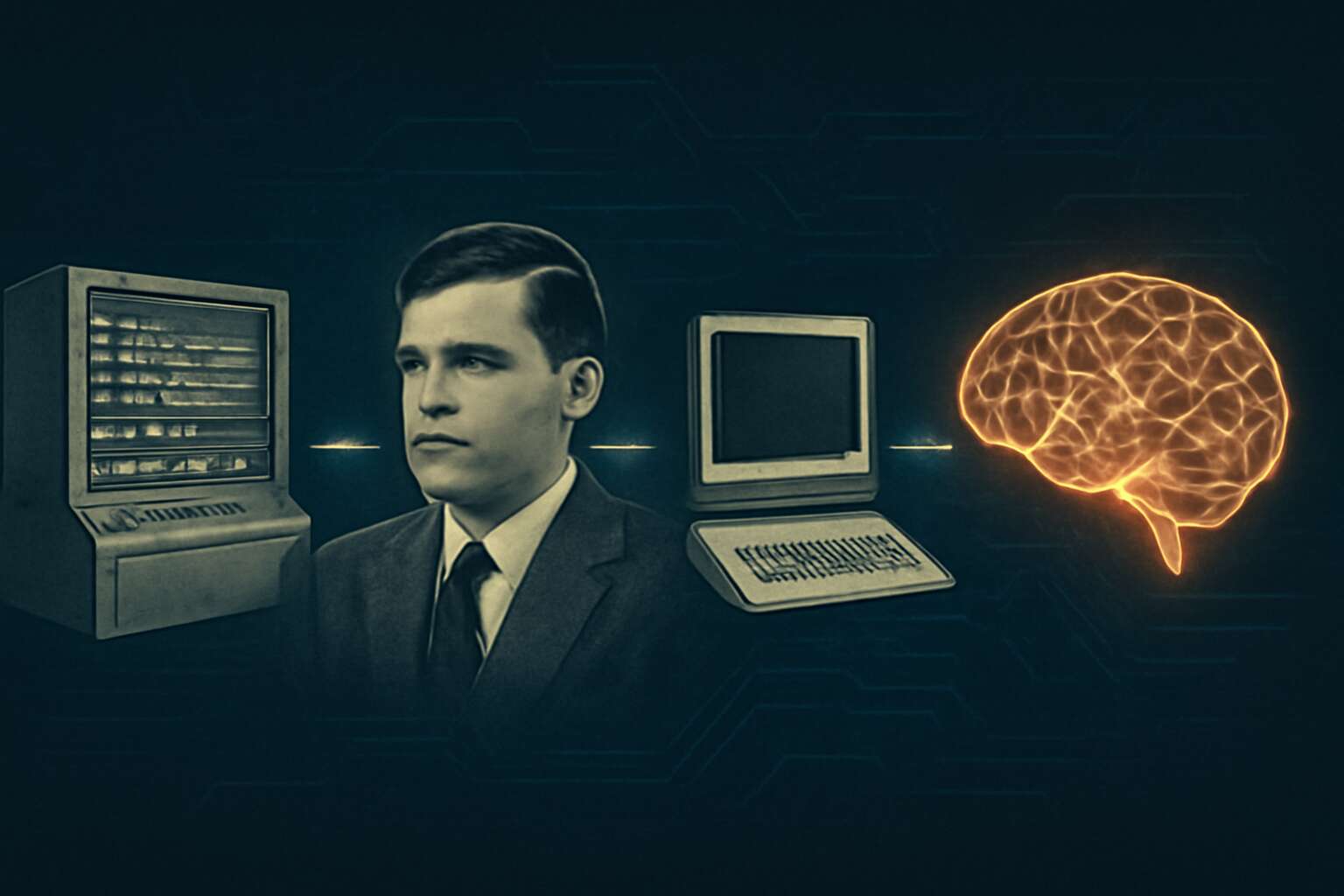
Foundations and early ideas in artificial intelligence
Pioneering ideas of machine intelligence
Across decades, the question when was artificial intelligence created has haunted laboratories and libraries. It is not anchored to one date but a tremor that began in mid‑century study halls, charged with audacity and wonder. In South Africa and beyond, that spark still hums whenever we glimpse thinking in copper and code.
Foundations were laid by dreamers who trusted logic as compass and machines as apprentices. From candlelit rooms to early laboratories, the field grew on a few big ideas:
- The power of formal logic to encode thinking
- Symbolic AI and the search for solutions
- Turing’s test and the dialogue of machines
From the Dartmouth Conference to the Logic Theorist, humble programs seeded a promenade toward autonomous thought, a lyric of bits becoming insight. The roots run deep, and in South Africa’s labs the cadence continues, patient and brave.
Early computing milestones related to AI
The foundations were laid by dreamers who treated formal logic as a compass and machines as apprentices. The question of when was artificial intelligence created is less a single date than a tremor in mid‑century study halls, where symbols and rules promised clarity. In South Africa’s labs, curiosity kept the conversation alive, turning thinking into something that could be modeled and tested.
- 1958: Lisp emerges as a practical language for symbolic AI
- 1966: ELIZA hints at human-like dialogue
- 1968: SHRDLU demonstrates language understanding in a block world
These clues flow into early computing milestones that gave form to the field: from the stored-program computer to back-propagation experiments that nudged neural ideas forward. The arc is far from tidy, but in South Africa’s universities the thread remains bright, stitching curiosity to capability.
Logic, mathematics, and the birth of AI theory
From chalkboards to silicon, the AI spark was a conversation, not a deadline. “Can machines think?” Turing asked, a question that still hums through labs, turning logic into practice. Foundations in logic and mathematics gave AI its language—clear rules, provable steps, and stubborn optimism. In South Africa, scholars watched this cross-pollination shift from theory to tangible experiments, reminding readers that theory and craft belong to the same room.
The bedrock of AI theory can be traced to these guiding ideas:
- Formal logic as compass, enabling symbol manipulation
- Mathematical foundations that framed algorithms
- Early notions of computability and proof systems
So, when was artificial intelligence created? The answer is a tremor across disciplines, not a single date. The birth of AI theory sits at the collision of logic, math, and practical curiosity—a lineage that continues to guide South Africa’s research corridors.
From symbolic AI to rule-based systems
In the candlelit labs of the early think-tanks, symbols learned to obey. Symbolic AI gathered the law of thought like moths to a lantern: crisp representations, ontologies, and rule-like finesse!
Production systems stitched knowledge into readable cloth—if-then threads that could be followed by a cautious machine’s mind. Here, the logic of deduction wore a practical cloak and walked the floors of research with a patient, spellbound tempo.
- Symbolic AI and knowledge representation
- Production rules and forward/backward chaining
- Expert systems as early practical engines
So, when was artificial intelligence created? The answer rests in a corridor where theory and tool collide—across South Africa’s universities and labs, from symbolic kings to rule-based engines that could answer questions and guide decisions. This era gave us narrow intelligences, each abiding by its own set of rules, and a haunting reminder that the first spark of AI was not a moment, but a method.
The birth of artificial intelligence and early milestones
Dartmouth Conference and formal beginnings
The dream of thinking machines didn’t erupt in a single spark; it grew from stubborn curiosity and sharp debates. The perennial question: when was artificial intelligence created? John McCarthy defined AI as “the science and engineering of making intelligent machines,” and the field gathered momentum in the 1950s.
At Dartmouth College in 1956, a spark became a strategy. The conference launched formal beginnings for AI as a discipline.
- Dartmouth Conference, 1956 — the event that birthed the AI field and popularized its term.
- Formal beginnings — researchers from diverse disciplines converged on a shared agenda, guiding early programs.
From that moment, milestones followed in quick succession, reshaping our notion of clever—yet progress kept its old-world etiquette, I must admit. Here in South Africa, universities and firms wrestle with pace and purpose with the same elegance!
Symbolic AI and expert systems
The birth of artificial intelligence wasn’t a single spark, but a patient ascent born from stubborn curiosity and lively debate. Early symbolic approaches framed problems as solvable puzzles through clear rules, while researchers tested problem-solving in constrained domains. In medicine and chemistry, expert systems translated know-how into practical decisions. The question when was artificial intelligence created still echoes in labs, a reminder that progress arrives in steady steps, not dramatic leaps!
- Symbolic reasoning and rule-based engines laid the groundwork for early AI solvers
- Expert systems like DENDRAL and MYCIN demonstrated real-world utility
From these seeds, the field matured and informs today’s tools, including how South Africa’s universities and firms approach responsible, explainable AI that fits local needs.
AI winters and rescues
The shift toward data-driven learning
Across decades, the spark of artificial minds flickered where mathematics met curiosity. The question when was artificial intelligence created resists a single date; it blooms at the crossroads of bold thinkers, early machines, and audacious experiments. In the 1950s, programs learned to play games, sketch proofs, and hint at a future where thought could be simulated.
From this birth, the path toward data-driven learning began, a sea change where intuition gave way to expectation grounded in observation. A few milestones stood as pillars.
- Perceptron era (1957)
- Backpropagation and the neural renaissance (1986)
For South Africa, data-driven learning now touches finance, wildlife conservation, and urban systems, proving that ideas travel as fast as bandwidth.
Defining artificial intelligence for diverse audiences
What constitutes artificial intelligence
Across South Africa’s bustling digital frontier, AI threads weave through business and daily life—quietly shaping decisions, services, and conversations. One in four online encounters now carries an AI strand, a statistic that hints at its enduring reach and resonance. This raises the question: when was artificial intelligence created.
Defining artificial intelligence for diverse audiences means embracing breadth and nuance. It is a spectrum—from machines that follow rules to systems that learn from data, perceive, and reason. To illuminate this, consider these facets:
- narrow AI versus general AI
- data-driven learning
- human–machine collaboration
Perhaps the most human part is the readerly moment: AI is not a single invention but a chorus of capabilities, evolving with culture, policy, and imagination. In South Africa, this definition invites schools, startups, and enterprises to greet AI as a partner in progress, not a specter.
Weak AI versus strong AI
Across South Africa’s fast-moving digital landscape, AI is not a single invention but a constellation of capabilities. The question when was artificial intelligence created emerges in classrooms and boardrooms alike. The answer isn’t a single date but a spectrum—tools that follow fixed rules and systems that learn, sense, and reason. To speak clearly to diverse audiences, many distinguish weak AI (narrow, task-bound) from strong AI (broad, adaptable)!
- Scope of tasks
- Learning and adaptation from data
- Human collaboration and oversight
Viewed this way, AI arrives as a partner in progress here—threading through schools, startups, and enterprises, shaping conversations with a distinctly human cadence.
Evaluation methods and AI tests
In South Africa’s boardrooms and classrooms, AI is everywhere but nowhere in a single glove. Defining artificial intelligence for diverse audiences means trimming jargon and highlighting capabilities people can relate to: pattern recognition, learning from data, decision support. That evergreen question—when was artificial intelligence created—tends to resurface, but the answer is a spectrum, not a date.
To speak meaningfully, we distinguish general capabilities from narrow tasks and measure progress by how AI learns, adapts, and is overseen by humans. Evaluation methods and AI tests anchor this understanding:
- Turing test: responses indistinguishable from a human conversational partner
- Task-specific benchmarks and real-world trials
- Safety, bias, and robustness assessments
In local contexts, governance-minded evaluation respects privacy, ethics, and practical impact in workplaces and classrooms alike.
Definitions in industry and academia
In South Africa’s towns and classrooms, AI is a spectrum of capabilities, not a single product. The enduring question when was artificial intelligence created often yields dates, yet practical definitions focus on what AI can do now: patterns in data, decision support, and learning tools. For diverse audiences, stripping jargon and tying ideas to everyday impact—efficiency, safety, trust—helps everyone read the signals.
Definitions in industry and academia exist side by side.
- Industry defines AI as systems that automate tasks, analyze data, and support decisions.
- Academia frames AI as algorithms that learn from data, adapt to new problems, and are evaluated for reliability and safety.
In practice, these definitions guide how we discuss AI’s progress in South Africa’s workplaces and schools, keeping the conversation human-centered and governance-aware.
Rise of machine learning and neural networks
From perceptrons to backpropagation
Across borders and boardrooms, AI spending now tops tens of billions, and South African startups are using machine learning to optimize energy grids and finance. The rise of neural networks feels almost cinematic—a quiet, relentless evolution from curiosity to cornerstone. The question when was artificial intelligence created remains a thread woven through decades.
From simple perceptrons to multi-layer learners, the leap hinged on a single insight: learning happens by adjusting weights across layers.
- Perceptrons and their linear limits
- Backpropagation unlocking deep learning across layers
In labs and on startup floors, I watched data, error signals, and persistence transform theory into practice. The echo of early experiments powers today’s tools, and the story still pulses with a hint of the supernatural in the code!
Neural networks revolution and modern AI
The question when was artificial intelligence created still lingers in investor briefings and coffee-stained notebooks. Rise of machine learning and neural networks has turned quiet curiosity into a global enterprise, a revelation felt in Cape Town labs and Sandton boardrooms alike. Modern AI moves with a patient, cinematic tempo—data, pattern, iteration—until the line between dream and tool blurs. In South Africa, startups are applying this current to energy grids and finance, proving the dream is architectural, not anecdotal.
- data abundance fueling learning at scale
- accelerated computation turning experiments into products
- open-source tools and collaborative ecosystems powering local innovation
Neural networks revolution and modern AI arrive as a tapestry of gradients and guided discovery. The shift is not spectacle but steady refinement, turning raw input into insight with elegance and grit. The result is a kinder future—systems that learn from experience, adapt, and cooperate with people without erasing the human touch.
The impact of data and compute power
Today the world generates 2.5 quintillion bytes of data each day, a flood that lets neural nets learn in real time. The rise of machine learning has turned quiet curiosity into a global enterprise, felt in Cape Town labs and Sandton boardrooms alike. That question—when was artificial intelligence created—haunts investor briefings, even as data and compute pull the discipline forward with a patient, cinematic tempo.
- Volume of data fuels deeper pattern discovery at scale
- GPUs and cloud compute accelerate experiments into production
- Open-source ecosystems empower local teams to innovate
In South Africa, this shift glints through energy grids and fintech, where models adapt to local rhythms and challenges. The arc is not a blaze but a wind—steady, elegant, capable of cooperation with people while preserving the human touch!
The modern era and present-day AI chronology
Key dates in AI development timeline
The modern era unfurls like a city of glass; the future is already here—it’s just not evenly distributed. Data rivers run and compute hums beneath the pavement as machines learn by example and adapt with a quiet, almost alchemical grace. People ask when was artificial intelligence created; the answer is a long twilight turning into sunrise, forged by decades of curiosity and cross-border collaboration. In South Africa and beyond, businesses weave this rhythm into daily decisions.
- 1997 — Deep Blue defeats Kasparov, a landmark that moved machines from novelty to strategy.
- 2012 — AlexNet ignites a data-driven revolution in vision and beyond.
- 2017 — Transformer architecture redefines language, enabling scalable, context-aware learning.
- 2020s — Generative models and large-scale systems reshape creativity, planning, and automation.
As the present unfolds, the line between tool and partner blurs, steering enterprises toward imaginative, responsible use of AI in life.
AI across sectors and applications
Across a city of glass and data rivers, 80% of large SA firms now pilot AI in some form, reshaping decisions from boardroom glare to hands-on intuition. The question of when was artificial intelligence created still haunts the corridors of research and business; the answer is a slow, spectral ascent born of decades of curiosity and cross-border collaboration.
Today, AI travels across sectors and applications, weaving insight into daily operations and steering strategy. In this present chronology, results emerge in quiet ways:
- Healthcare: diagnostics, medical imaging, and personalised care
- Finance: risk scoring, fraud detection, and automated advisory
- Manufacturing and energy: predictive maintenance, demand forecasting, and grid optimization
As the modern era matures, the line between tool and partner blurs. We move toward imaginative, responsible use that respects privacy, governance, and human oversight—an unseen rhythm guiding South Africa’s digital future.
Current challenges and ethical considerations
AI in the modern era is no longer a rumor in a lab; it’s a daily partner across boards and clinics. In South Africa, 80% of large firms now pilot AI in some form. “when was artificial intelligence created” remains a debated refrain as machines shadow human judgment and quietly sharpen strategy.
Current challenges and ethical considerations are the real test: privacy, bias, explainability, accountability, and workforce impacts in SA.
- Privacy by design and robust data governance
- Fairness, bias mitigation, and inclusive outcomes
- Transparency, explainability, and clear accountability
- Workforce transition and upskilling for resilience
As this rhythm deepens, governance, privacy, and human oversight remain the compass, not an afterthought.
Future outlook and ongoing research
AI in the modern era isn’t a lab rumor; it’s the day-to-day ally in South Africa’s boardrooms and clinics. Numbers back it up: pilots turn into policy, dashboards into decisions. And yes, the perennial question—when was artificial intelligence created—keeps surfacing as machines shadow human judgment and quietly sharpen strategy.
Looking ahead, research will chase smarter, safer horizons for every SA sector.
- Edge-ready, data-efficient models that run locally in devices and clinics
- Open, auditable benchmarks and transparent evaluation for trust
- Homegrown SA AI ecosystems, skills uplift, and data sovereignty
The chronicle continues, with governance, collaboration, and curiosity as the compass—no wishful thinking, just real-world grit.




0 Comments