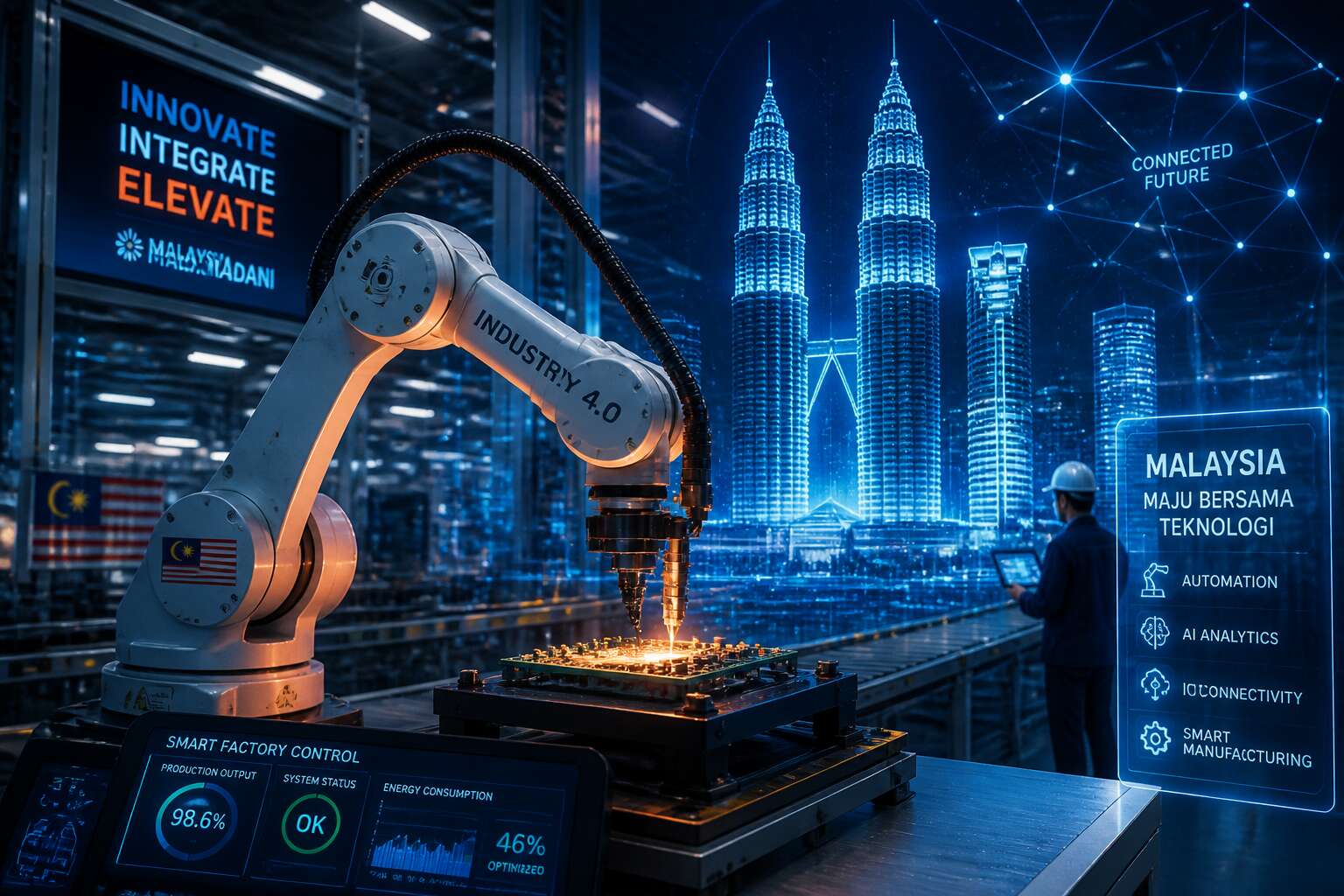
Understanding 4IR in the Malaysian Context
Defining the Fourth Industrial Revolution: Key Technologies and Concepts
Malaysia spends billions on automation and data, yet its 4IR story remains underreported. The national strategy, Industry4WRD, pushes 500 small and medium enterprises into digital transformation by 2025. That is a specific target, not a vague aspiration.
Key technologies underpin this drive. IoT sensors monitor palm oil estates, artificial intelligence forecasts export demand, and robotics handle precision manufacturing. These tools converge to address local conditions.
- IoT for real time crop monitoring
- AI for market demand prediction
- Robotics for assembly line flexibility
For a South African audience, 4ir malaysia shows how a middle income nation can bypass infrastructure gaps through targeted policy. The lesson is to adapt core concepts, not copy them outright.
Why 4IR Matters for Malaysia: Economic Ambitions and Regional Positioning
Malaysia’s drive for 4ir malaysia is not a policy experiment. It is a survival strategy. The nation occupies a middle position between China’s manufacturing concentration and Singapore’s financial infrastructure. To avoid losing relevance, Kuala Lumpur uses its export capacity and a workforce already experienced in semiconductor fabrication.
Regional positioning means more than trade routes. Malaysia aims to become a reference point for ASEAN’s digital economy. The government has allocated resources toward high value logistics and data governance. This yields three observable priorities:
- Strengthening its role in global electronics supply chains
- Building cross border data corridors with neighbours
- Retaining skilled talent against regional competition
For South Africa, the lesson is about sequencing. Malaysia’s ambitions are calibrated to its geographic advantages. That is the uncomfortable part. We must define our own version of what 4ir malaysia represents, not imitate its targets.
The Evolution from 3IR to 4IR: Malaysia’s Industrial Journey
Malaysia’s export economy was built on the hardware logic of the Third Industrial Revolution. That era achieved volume. The present era demands intelligence. The transition to 4ir malaysia is a deliberate reengineering of production systems, not a simple upgrade. Observe the practical agenda inside the shift:
- Replacing linear assembly lines with sensor driven feedback loops.
- Shifting skilled labour from routine tasks to data interpretation.
- Rebuilding logistics networks around predictive analytics.
Each phase preserves the original industrial strengths while changing how decisions are made on the factory floor. The silicon wafer remains central, but its value now extends to the software reading it.
Demographic and Market Drivers Shaping Adoption in Malaysia
Malaysia’s median age sits below 30, a rarity among upper middle income economies. In my view, that demographic reality shapes how 4ir malaysia takes root. Young engineers expect data dashboards, not paper logs. Market drivers reinforce this shift.
Consider the domestic market: over 30 million people, densely urbanized, with smartphone penetration above 80 percent. These conditions make predictive logistics viable. For factories in Penang or Johor, the competitive pressure comes from regional neighbours.
Several forces accelerate adoption:
- Urban labour pools concentrated in industrial corridors
- Government funded upskilling programs targeting automation
- Export oriented firms facing stricter efficiency benchmarks
The result is an adoption curve that adapts quickly because the population and markets already move at digital speed.
Government Initiatives and Policy Frameworks Driving 4IR
Industry4WRD: The National Policy on Industry 4.0
Malaysia launched Industry4WRD in 2018 with a clear target: bring 500 small and medium enterprises into smart manufacturing within five years. I find the policy’s pragmatism refreshing. It begins with digital readiness assessments, so firms understand their starting point before spending on automation. The government also offers tax incentives for companies adopting connected machinery.
Support programs center on three pillars:
- Smart manufacturing adoption
- Workforce reskilling through dedicated academies
- Financial assistance for technology upgrades
The Human Resource Development Fund channels resources specifically for Industry 4.0 training. The Readiness Center provides diagnostic tools to manufacturers across Penang, Johor, and the east coast states. This spread matters because 4ir malaysia cannot succeed if policy only benefits the Klang Valley. The framework acknowledges regional differences and adjusts support accordingly. For South African readers watching ASEAN’s digital push, Industry4WRD offers a concrete example of national coordination around 4ir malaysia.
Malaysia Digital Economy Blueprint and Its 4IR Roadmap
Malaysia’s digital push extends well beyond Industry4WRD. MyDIGITAL, the national digital economy blueprint, sets a clear target: digital economy contributions reaching 22.6 percent of GDP by 2030. That is a bold number!
The 4IR roadmap translates that ambition into manufacturing milestones:
- interoperable data standards across supply chains
- cybersecurity frameworks for industrial IoT sensors
- regional talent pipelines outside the Klang Valley
I see this as policy with direct delivery mechanisms. For South African manufacturers, the key observation is that 4ir malaysia succeeds when agencies share responsibility for outcomes. The entire framework depends on this coordination.
The Role of MIDA and Investment Incentives for Smart Manufacturing
MIDA reviews every significant smart manufacturing project in Malaysia. The Malaysian Investment Development Authority administers the tax incentives behind 4ir malaysia, giving policy a direct financial expression.
Investors automating production can access:
- capital allowances on robotics and industrial IoT sensors
- tax exemptions for high-technology manufacturing
- import duty relief on digital machinery
These incentives carry conditions. Recipients must meet the data interoperability standards and cybersecurity expectations set by the national roadmap. I find that conditionality instructive. Malaysia does not hand out tax relief without demanding alignment.
National IoT and AI Frameworks Supporting Digital Transformation
The National IoT Strategic Roadmap anchors Malaysia’s approach to connected infrastructure. It establishes interoperability protocols that allow industrial sensors, logistics trackers, and public utility grids to share data without proprietary constraints. The National AI Framework addresses ethics, security, and talent development. Together, these instruments define the technical boundaries of 4ir malaysia.
Several elements characterise this policy architecture:
- A certification system for IoT devices entering the Malaysian market
- Mandatory data privacy impact assessments for AI deployments in public services
- Requirements for government agencies to publish open data sets from digital initiatives
Public sector bodies must demonstrate measurable digital adoption against these standards. Private companies that align their systems gain preferential access to government pilot projects. The result is an evolving regulatory environment where policy directives respond directly to real-world implementation data.
Infrastructure Buildout: 5G Rollout, Data Centers, and Smart Cities
Malaysia’s 5G rollout has moved with unusual speed. The national network, built through a single wholesale model, now reaches over 80% of populated areas. This shared infrastructure approach lowers entry costs for enterprises exploring 4ir malaysia applications.
Data center investment follows a similar pattern. Government land grants and streamlined approvals have attracted regional cloud providers to Johor and Selangor. Smart city pilots in Kuala Lumpur and Penang link traffic systems, waste collection, and flood sensors into one operations platform.
- Spectrum allocation tied to rural coverage obligations
- Green building standards for new data centers
- Open API requirements for municipal platforms
These policy levers shape how private capital deploys across the country.
Impact of 4IR Across Key Malaysian Industries
Manufacturing and Electronics: Smart Factories and Automation
Malaysia’s electronics exports exceed RM400 billion annually, but the significant change is happening inside factory walls. Automation has moved past the experimental stage. For manufacturers on the ground, the production line now runs on data streams and robotic arms that learn from every cycle.
The shift is visible in Penang’s industrial parks. Smart factories are deploying adaptive robots that switch between tasks with minimal reprogramming. I recently spoke with a plant manager who described how sensors on his CNC machines flag wear before a breakdown occurs. That awareness saves hours of unplanned stoppage.
- Real time monitoring reduces energy use in high heat processes
- Automated guided vehicles move components between stations without collisions
- Edge computing lets machines make split second decisions without cloud latency
Electronics assembly is particularly suited to this transformation because precision matters. A single misaligned chip can ruin an entire batch. By integrating vision systems and closed loop controls, producers under the 4ir malaysia agenda are achieving yield rates that seemed impossible a decade ago.
Palm Oil and Agriculture: Precision Farming and IoT Integration
In Malaysian oil palm estates, the internet of things is rewriting the rules of plantation management. Soil sensors measure moisture and nutrient levels across thousands of hectares, sending data to central dashboards that guide irrigation and fertiliser schedules.
I have seen estates where drones scan canopy health, spotting fungal infections before they spread. This is 4ir malaysia in action, turning age old agricultural practices into precise operations. The outcomes speak clearly:
- Aerial imaging reduces labour costs.
- Automated irrigation cuts water usage by 30 percent.
- Yield predictions improve with machine learning.
Higher yields with fewer inputs, and that matters as global demand for sustainable palm oil grows!
Oil, Gas, and Energy: Digital Twins and Predictive Maintenance
Malaysia’s oil and gas platforms run on a simple premise: breakdowns are expensive. Digital twins now mirror every valve and vessel in real time, so problems announce themselves before they become emergencies. Predictive maintenance schedules repairs with surgical precision. This is 4ir malaysia, though no one on the rig calls it that. They call it staying ahead of the leak. One operator trimmed unplanned downtime by a third in the first year. The financial picture responds accordingly:
- Maintenance budgets shrink by roughly 25 percent.
- Asset lifecycles extend well beyond original engineering estimates.
- Worker exposure to hazardous inspection areas drops significantly.
Energy executives now treat operational data as a core commodity, one that pays dividends in every barrel produced.
Healthcare: Telemedicine, AI Diagnostics, and Digital Records
Hospitals in Kuala Lumpur now triage patients with algorithms before a doctor touches a stethoscope. Telemedicine consultations grew fourfold after the pandemic, and the backlog in public clinics has eased noticeably. AI diagnostics read chest X-rays for tuberculosis with accuracy that rivals senior radiologists. Digital records follow patients across facilities, ending the old habit of carrying faded paper folders. The shift shows up in everyday outcomes.
- Waiting room times have dropped sharply.
- Rural patients consult specialists without six hour bus rides.
- Data entry errors have become a rare event.
None of this required a grand rebranding. 4ir malaysia simply means the system finally works for the people who need it most. The Ministry of Health calls it digital transformation. Nurses call it getting home before midnight.
Financial Services: Fintech, Digital Banking, and Blockchain
Malaysia’s financial sector outpaces its own regulations! Digital banks now serve customers who never visited a physical branch. The central bank approved five digital bank licenses, and three have already launched operations. Payment giants process millions of transactions daily across the region. This momentum stems from 4ir malaysia policy direction.
Blockchain technology settles cross-border trades in minutes instead of days. Fintech startups in Kuala Lumpur raised RM 2 billion in venture funding. Traditional banks respond by building their own digital arms.
Here is what changed:
- Account opening dropped from five days to five minutes
- Loan approvals use alternative credit scoring for gig workers
- Islamic finance contracts execute through smart contracts
The old banking model depended on physical presence. 4ir malaysia rewrites that assumption through data, automation, and distributed ledgers. Financial inclusion numbers tell the story. Millions of unbanked Malaysians now hold e wallets. The central bank’s interoperability push keeps incumbents innovating.
Logistics and E-Commerce: Autonomous Vehicles and Smart Warehousing
Malaysia’s highway of commerce now moves with software. Autonomous forklifts glide through darkened warehouses, reading barcodes from any angle. Delivery vans near Shah Alam test self-driving routes, guided by lidar and live traffic data. The results appear in quieter depots and faster turnaround times:
- Inventory counts that take minutes, not weekends
- Predictive routing that avoids congested toll plazas
- Cold chain sensors that flag temperature drift instantly
Smart warehousing turns storage into strategy. I find one detail remarkable: sellers in Johor ship to Sabah without touching a box. For South African readers watching this shift, the pattern is clear. 4ir malaysia rewrites physical supply chains.
Challenges and Barriers to 4IR Adoption in Malaysia
SME Readiness: Funding, Expertise, and Technology Access
Most Malaysian SMEs recognise the promise of 4ir malaysia, yet the path to adoption remains steep. Capital constraints top the list of obstacles. Upgrading legacy machinery to smart systems demands investment that many smaller firms cannot secure from traditional lenders.
Funding hurdles appear in several forms:
- High upfront costs for hardware and software
- Limited access to venture capital or government grants
- Uncertain return on investment timelines
Expertise presents an equally stubborn barrier. Digital literacy is uneven across the workforce, and few SMEs employ staff who can implement or maintain Industry 4.0 solutions. Access to affordable technology compounds the problem. Advanced sensors, cloud platforms, and cybersecurity tools carry costs that stretch modest operational budgets.
The result is a widening gap between large enterprises and the SME sector, one that policy interventions must address directly.
The Digital Talent Gap: Skills Shortage and Workforce Retraining
Malaysia produces thousands of engineering graduates each year, yet many factories cannot find workers who can program a robotic arm! That gap is not about intelligence. It is about curriculum lag. Most universities still teach mechanical systems, not cyberphysical integration. I have seen plants where employees distrust digital sensors because no one trained them to verify that data.
As 4ir malaysia accelerates, retraining programs remain piecemeal. Companies report that retraining consumes months, and employees struggle to apply abstract concepts on the production floor. The missing link is practical mentorship.
Typical barriers include:
– Outdated technical curricula
– Low enrollment in computer science programs
– Brain drain of skilled workers to higher paying nations
Without a national effort to reskill midcareer technicians, 4ir malaysia will remain a promise for the few, not the many.
Infrastructure Limitations: Connectivity and Data Sovereignty Issues
A factory in Penang streams terabyte-scale sensor data in milliseconds, but a supplier two hours away still relies on intermittent broadband. That disparity defines the real barrier to 4ir malaysia.
Data sovereignty compounds the problem. Global cloud providers host Malaysian manufacturing data on servers outside the country, and cross-border transfer rules remain ambiguous. I have watched companies hesitate to upload proprietary production data, and that hesitation stalls AI adoption and real time analytics.
Common pain points include:
- Uneven 4G and 5G coverage across industrial zones
- High latency in rural supply chain nodes
- Conflicting data residency requirements for foreign owned plants
South African industrialists tracking 4ir malaysia will see familiar friction; patchy networks and sovereignty debates slow adoption long before capital becomes an issue.
Regulatory Hurdles: Cybersecurity, Data Privacy, and Compliance Standards
“We were ready to invest, but the regulations moved slower than our machines,” a factory manager in Johor told me. That quote captures the regulatory fatigue stalling 4ir malaysia. Cybersecurity rules under the Personal Data Protection Act clash with cross border transfer demands, leaving foreign owned plants in a compliance bind.
Malaysian authorities enforce separate standards for data privacy and cybersecurity, yet no unified framework exists for industrial IoT. One plant must satisfy its headquarters in Singapore and local auditors simultaneously. The result is duplicated effort and delayed rollouts!
- Ambiguous rules on cross border data flows
- Overlapping oversight from multiple agencies
- Certification costs that hit small suppliers hardest
South African industrialists will recognize that friction; capital is ready, but paperwork becomes the silent obstacle for 4ir malaysia.
Future Outlook and Strategic Opportunities for Malaysia
The Rise of AI and Advanced Robotics in Malaysian Production
Malaysian production is entering a phase where AI and robotics converge. The next wave of 4ir malaysia depends on machines that learn and adapt in real time. I see advanced robotics moving beyond repetitive tasks into predictive maintenance and quality control.
Strategic opportunities emerge in three areas:
- Collaborative robots working alongside skilled technicians
- AI driven supply chain optimization
- Edge computing for latency sensitive manufacturing
These shifts demand new investment models and cross sector partnerships. Malaysian producers who embrace this evolution will define regional standards, while those who hesitate risk obsolescence. The path forward requires deliberate action today!
Green 4IR: Sustainable Manufacturing and the Net-Zero Ambition
Malaysia cannot reach net-zero by 2050 without 4IR technology adoption. The Green Technology Master Plan pushes manufacturers toward carbon-neutral production, but execution is the open question. Renewable energy integration, carbon capture pilots, and circular economy models are operational mandates now, not future possibilities.
Three strategic opportunities define the green manufacturing shift within 4ir malaysia:
- Industrial electrification using solar and hydro microgrids
- AI-driven energy management systems for real-time consumption tuning
- Closed-loop waste-to-resource systems with IoT tracking
Policy now links smart factories to sustainable production. Regional observers, including South African manufacturers, will need to decide whether they watch or engage.
Positioning Malaysia as a Regional 4IR Hub in Southeast Asia
Malaysia’s ambition to become Southeast Asia’s 4IR hub rests on a narrow window of execution. The country hosts over 700 regional headquarters for global tech firms, and data center capacity is growing nearly 30% annually. That momentum draws investment from neighboring markets.
For South African manufacturers, the question is whether we observe or participate. Malaysia offers a testbed for cross-border automation standards, regional AI governance pilots, and integrated logistics corridors. These are operational opportunities tied to investment pathways, not abstract policy documents.
Strategic opportunities ahead:
- Regional AI training datasets localized for ASEAN languages
- Cross-border smart grid interoperability trials
- Harmonized data sovereignty rules for multinational manufacturers
These positions within 4ir malaysia link East Asian supply chains to emerging African markets.


0 Comments