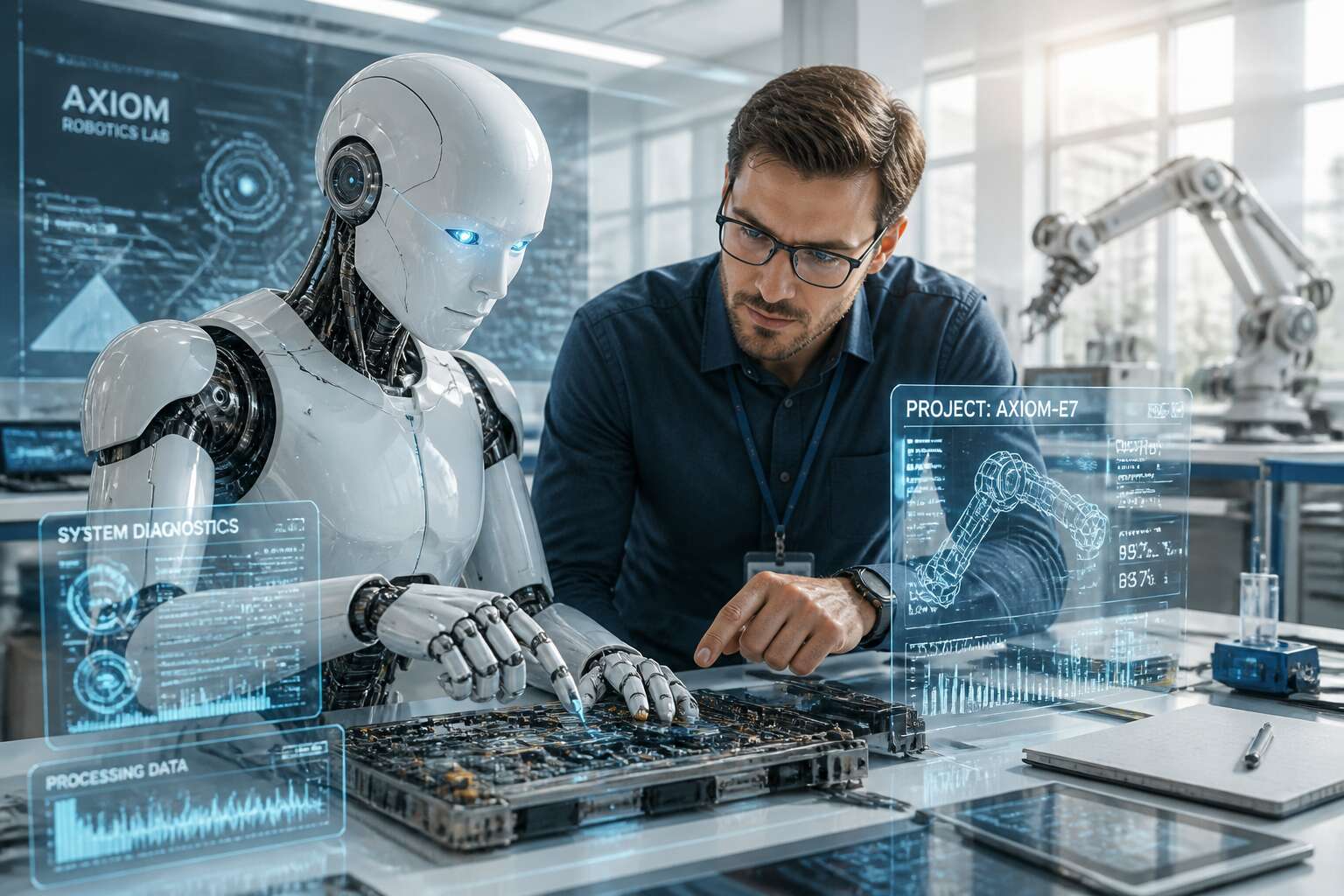
The Convergence of Machine Intelligence and Mechanical Systems
Defining the Interdisciplinary Field
In South Africa, the fusion of artificial intelligence with robotics is no longer a distant prospect. It is happening on factory floors in Gauteng and in agritech hubs in the Western Cape. The interdisciplinary field demands engineers who grasp neural networks and programmers who respect torque limits.
Consider the practical realities!
- Sensor fusion must handle load shedding interruptions.
- Edge computing reduces latency in remote mining operations.
- Safety protocols require human oversight at every stage.
The convergence of machine intelligence and mechanical systems redefines what we build. We are moving past simple automation into adaptive behaviour. In this shift, the machine learns from its environment and adjusts its movements accordingly. For our industries, this means fewer breakdowns and more predictable output.
How AI Transforms Traditional Robotics
In South Africa, the shift from fixed automation to adaptive machinery is measured in fewer breakdowns and steadier output. Traditional robots repeat the same motion until something fails. Artificial intelligence with robotics changes that relationship entirely. The machine observes its own performance, learns from deviations, and adjusts its next move without waiting for a programmer.
The practical result is a system that monitors stress, wear, and environmental changes in real time. A welding arm in a Gauteng plant can detect a slight misalignment and correct its path mid-task. That is the convergence of machine intelligence and mechanical systems.
This unlocks specific improvements:
– Predictive maintenance before a breakdown halts production
– Quality control that samples every unit instead of a random few
– Safer collaboration between humans and machines
These are incremental gains, but they accumulate quickly. South African industries are already adapting.
The Role of Machine Learning in Autonomy
Machine learning grants a robot something close to judgement. Fixed programming demands a rule for every scenario, but learning systems build responses from raw sensory data. A mobile unit in a Durban warehouse no longer needs a perfect map. It constructs one from each pass, marking obstacles and shortcuts as it moves.
At this point, artificial intelligence with robotics stops being a demonstration and becomes an operating principle. Consider what machine learning actually enables:
- Navigation through spaces that change daily, without a human redrawing the path.
- Manipulation of objects that arrive in unpredictable shapes.
- Coordination of multiple machines sharing one floor without collision.
Each capability removes a layer of human supervision. We see this shift in South African facilities daily. The machine becomes less a tool and more a partner, one that never tires. That is the difference between responding to problems and preventing them.
Core Technologies Enabling Intelligent Robotics
Computer Vision and Perception Systems
Computer vision gives robots sight. Perception systems give them understanding. Processing raw pixels into actionable knowledge is a difficult task, requiring object recognition, spatial mapping, and scene interpretation.
For artificial intelligence with robotics, this is where sensing meets decision making. A robot in a busy factory needs more than a single camera. It requires depth sensors, lidar, and algorithms that combine multiple inputs into one reliable spatial model.
Perception technologies can be grouped into several categories:
- Convolutional neural networks for feature extraction
- Simultaneous localization and mapping for environmental tracking
- Stereo vision for distance measurement
South African operations rely on these systems for mining conveyor inspection and fruit grading. Dust, intense sunlight, and rough terrain place unusual stress on vision hardware. Engineers here adapt perception models to handle these conditions, making the technology more resilient for everyone!
Real machines already work this way. Autonomous loaders and sorting arms depend on robust perception to function without constant human input.
Natural Language Processing for Human-Robot Interaction
Natural language processing lets operators speak to machines directly. A control room supervisor in Gauteng can issue verbal commands to a sorting robot without touching a console. The robot parses the instruction, maps it to an action, and confirms execution in real time. I have seen operators adapt to voice controlled systems within days.
Speech recognition is only the first layer. The system must handle accent variation, ambient noise, and domain specific vocabulary. South African English, Afrikaans, and isiZulu speakers use different terms for the same machine action. Engineers train language models on local speech patterns to improve accuracy.
Semantic understanding goes further. The robot distinguishes between “move the arm left” and “check the left conveyor belt.” Both sentences share words, but they demand completely different responses. This requires intent classification and context tracking, which makes artificial intelligence with robotics more practical on factory floors and in mine control rooms.
Reinforcement Learning in Robotic Control
Reinforcement learning turns robots into trial-and-error problem solvers. Engineers define a reward signal instead of programming every motion. The robot explores its joint space to find which movements succeed. A robotic arm learns to pick castings from a Johannesburg conveyor with no hand coded logic.
The training loop is demanding. Simulated episodes run overnight to teach the policy edge cases. On the physical floor, friction or alignment variations no longer break it. The policy adapts because it saw the anomalies in simulation.
Key enablers:
- Dense reward shaping with feedback every few milliseconds
- Domain randomisation that forces the policy to ignore visual noise
- Safe exploration constraints that prevent damage to the robot and workers
I have watched systems refine grip pressure on citrus sorting lines in the Cape. Each batch of fruit improves the controller. That is artificial intelligence with robotics operating without human intervention.
This is artificial intelligence with robotics at its most direct!
Sensor Fusion and Real-Time Data Processing
Sensors give a robot its perception of the world. Without them, the most sophisticated arm is an inert assembly of motors and gears. The real work begins when lidar, thermal cameras, force-torque sensors, and inertial measurement units feed one controller. Sensor fusion stitches these streams into a single coherent picture. In a Gauteng warehouse, that means telling a steel pallet apart from a worker who walked into the aisle.
Real-time data processing turns those fused streams into action. The robot interprets signals within milliseconds. Any delay degrades the operation. This is where artificial intelligence with robotics becomes genuinely responsive. Edge computing handles the heavy processing on board, so the machine does not wait for a cloud server to make up its mind. I have seen robots on Durban docks adjust their grasp mid-motion when a crate shifted slightly. That responsiveness is the quiet achievement of the whole discipline.
Edge AI and On-Device Intelligence
Edge AI relocates machine intelligence from distant data centres into the machine itself. A robot with its own inference engine does not require a stable network to think. That matters on a South African mine site or a coastal port where connectivity falters.
The operational benefits are concrete:
- Latency drops because the decision loop runs in microseconds, not round trips.
- Bandwidth costs shrink when raw video never leaves the device.
- Sensitive data stays on site, which simplifies compliance and corporate discretion.
On-device intelligence also expands what artificial intelligence with robotics can achieve. A robot refines its responses with local production data, improving without central oversight. I have seen South African manufacturers benefit from letting their machines act on insights that never leave the factory floor.
Real-World Applications Across Industries
Manufacturing and Industrial Automation
The robotic arms on South African production floors no longer repeat fixed motions. They respond to variance in real time, adjusting force and speed as materials arrive. I have seen this shift transform how plants handle custom orders! Artificial intelligence with robotics changes the economics of manufacturing, because a single line now produces hundreds of variants without manual reprogramming.
Examples from industrial plants:
- Automated inspection that catches porosity in castings
- Adaptive torque control for different alloy grades
- Dynamic routing of pallets between workstations
Each cycle feeds data back into the system, refining the next move. Scrap rates fall, throughput climbs, and human workers focus on exception handling.
Healthcare and Surgical Robotics
The operating theatre no longer belongs solely to the human hand. In South African hospitals, artificial intelligence with robotics helps surgeons navigate sensitive tissue with submillimetre precision. One system I observed adjusts its instrument path mid-procedure, compensating for micro-movements from the patient’s breathing. These platforms do not replace clinical judgement; they extend it.
Consider the everyday benefits:
- Preoperative planning built from CT and MRI data
- Real-time tremor filtering during delicate dissections
- Automated suturing that maintains consistent tension
Each of these functions requires artificial intelligence with robotics to interpret live signals and respond within milliseconds. For patients in rural areas, the implications are profound. Remote-controlled surgical units, guided by AI, could soon bring specialist care to facilities where no specialist exists. That is the quiet revolution unfolding in operating rooms.
Logistics and Autonomous Delivery
In South Africa, logistics companies lose billions each year to route inefficiency. Artificial intelligence with robotics now addresses this waste directly. Autonomous delivery vehicles process traffic patterns, weather shifts, and loading bay queues in real time.
What does this mean for a distributor in Johannesburg?
- Dynamic rerouting around load-shedding blackouts
- Robotic sorting arms that identify damaged parcels by acoustic signature
- Drone dispatch to remote farms where gravel roads stall conventional trucks
These systems adapt to each district’s patterns. A fleet manager I consulted described how AI-driven units predict delivery windows within eleven minutes, down from a full afternoon. The hardware matters, but the intelligence embedded in it transforms idle capacity into precision.
Agriculture and Environmental Monitoring
South African farms lose nearly a third of their yield to undetected soil stress. Artificial intelligence with robotics changes that calculus. In the Western Cape, autonomous ground units sample soil moisture at depths humans cannot easily reach, while overhead drones map canopy health across thousands of hectares.
Consider what this means for environmental monitoring:
- AI-driven sensors detect early signs of root rot before visible wilting
- Robotic pollinators compensate for declining bee populations in orchards
- Autonomous water monitors track borehole levels during drought cycles
The intelligence embedded in these systems learns each farm’s phenological cycles. I spoke with a conservationist in Limpopo who now predicts invasive plant spread with eighty percent accuracy, up from a blind guess. One orchard cut irrigation water by a third without losing a single tree! This is applied intelligence for the land itself.
Service Robotics in Hospitality and Retail
At a Johannesburg hotel, a robot butler delivered champagne to the wrong room. It apologized in three languages. The guest kept the bubbly and tipped the machine. This is service robotics in South Africa, where artificial intelligence with robotics handles the repetitive chores humans loathe, minus the staff-room gossip.
Retail bots now count stock overnight, so floor staff answer real questions instead of hunting for size eight sneakers. The hospitality sector deploys them for:
- luggage hauling that once strained backs
- room service delivery with GPS precision
- lobby queue management during peak season
None of this replaces the concierge’s warmth. Yet artificial intelligence with robotics makes these systems cheaper than a single complaint call from an irritated guest.
Exploration in Hazardous Environments
The deepest gold mine on Earth yawns beneath South Africa’s Free State. At 4 kilometres down, rock temperatures exceed 60 degrees Celsius. No human can work there for long. But artificial intelligence with robotics can. A machine with thermal vision and a hydraulic arm crawls through the stopes, measuring stress fractures and gas seepage while the shift boss watches from a surface console. This is exploration in hazardous environments, executed by systems that treat a collapsed tunnel as navigable terrain.
Consider the deployments already running:
– Mine rescue units use snake-like bots to slither through collapsed shafts
– Underwater drones inspect leaking pipelines off Durban’s coast
– Firefighters deploy heat-shielded crawlers into burning structures
Each machine carries sensors humans cannot wear. Each one decides without waiting for a command. The human operator simply sets the boundary. Artificial intelligence with robotics manages the risk beyond that line.
Challenges and Ethical Considerations in AI-Powered Robotics
Safety and Reliability in Unpredictable Settings
Unpredictable settings remain the gravest test for autonomous systems. A machine that performs flawlessly in a lab can freeze when rain distorts its sensors or when a child crosses its path. These moments expose the fragility of artificial intelligence with robotics. Reliability demands more than faster processors; it requires judgment that mirrors human caution.
Ethical accountability grows murky when machines make split second decisions. Who bears responsibility when an autonomous system harms someone in a chaotic, real world environment? The programmer, the manufacturer, or the algorithm itself?
Key concerns include:
– The opacity of deep learning models
– Bias embedded in training data
– The erosion of meaningful human oversight
South African developers contend with load shedding and uneven infrastructure. Safety cannot remain a theoretical exercise. It must be tested against the unpredictability of everyday life.
Job Displacement and Workforce Transformation
The night shift never ends for a machine. Across South Africa, artificial intelligence with robotics is quietly taking positions that once anchored households, from sorting packages to monitoring production lines. The transformation is not a future event. It is occurring now, and the people displaced by it rarely receive a warning.
Ethical accountability lags behind the technology itself. Who owns the obligation to retrain a worker whose entire industry evaporates? Who absorbs the loss when a town’s primary employer automates? The answers are often vague, and vagueness protects those who already hold power.
- Skills perish faster than training programmes can replace them
- Safety nets assume a working pattern that no longer exists
- Worker voices are absent from the design of their own replacement
The true measure of artificial intelligence with robotics is what it takes from those who cannot adapt, and what it gives to those who own it.
Bias and Fairness in Decision-Making Algorithms
An algorithm in Johannesburg denied a loan to a qualified applicant based on a postal code proxy. This is not a malfunction. It is the intended logic of a system trained on unequal data. Artificial intelligence with robotics inherits the biases of its creators, then amplifies them at scale.
Fairness in decision-making algorithms is not a technical problem. It is a legal, social, and moral one. When a robot sorts résumés or a system flags fraud, it uses a definition of normal that excludes entire communities.
- Training data reflects historical discrimination
- Models are rarely tested for disparate impact
- Grievance mechanisms are almost nonexistent
The burden of proof sits with the accused, not the algorithm. We cannot assume neutrality where data itself carries the scars of policy.
Privacy and Data Security Concerns
The privacy risk in artificial intelligence with robotics is not remote. A warehouse robot in Gauteng scans pallets, but it also logs the movements of every worker on the floor. The camera sees faces. The sensors record biometric data. That information flows to a server, and nobody has asked whether it should.
Data security here is a persistent weakness. Most robotic systems were built for speed, not for defending what they collect. A compromised robot becomes a surveillance device. A compromised fleet becomes a data breach affecting thousands of people.
Consider the questions I rarely see engineers ask:
- Who owns the data collected by a robot in a public space?
- How long is that data retained, and who can subpoena it?
- What happens to biometric information when a robot changes ownership?
South African law protects personal information, but enforcement lags behind deployment.
The Question of Machine Autonomy and Accountability
When a robot acts without human instruction, who answers for the outcome? That is the core of machine autonomy. In South Africa, a self-guided unit on a mine or in a hospital corridor can make choices in milliseconds. Those choices carry consequences.
The first problem is legal. Courts understand human intention. They struggle with algorithmic decisions. If an autonomous system harms someone, is the operator liable? The manufacturer? The programmer? The line blurs with every upgrade.
- Who tests the moral boundaries of autonomous actions?
- Who audits the decision logs?
- Who revokes control when something goes wrong?
Artificial intelligence with robotics demands clear accountability. But the technology moves faster than our rules.
Future Trends Shaping the Next Generation of Intelligent Robots
Collaborative Robots (Cobots) and Human-Robot Teaming
During recent visits to assembly lines in Gauteng and the Western Cape, I have watched cobots adjust their pace to match a human worker’s rhythm. The next generation will go further, anticipating intent rather than merely reacting to commands. This shift depends on artificial intelligence with robotics combined into systems that share a workspace without dominating it.
Future collaborative teams will likely include:
- Adaptive torque control that softens or stiffens joints based on proximity
- Shared mental models that let a robot predict a human’s next move
- Gesture recognition refined through continuous daily interaction
The human sets strategy; the machine handles precision. South African manufacturers adopting this approach gain flexibility without surrendering oversight. The most promising experiments treat the robot as a colleague rather than a tool.
Swarm Robotics and Distributed Intelligence
Swarm robotics rejects the single hero machine. A thousand simple units, each following local rules, produce behaviour no individual commands. I find this strangely human. Our own crowds and markets operate on similar principles, collective wisdom arising from individual ignorance.
Distributed intelligence means no central brain to fail. Instead, artificial intelligence with robotics spreads across nodes, each sensing, deciding, and adjusting in milliseconds. The system adapts by subtraction, losing units without losing purpose.
Consider what makes swarms effective:
– Decentralised decision making
– Local communication
– Scalable coordination
These properties matter in South African contexts like mine safety or crop monitoring, where one drone is a liability, but fifty are a resource. We are learning to trust patterns over individuals.
Explainable AI for Transparent Robot Behavior
The next generation of intelligent robots will act and then explain themselves. Explainable AI gives machines the ability to show their reasoning, which matters when a robot makes a decision in an unpredictable environment. In South African mining operations, a robot that can articulate why it halted a conveyor belt builds more trust than one that simply stops.
Future trends point toward layered transparency, where systems offer different levels of detail depending on who is asking. A safety officer needs operational reasoning; an engineer needs algorithmic insight. Designing for both audiences is the challenge!
The shift is significant for artificial intelligence with robotics. When machines can account for their choices, they become auditable, certifiable, and deployable in settings where trust is the bottleneck.
Biomimetic Robots and Adaptive Morphologies
Nature spent billions of years solving movement. Biomimetic robots borrow those solutions. A snake-shaped unit slithers through collapsed mine shafts. A bird-inspired drone rides thermal winds over the Karoo. Adaptive morphologies let a machine change its shape to fit the task. Soft grippers stiffen on demand. Wheels transform into legs.
For artificial intelligence with robotics, this means hardware is no longer fixed. I see the robot’s body becoming part of the decision system, responding to terrain, weather, and load. In South Africa, environments shift from underground tunnels to open veld, so a robot that reshapes itself is a practical necessity.
Adaptive morphology unlocks several capabilities:
- Inspection robots that squeeze through narrow pipes.
- Search machines that climb rubble and flatten to crawl under obstacles.
- Agricultural units that adjust their reach for varied crop heights.
Future artificial intelligence with robotics will not be locked into one form. It will negotiate its shape.
Integration with Digital Twins and IoT Ecosystems
A digital twin is a virtual replica of a robot, fed by IoT sensors in real time. On a mine in Limpopo, motor heat and drive strain data flow into the twin. Artificial intelligence with robotics compares that model to the real machine and predicts failures before they happen.
This changes maintenance. Fleet operators no longer service robots on fixed schedules. The twin signals when a unit needs attention. IoT supplies weather and grid load data for better predictions.
To me, that is the next generation: every robot gets a digital counterpart that knows its condition before anyone on site does!

0 Comments