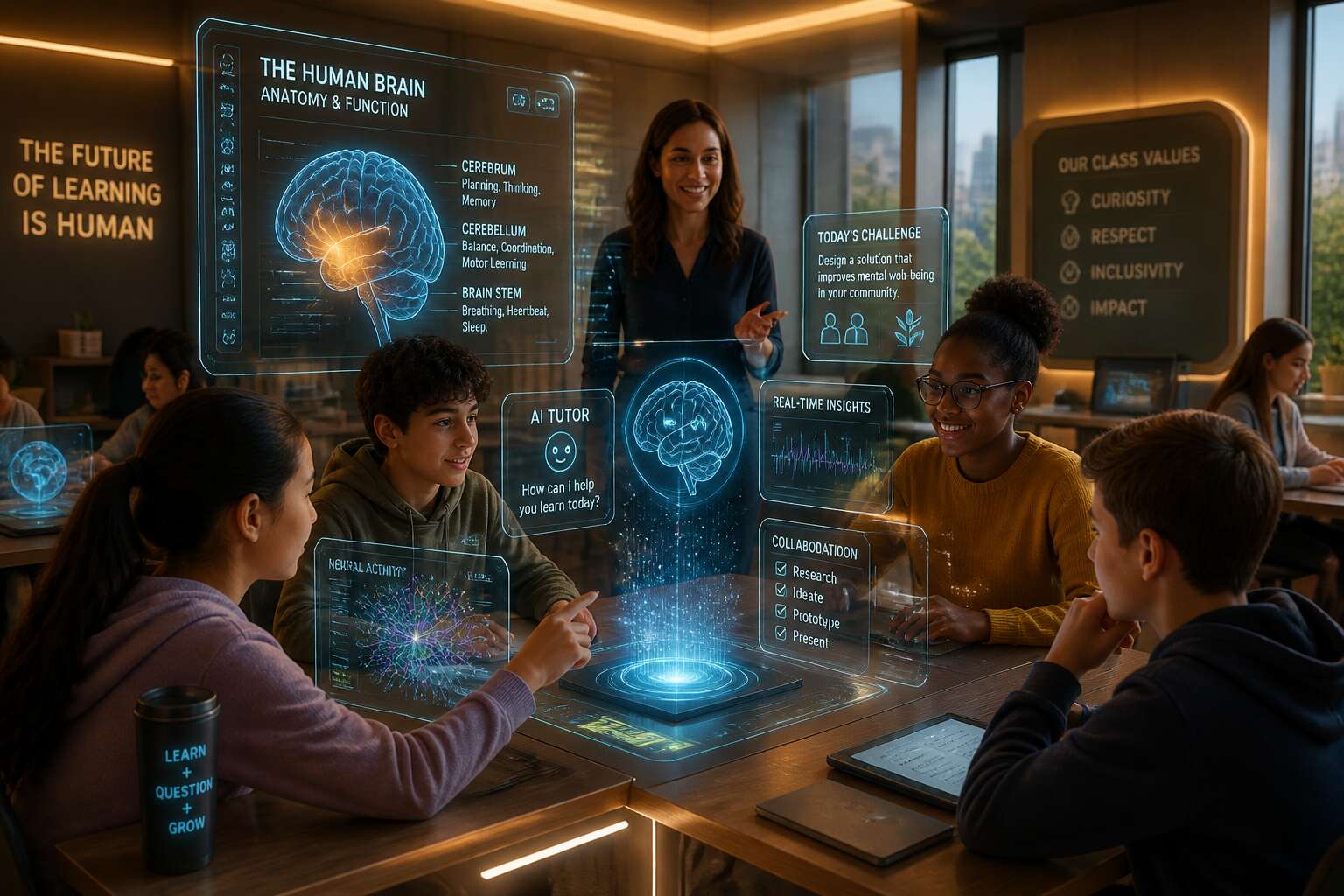
Understanding AI’s Role in Modern Classrooms
What Is AI and How Does It Apply to Learning Environments?
In South African classrooms, the chalkboard now shares space with adaptive algorithms. I have watched these tools refine their responses to individual mistakes. Artificial intelligence for education operates through pattern recognition and predictive analytics. It scans student responses to adjust lesson pacing in real time. The system identifies gaps in comprehension before a learner raises a hand, then serves remedial content or extension tasks automatically!
The applications within a learning environment are concrete:
- Automated marking of multiple choice and essay drafts.
- Generating individualized practice sets based on error frequency.
- Predicting learner drop-off risk using engagement metrics.
These functions free the educator from repetitive administration, allowing more time for direct mentorship and dialogue. The technology does not judge a learner’s history. It reads their current digital footprint and responds. In a country with wide resource disparities, this creates a baseline of responsive support, though it requires reliable connectivity and thoughtful implementation.
The Shift from Traditional Teaching to Data-Driven Instruction
I used to plan lessons by guesswork. A nod meant understanding; a blank stare meant relearn. That was teaching with anecdote, not evidence. Now, with artificial intelligence for education, the guesswork yields to analytics. My lesson plan evolves into a data-driven conversation with each learner’s progress.
Traditional teaching measured success at term end, when intervention was too late. Data-driven instruction reveals stumbling blocks during the activity. The teacher becomes a real-time troubleshooter, not a post-mortem examiner.
- Response latency shows who struggles before asking
- Error clusters reveal systemic misconceptions
- Mastery checks guide pacing decisions
The classroom runs on evidence. If a concept stumps seven learners, I know in seconds, not weeks. If another blazes ahead, theardware offers extension work without my intervention. This is artificial intelligence for education in practice: freeing teachers for dialogue, not data entry. But it demands a new skill: knowing when to override the algorithm.
Key Benefits of Integrating Artificial Intelligence in Education
A single school day in South Africa generates thousands of learning data points. Most go unrecorded. Artificial intelligence for education captures those signals and turns them into actionable insight. AI does not replace teachers. It surfaces patterns beyond immediate perception. When a learner hesitates on a quadratic equation, the system logs that hesitation. When another submits identical phrasing across essays, the algorithm flags potential plagiarism. I have watched teachers spend entire weekends marking identical errors across forty scripts. AI collapses that labour to seconds.
Key benefits emerge in practice:
- Adaptive assessments that adjust difficulty mid-task
- Automated marking that frees educators for mentoring
- Predictive analytics that identify at-risk learners before report cards do
None of this works without teacher oversight. The educator holds final authority over every algorithmic suggestion. The technology augments professional judgement, it does not supplant it.
Common Misconceptions About AI in Academic Settings
Nobody raises a hand when a learner silently gives up on a fraction problem. But artificial intelligence for education notices. It reads the pause, the skipped step, there repeated error. This is not surveillance. It is attention at scale, helping teachers see what ordinary observation misses.
Misconceptions persist. Some believe artificial intelligence for education judges learners. It does not. It surfaces patterns and teachers interpret them. Others fear it erases connection. The opposite holds true. Artificial intelligence for education handles repetitive analysis, freeing educators to spend more time on mentorship.
- AI does not replace teacher judgment.
- AI does not label learners as failures.
- AI works with existing classroom data.
The real misunderstanding is that AI replaces intuition. It strengthens intuition by revealing what happens between questions, between lessons, between terms. For South African schools, this visibility is not a luxury. It is a way to make every teaching moment count.
Key Applications and Tools for Personalized Learning
Adaptive Learning Platforms That Adjust to Student Progress
Thirty learners. One lesson. No single path works. In many South African classrooms, that reality is daily. Adaptive platforms answer with recalibration, adjusting each next question to the learner’s last response. I have seen systems that shift difficulty and pacing in seconds, without waiting for a term report. This is artificial intelligence for education applying its mechanism: continuous adjustment.
Specific tools vary. Some use diagnostic pretests to map existing knowledge. Others analyze error patterns to offer corrective scaffolds, not mere right or wrong feedback. A platform might present a video for one learner, a text summary for another. Meanwhile, teachers receive aggregated insights from the same system, without having to mark a single script.
Tools commonly embed these features:
- Real-time question sequencing that responds to mastery
- Learner metadata, such as response times and hint usage
- Automated grouping of learners with similar gaps
AI-Powered Tutoring Systems and Virtual Assistants
AI powered tutoring systems now offer learners something akin to a private mentor. These tools diagnose gaps through conversation, then guide each student through incremental steps. Virtual assistants handle routine queries, freeing teachers to focus on deeper instruction.
- Immediate feedback on written or spoken responses
- Step by step problem solving hints
- Practice questions generated from each learner’s error patterns
Such assistants integrate with existing school software, so data flows without disruption. For artificial intelligence for education to reach every learner, these tools must also respect limited internet access. Offline modes and low data versions already exist in several local platforms!
Automated Assessment and Feedback for Educators
A teacher in Cape Town can grade forty essays before lunch, yet still miss each learner’s specific struggle. Artificial intelligence for education changes this process. Automated assessment tools now analyze written responses, flag misinterpretations, and suggest tailored follow up questions.
Personalized learning works best when feedback is immediate. One platform used in South African schools offers:
- Instant scoring with explanatory comments
- Misconception heat maps per class
- Adaptive homework sets based on error frequency
These outputs give educators a second set of eyes. For artificial intelligence to serve every classroom, such tools must also function on low bandwidth networks. Offline versions already exist. Teachers reclaim time for one on one conversations.
Smart Content Creation and Curriculum Curation
Learners need materials. Content creation has become a quiet labour. AI tools generate question banks, summaries, and practice scenarios from a single lesson outline. In South Africa, some platforms now align these outputs with CAPS requirements, sparing teachers from building resources after hours. The result is a collection of exercises that adaptin language and difficulty, yet remain anchored to preset curricular goals.
Curriculum curation applies the same logic. AI sifts through open educational repositories, flagging resources that match a grade’s pacing and conceptual sequence. It discards outdated worksheets and finds fresh examples without human search fatigue. Teachers receive a structured sequence, not a jumbled archive.
- AI generates CAPS aligned practice sets
- Curates local examples from township to farm contexts
- Flag topics learners will likely struggle to master
These tools do not replace professional judgment. They reduce the time between an original lesson idea and the worksheet students actually receive. Artificial intelligence for education must respectthe craft already present in South African classrooms.
Predictive Analytics for Student Performance and Retention
A learner misses three assignments in a row. The system notices before the teacher does. That is predictive analytics in action! It studies digital traces, from login times to quiz attempts, and forecasts who might stumble. In South Africa, where class sizes can exceed forty learners, this foresight is not a luxury. It is a survival tool.
Consider a Grade 10 learner in Limpopo whose engagement dips every Tuesday afternoon. The system flags the pattern. Teachers can then adjust before a failing term becomes a dropout statistic.
Some tools worth knowing:
- Early warning systems that track attendance, assignment submission, and assessment scores
- Retention dashboards that visualise cohort trends across terms
- Intervention triggers that suggest targeted support materials
Artificial intelligence for education, applied this way, does not replace the teacher’s intuition. It sharpens it. The data works alongside the educator, quietly and continuously.
Language Learning and Accessibility Tools
South Africa’s eleven official languages often slow learning down. Artificial intelligence for education changes that with real-time translation and adaptive language exercises. A learner in Eastern Cape can follow a maths lesson in English while getting prompts in isiXhosa. Progress stays steady.
I have watched personalized learning tools adjust reading levels and practice questions to match each child’s grasp. They track errors and celebrate small wins! Accessibility tools help too. Speech-to-text assists learners with writing difficulties. Screen readers open up text for the visually impaired.
- Language apps that switch between home language and English
- Text enlargement and contrast settings for low vision
- Voice assistants that answer homework questions aloud
These quiet helpers make the classroom more inclusive, one learner at a time.
Overcoming Challenges in AI Adoption for Schools
Addressing Data Privacy and Security Concerns
Digital classrooms generate records of every click, answer, and hesitation. That data can power artificial intelligence for education, but it also creates a legal duty. South Africa’s Protection of Personal Information Act holds schools accountable for learner data, and most educators have never received a single lesson in data governance.
The real obstacle is not encryption alone. It is the silence around who sees what. Teachers worry about sharing grades with an algorithm. Parents worry about a leaked database. These fears stall adoption. To address them, schools need transparent policies, visible consent procedures, and regular staff training.
A few practical moves can help:
- Map every digital tool’s data flow before purchase.
- Delete learner records after each academic year, unless legally required.
- Create a clear breach response plan and rehearse it.
Preparing staff and families for these steps builds trust. Trust, after all, is the true prerequisite for meaningful AI adoption in South African classrooms.
Bridging the Digital Divide and Ensuring Equitable Access
Fewer than one in five South African public schools have reliable internet access. That gap determines whether artificial intelligence for education reaches every child or only those in well-connected districts. Connectivity is the first obstacle, though not the final one.
Load-shedding interrupts the school day. A single tablet may serve six learners. Data bundles cost more than many families can pay. These constraints sit alongside uneven teacher training and aging devices.
- Infrastructure procurement is fragmented across provincial departments
- Maintenance backlogs keep faulty equipment out of service
- Community internet points remain scarce in rural areas
Equitable access requires coordinated planning between education authorities, network operators, and school governing bodies. Without that coordination, artificial intelligence for education will simply reproduce existing inequalities instead of easing them.
Training Teachers to Work Alongside AI Systems
Training teachers to work alongside artificial intelligence for education requires more than a workshop. In schools where load-shedding disrupts digital lessons, educators need strategies for keeping lessons alive when machines fail. They must read AI suggestions critically, deciding when to trust the algorithm or override it with local knowledge.
Overcoming adoption challenges begins with co-design. Teachers should shape the tools from the outset. Technical teams can train them on the model’s limits. A structured approach works well:
- Monthly microsessions led by teacher leaders, not external consultants
- Video reviews comparing AI feedback with teacher observations
- Shared repositories of lesson plans showing human machine collaboration
These routines turn artificial intelligence for education into a partner debriefed after every lesson. Teachers become skilled interpreters of algorithmic output. Professional judgment sharpens because AI handles repetitive scoring and scheduling tasks. Principals must allocate time for joint learning. Without support, a rollout cannot succeed.
Managing Costs and Infrastructure Requirements
In South African schools, the true cost of artificial intelligence for education is seldom the software licence. It is the backup battery, the solar panel, the fibre connection that falters when a thunderstorm rolls over Johannesburg. Budgets assume steady electricity and cheap data, but reality disagrees. A school might stretch to buy tablets, then watch them sit idle during stage six load-shedding. Infrastructure planning must therefore include offline capabilities and robust hardware.
Consider the recurring expenses that appear only after adoption:
- Data bundles for learner devices
- Maintenance contracts for ageing computers
- Surge protectors and inverters
Without these line items, the AI platform fails in daily use. Schools that succeed treat infrastructure as a monthly cost, not a once-off purchase.
Evaluating the Accuracy and Bias of AI Algorithms
When a school adopts artificial intelligence for education, the algorithm’s verdict can quietly shape a child’s future. Yet those predictions often carry hidden biases, trained on data sets from other countries or wealthier communities. A learner in Limpopo might be flagged as at risk simply because the model never encountered her context.
Evaluating accuracy requires more than checking a test score. Schools must ask who labelled the training data, and what assumptions those labels encode. Transparent audits are scarce, but teachers can compare AI output against their own observations to spot anomalies.
- Request model documentation
- Test with local examples
- Review decisions quarterly
Bias creeps into every layer, from language to connectivity. Without vigilance, artificial intelligence for education can reinforce existing inequities instead of easing them.
Future Trends and Ethical Considerations in Educational AI
The Rise of Generative AI in Homework and Creative Assignments
The rise of generative AI in homework and creative assignments unveils a moral tension. Students can now produce essays and artwork with artificial intelligence for education tools in seconds. This convenience blurs the line between genuine cognition and algorithmic assembly, forcing educators to question what authentic learning truly means.
Consider a learner who pastes a prompt and submits the output without modification. Learning becomes a transaction, not a transformation. Original thought risks being replaced by pattern recognition, and academic integrity grows murkier with each passing semester. Yet outright prohibition ignores the technology’s permanence.
Several ethical questions demand attention:
- Should institutions define tasks where AI assistance is acceptable?
- How do we evaluate creativity when machines iterate endlessly?
- Can assessments isolate human contribution from machine output?
These answers will determine how artificial intelligence for education evolves across South African schools, where learners deserve frameworks that foster genuine intellectual growth rather than convenient shortcuts.
Ethical Use of Student Data and Informed Consent
As artificial intelligence for education matures, the next frontier involves consent architectures that keep pace with algorithmic complexity. Learners and parents rarely grasp how predictive models repurpose biometric, behavioural, and academic data. Informed consent, the ethical foundation of responsible deployment,demands plain language disclosures that adapt as systems learn.
Future trends point to dynamic consent frameworks: granular controls, revocable permissions,and audit trails that render every data transaction visible. Schools in South Africa must align these shifts with POPIA requirements, treating consent as an ongoing dialogue rather than a static checkbox.
- Shift from one-time authorisation to continuous, context-aware permission
- Increased learner agency over data narratives
Ethical AI depends on this recalibration: consent becomes a living practice, not a legal formality.
Preparing Students for an AI-Driven Workforce
South Africa’s labour market will not wait for schools to catch up. Artificial intelligence for education is shifting from a support tool to an arbiter of student potential. Curricula must pivot from content mastery toward algorithmic discernment. Students need to interrogate the logic embedded in AI systems, not merely execute their outputs.
This raises a question of accountability. When an AI system steers a learner toward a declining field, or reinforces a biased notion of success, who steps in? Schools must teach students to hold AI responsible even as they rely on it. Ethical readiness is now a prerequisite for meaningful work.
Future classrooms will demand skills that machines cannot recapitulate.
- Navigating ambiguity
- Ethical judgement under uncertainty
- Collaborative negotiation with intelligent agents
For South Africa, artificial intelligence for education must embed local contexts into its design so students understand how automation reshapes their communities before they can reshape it.
The Role of Human Educators in an Automated Era
By 2030, South African classrooms will host AI systems making split-second decisions about learner pathways. The question shifts from capability to accountability. Artificial intelligence for education must adopt a moral architecture that values learners over metrics.
Human educators carry the ethical responsibility. We read the cultural texture of a township classroom, the silent signal of a struggling child. Our work is relational and irreplaceable.
- We challenge AI outcomes that miss local realities.
- We model judgement under uncertainty.
- We convert raw data into human dignity.
Future systems may predict performance. Only people can make AI answerable to the communities it serves.
Emerging Technologies: Virtual Reality, Chatbots, and Intelligent Agents
Virtual reality transports learners into laboratories too hazardous or expensive to construct. Chatbots offer immediate responses, yet they cannot perceive the tremor in a learner’s voice. Intelligent agents reorganise study schedules around behavioural patterns, but these systems carry the assumptions of their creators.
- Who audits the algorithm?
- Who owns the data generated by immersive experiences?
- Who answers when an intelligent agent makes a flawed recommendation?
The ethics of artificial intelligence for education in South Africa rest on transparency. A township classroom with unreliable connectivity demands different safeguards than a private school. We must examine who controls the data, who profits from the insights, and whether these tools honour local knowledge systems.
Developing Responsible AI Policies for Institutions
Future trends in artificial intelligence for education will centre on institutional accountability. South African schools and universities need policies that anticipate ethical failure, not merely respond to it. These policies must be built with educators, not handed down by vendors.
Responsible AI policies should require algorithmic audits, clear data ownership rules, and accessible grievance channels when an intelligent agent makes a flawed recommendation. The safeguards for a township classroom with intermittent connectivity must differ from those in a private school. I believe the measure of any policy is whether it protects the learner, not the system.
Practical Steps for Educators and Institutions
Assessing Readiness and Setting Clear Objectives
For artificial intelligence for education to take root in South African classrooms, readiness begins long before any software is purchased. Schools must audit their current reality, not their aspirational one. Are there reliable devices? Does the Wi-Fi survive a typical day? Is there technical support beyond an overburdened IT coordinator? These answers shape everything.
A honest readiness check might include:
- Inventory existing hardware and connectivity in every classroom
- Survey teacher confidence with digital tools, not just their willingness
- Document learner access outside school hours
Once you know your baseline, set objectives that are narrow and measurable. Instead of adopting AI broadly, commit to one pilot class, one subject, one term. Define what success means: reduced grading time, improved homework completion, or clearer feedback loops. A focused objective lets you iterate without drowning in data. And it builds evidence for the next step.
Selecting the Right AI Tools for Specific Learning Outcomes
Once your objective is narrow, selection becomes a process of elimination. List tools that address your specific learning outcome, then remove those that fail your context. A tool that promises analytics but drains your bandwidth will not serve your learners. This is how artificial intelligence for education should be evaluated: against the conditions of a South African classroom.
When you request trials, ask for evidence that matches your conditions!
- Case studies from schools with similar device ratios.
- Details on uptime during load shedding.
- A teacher-led pilot for one term, not a vendor demonstration.
Integrating AI into Existing Curricula Without Overloading Students
Start with one subject, not five! Integrating artificial intelligence for education works best when you choose a single lesson where automation genuinely reduces teacher workload, such as marking multiple choice quizzes. Expand only after both you and your students feel comfortable with the rhythm.
- Use AI for low stakes tasks first, like generating practice questions.
- Set a strict time limit for AI assisted work to protect class hours.
- Reserve one day per week for unplugged discussion of what the AI produced.
This gradual approach prevents cognitive overload. Teachers in South African classrooms should treat AI as a co-teacher, not a curriculum replacement. The goal is small, sustainable shifts that respect existing structures and learner patience. The result matters more than the tool.
Monitoring Impact and Iterating on Implementation
Tracking the real effect of artificial intelligence for education requires more than a glance at engagement dashboards. Set a monthly rhythm to compare learner performance before and after each AI assisted activity. Look for patterns in submission quality, not just speed.
Then adjust one variable at a time. Change the prompt style, the data source, or the feedback format. Keep everything else stable so you know what actually moved the needle.
- Collect learner feedback on AI generated explanations weekly.
- Review error logs to spot recurring misconceptions.
- Share findings with other educators to avoid duplicating failed experiments.
Institutions should also revisit their training plans. If educators avoid the tool, the problem is usually workflow, not willpower. Iteration means changing the process, not blaming the user. These steps turn artificial intelligence for education from a novelty into a reliable classroom partner.
Collaborating with Vendors and EdTech Specialists
Working with vendors and EdTech specialists turns artificial intelligence for education into a shared effort. I have learned that problems arise when communication remains one way. Educators describe classroom realities, while vendors explain technical limits. Set a fixed schedule for joint reviews, using student work samples as the evidence base.
- Ask for model documentation in plain terms.
- Request a sandbox environment for testing.
- Agree on response times for bug fixes.
This structure keeps both parties accountable. Vendors gain insight into daily teaching rhythms. Institutions gain confidence in what the system actually does.
Building a Culture of Innovation and Continuous Learning
One morning, a teacher in Limpopo tried an AI tool and watched her learners argue over a math problem. That moment built more trust than any workshop! Real adoption of artificial intelligence for education starts with these small, visible wins.
Creating a culture of innovation requires deliberate space. Schools that block out time for honest reflection see better results. I have seen staff meetings where everyone shares a misstep without fear.
- Set a weekly hour for experimentation
- Pair teachers across subjects to swap insights
Leaders should ask questions rather than dictate answers. This approach turns continuous learning into a shared habit, not a mandate.


0 Comments