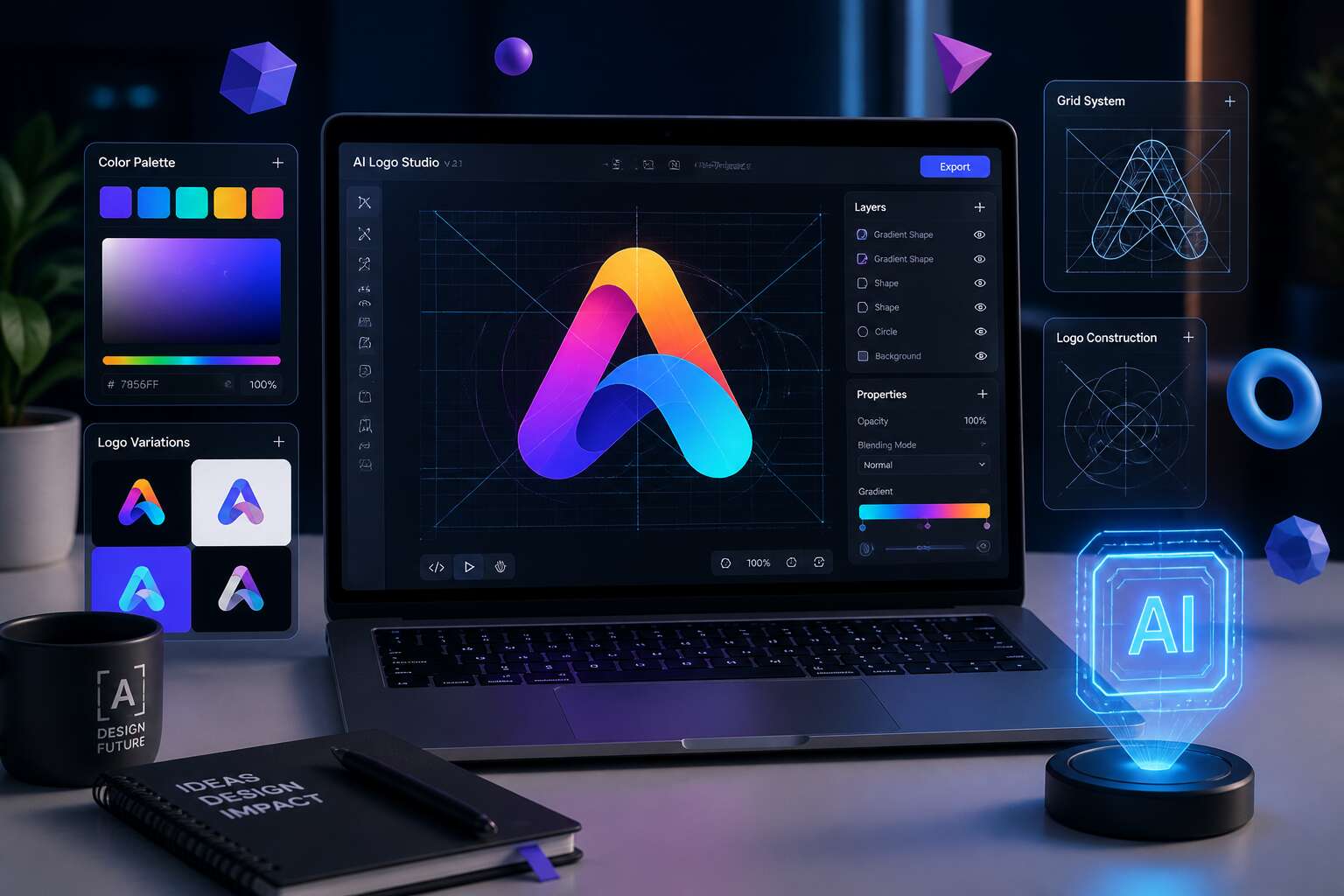
Essential Capabilities of Modern Logo Design Tools
Automated Brand Color Extraction
A striking 78% of small businesses admit their brand colours were chosen by personal preference rather than strategy. A good ai logo generator changes that.
Automated brand colour extraction is one of the more practical capabilities found in modern design suites. Instead of starting from scratch, you feed the ai logo generator an existing image, a website screenshot or even a product photograph. The system studies dominant hues, calculates complementary tones and assembles a complete palette. This is not arbitrary. It relies on colour theory algorithms built to guarantee contrast and readability.
The tool evaluates several dimensions:
- Hue distribution across the source image
- Saturation levels and luminance values
- Regional colour associations relevant to South African audiences
The output is a cohesive palette that feels deliberate. Applying these colours directly to your logo variations ensures consistency across every touchpoint. For growing businesses without an in-house design team, this removes the pressure of colour selection altogether.
Scalable Vector Export Options
When you take your logo from screen to signage, the file format decides everything. A pixel-based design falls apart when stretched across a shopfront or engraved onto a metal plate. Scalable vector export options separate competent platforms from disposable ones. The right ai logo generator should deliver an SVG at minimum, ideally with PDF and EPS versions included.
Consider what this means when you hand your new identity to a local printer:
– The file opens perfectly at any size
– Colours stay accurate in CMYK and RGB workflows
– Every curve and line remains mathematically precise
A vector workflow protects your brand from reproduction disasters. Without it, you will eventually pay someone to redraw your entire logo. A serious ai logo generator solved that problem before you ever clicked download.
Smart Icon and Font Pairing
Nearly 60% of a logo’s perceived quality comes down to type and symbol working in unison. An ai logo generator that treats icons and fonts as separate tasks will deliver a disjointed result. The best systems evaluate visual weight, stroke thickness, and negative space automatically. This ensures the mark and wordmark share a rhythm, not just a colour palette.
Smart font pairing goes beyond decoration. Modern tools analyse whether a geometric icon belongs with a grotesque sans serif or a humanist typeface. They measure x-heights, optical alignment, and kerning pairs within seconds. Indie designers waste hours on these micro-decisions. A capable ai logo generator compresses that process into a single click, while still allowing manual override.
– The tool checks contrast between icon angles and letterform curves
– It tests legibility at small sizes, like favicons or invoice headers
– It flags mismatched line weights before you export
This is where template fatigue disappears. Individual fonts replace generic library defaults. The system learns from industry norms, so a legal firm gets restrained serifs and a streetwear brand gets condensed display type. The outcome looks considered, never assembled. That difference often separates a professional identity from a hobby project.
Real-Time Editing and Preview
Real time editing changes how a designer interacts with a brand mark. Every adjustment to spacing, curve, or alignment updates instantly across the canvas. An ai logo generator that renders these changes without lag lets you test directions while the idea is still warm.
Preview matters beyond the main viewport. The best tools simulate the logo on a shopfront in Rosebank, a mobile screen, or a delivery vehicle. You see how the mark breathes in context, not just on a blank background. This kind of feedback prevents expensive mistakes later.
- Toggle between light and dark environments immediately
- Scale the identity down to favicon size in one action
- Compare two versions side by side without exports
Speed here is not a luxury. I have watched concepts die because an ai logo generator lagged mid adjustment. When every pixel reacts the moment you nudge it, you explore more options and commit with confidence.
How Automated Design Platforms Enhance Brand Consistency
Unified Visual Identity Across Touchpoints
A brand only earns recognition when every point of contact whispers the same truth. A customer might first meet you on a LinkedIn banner, then hit your website, then see a van in a parking lot. If those experiences feel unrelated, familiarity slips away. An ai logo generator now solves this dissonance before it starts. Automated systems in these platforms enforce rules around spacing, clearspace, and minimum sizes, so your mark remains legible and proportionate whether it appears on a billboard in Sandton or a favicon on a phone. This translates into a systemic discipline that humans often abandon under deadlines.
The value emerges in the handoff, not just the initial design. Your small business team in Cape Town might need a presentation deck, while your partner in Durban requires social media templates. A centralised generation system ensures both outputs pull from the same master file. Every export carries the same weight, the same optical adjustments, and the same tonal alignment. There is no freelance interpretation or manual redrawing.
Consider how automated platforms simplify the scaled rollout:
– Locking the primary colour palette to a percentage of the original hex value.
– Automating monochrome and reverse versions for dark backgrounds.
– Defining the exact vertical and horizontal orientation for different headers.
– Scaling the mark without recalculating stroke widths.
This does not replace a designer’s eye. Instead, it removes the tedious repetition that causes mistakes. The platform becomes the keeper of the brand bible, the arbiter of spacing, and the guardian of proportion. For a business in a growing economy where first impressions are critical, a consistent visual identity across every customer interaction builds a quiet trust that outshines any single splashy campaign. The consistency acts as a silent promise, delivered through every asset you release into the wild.
Dynamic Templates for Multiple Formats
Every brand needs its identity to fit a dozen containers before lunch. A billboard, a business card, a Zoom background. Each demands a different shape and breathing room. An ai logo generator builds templates that reshape themselves without losing their core.
These templates carry parameters, not guesses. The platform measures padding, crop, and configuration for a square profile picture versus a wide website header. A Johannesburg team launching a campaign at noon gets assets that arrive ready, no manual redrawing required.
- Automated resizing for profile images, banners, and print collateral
- Pre-set safe zones that protect the mark from awkward cropping
- Format-specific exports that keep the logo legible at every dimension
The ai logo generator holds the rules. Your team focuses on the work itself.
Built-In Style Guides
The more a brand grows, the more its identity invites slow erosion. Every stray design decision chips away at recognition. An ai logo generator prevents this drift by acting as the keeper of the brand’s built-in style guide. The guide is not a PDF for employees to ignore. It is encoded within the platform, binding each design choice to the established standard.
Style guides govern what other tools leave to instinct. White space, text scale, color ratio, and visual weight are all measured and locked. Designers work within the system rather than against it.
- Clearance requirements around the logo
- Typography pairings and fallback hierarchies
- Contrast values for backgrounds and overlays
The ai logo generator enforces these rules across teams and timelines. Consistency emerges from enforcement, not hope.
Direct Integration with Marketing Tools
Marketing teams do not fail from bad design. They fail from fragmented execution. An ai logo generator changes that by plugging into your existing tools. Email builders, social schedulers, and ad platforms receive the same updated brand files. No one hunts for the correct version anymore!
This direct integration creates practical discipline. Every generated asset arrives pre-configured for the channel. The system resizes, renames, and stores files without manual intervention. Consistency does not depend on a designer remembering the rules. It depends on the process.
The gains are concrete:
- Correct files land in the right folders
- Brand updates propagate instantly across campaigns
- Creative handoff delays disappear
An ai logo generator makes brand management part of your infrastructure. That is how consistency becomes routine.
Top Creative Strategies for Standout Logo Results
Leveraging Negative Space Effectively
Most viewers ignore the empty space in a logo. Skilled designers use that negative space to embed a second message. An ai logo generator can measure proportions and detect when a background shape begins to read as an object. That creates a sharper brand mark without extra complexity.
Three strategies deliver standout results:
- Bleed the letterform into the surrounding shape
- Suggest movement through cutouts
- Reverse the figure and ground relationship
Each tactic forces a double take. That momentary pause is what makes a logo stay in the mind.
Choosing the Right Typography for Your Industry
The sharpest brand marks often succeed on letterform alone. In Cape Town’s crowded financial district, a serif face signals institutional weight, while a playful rounded font would sink a client’s confidence. Typography establishes the business’s credibility before a single word is read.
An ai logo generator can evaluate industry norms and suggest typefaces that fit your sector. This removes the guesswork from a decision that carries real commercial consequence. For instance:
- Insurance and legal firms rely on stable, upright sans-serifs
- Boutique food brands choose warm, hand-drawn styles
- Technology companies prefer geometric precision
The letterforms you select dictate the logo’s personality, mood, and perceived value. Platforms that understand these subtleties help you build a mark that resonates with the right audience.
Balancing Minimalism and Distinctiveness
Minimalism alone breeds anonymity, but distinctiveness without restraint produces noise. A logo must remain legible across billboards in Sandton and storefronts in Khayelitsha, retaining its character at every scale. An ai logo generator navigates this tension by testing successive reductions, stripping a mark to its essential geometry while preserving the quirk that secures recall. This editing process demands a certain ruthlessness, the willingness to discard what merely pleases.
For South African founders, that equilibrium has commercial consequences. The marks I most admire share observable disciplines:
- The silhouette reads clearly in monochrome, never leaning on gradients.
- The form stays recognizable when reduced to a favicon.
- A single deliberate anomaly creates memory without clutter.
Such restraint converts a simple shape into a lasting asset. An ai logo generator can produce many iterations along this spectrum, allowing you to choose the version that speaks with confidence and quiet permanence.
Testing Scalability from Favicon to Billboards
In South Africa, a logo is just as likely to appear on a truck’s flank as on a phone screen. Testing scalability means pushing your mark to extremes. A favicon at 16 pixels behaves differently than a 5-metre billboard along the M1.
Reduce your logo until it blurs. Then reduce it more. The shapes that survive this process will carry your brand across every format. An ai logo generator makes this iteration swift, producing size-specific previews without manual redraws.
When reviewing scaled versions, evaluation points include:
- Line weight consistency at minimum and maximum sizes
- Whether fine details disappear or distort at small sizes
- Spacing that holds up in tight, small-scale placements
Design decisions become clearer when you see your mark blown up across a simulated highway banner, then crunched down to a social media avatar. The gap between those extremes reveals what your logo truly offers.
Evaluating Free vs Paid Logo Creation Solutions
Cost Comparison and Hidden Fees
The average South African entrepreneur will happily pay R500 for a braai but recoils at spending R200 on a logo. Free logo tools lure you in with slick interfaces, then charge for the privilege of owning your own mark. A paid ai logo generator often includes commercial licensing, vector files, and source edits. The free version may hold your design hostage behind a paywall.
Hidden fees appear in predictable corners:
– Watermarked previews until you upgrade
– Extra charges for transparent backgrounds
– Subscription renewals that auto-debit without warning
Compare the total cost of ownership. A once-off payment for a professional generator beats a monthly subscription that outlives your startup’s enthusiasm.
Usage Rights and Ownership Permissions
When you download a free logo, you inherit a hidden landlord. The platform often keeps a licence to resell your mark to someone else in another province. A paid ai logo generator typically transfers full ownership to your business, including the source files and commercial rights.
Ownership permissions vary. Some free services let you use the design for social media but restrict print, packaging, or trademark registration. This becomes a problem when your brand grows and you need exclusive control. The licensing terms tell the real story. You are not buying the artwork, you are renting a permission that the platform can revoke or change. Free options ask you to surrender rights in exchange for convenience. Paid generators offer clarity: the mark is yours, wholly and permanently.
AI Sophistication and Customization Depth
The gap between free and paid logo tools is not about features. It is about the depth of the AI’s reasoning. A basic ai logo generator matches your industry to a template library. It might even let you tweak colours, but the underlying model treats your brand like a search query.
Paid systems use layered neural networks that study your brief, your competitors, and your market position. They generate multiple design routes, then refine the strongest concepts. I have tested dozens of both types, and the difference shows in the small details: spacing, optical alignment, and how the mark behaves when scaled.
Consider what you are actually testing:
– How many design variations the AI produces before repeating itself
– Whether the tool understands brand personality versus generic aesthetics
– If the generator explains its choices or simply outputs a pretty picture
Free tools deliver what the template allows. A sophisticated paid ai logo generator delivers what your brand requires.
Customer Support and Revision Policies
When a South African startup hits a snag with its logo, the response time from the support team often matters more than the original design. Free platforms typically offer email tickets with 72 hour turnaround. Paid systems provide live chat and same day revisions. I have watched startups lose a week waiting on free support teams. The difference becomes visible when your brand assets need urgent adjustments before a product launch.
Customer support policies vary wildly across providers. Some limit revisions to three per project. Others offer unlimited iterations until final approval. A dependable ai logo generator will document these terms before payment:
- Revision caps for each package tier
- Response time guarantees for support tickets
- Refund or exchange conditions for unsatisfactory marks
Consider what happens after you download the files from an ai logo generator. Will the vendor rework the design if a stakeholder rejects it?
Future Trends in Automated Branding and Design
Generative Adversarial Networks in Design
The next wave of automated branding will be powered by generative adversarial networks, and it is arriving faster than most design teams expect. Instead of relying on static templates, these systems place two neural networks in competition, refining outputs until they feel handcrafted. In South Africa, where small businesses often run on tight timelines, this shift means a brand can change quickly without losing its core personality.
What excites me is the direction this is heading. Automated branding tools are learning to respect cultural nuance, local colour preferences and language-specific spacing. The ai logo generator of tomorrow will produce a mark and then suggest variations that adapt to changing market moods. Some systems already experiment with motion and interactive elements, pushing logos beyond static files.
Personalized Logo Suggestions Based on Audience
Consider what happens when an ai logo generator begins to sense its audience the way a host senses a room. The next wave of automated branding will shift from static outputs to living suggestions, where every colour and curve is chosen with a specific viewer in mind. In South Africa, where languages shift between streets and suburbs, this matters deeply.
Personalised logo suggestions based on audience behaviour will soon feel ordinary. The system will study how customers respond on their phones, then offer alternatives that resonate with that exact group. That is the part I find exciting!
- A logo that softens its corners for a children’s clinic
- One that sharpens into bold geometry for a construction firm
This future relies on data, yes, but also on attentive care. The ai logo generator of tomorrow will feel like a quiet collaborator, learning the habits of the people it serves.
Integration with Augmented Reality Branding
Augmented reality is the next canvas for brand identity. An ai logo generator will soon craft marks that exist in both physical and digital space. Imagine a logo that reacts to a user’s environment through a phone camera. This is the direction automated branding is heading.
Design integration with AR means logos must adapt in real time. They need to shift shape, colour, and motion based on context. This demands a new kind of intelligence from the ai logo generator.
- A restaurant logo that animates onto a menu when scanned
- A delivery van logo that expands to show tracking info
- A storefront sign that changes its message at night
For South African businesses, this opens doors. A township spaza shop can have the same AR presence as a corporate brand. The tools will be simple. The impact will be significant.
Ethical and Copyright Implications
The next phase of automated branding will make the ai logo generator an essential tool for navigating legal and ethical boundaries. As these systems become more sophisticated, they will likely learn to avoid existing trademarks and cultural symbols automatically. This is a significant advantage for South African entrepreneurs who lack access to expensive legal counsel.
However, automated design raises complex questions about authorship and intellectual property. When a machine generates a mark, who holds the copyright? The developer of the algorithm, the user, or no one at all. Future regulation will need to address this ambiguity.
– Determining liability for trademark infringement
– Establishing clear copyright ownership for generated assets
– Defining the scope of fair use for existing brand elements
The ethical responsibility will shift to the user, who must understand the provenance of their design. An ai logo generator can produce a distinctive mark, but it cannot guarantee legal safety. This creates a new dynamic where business owners must become more literate in design law.




0 Comments