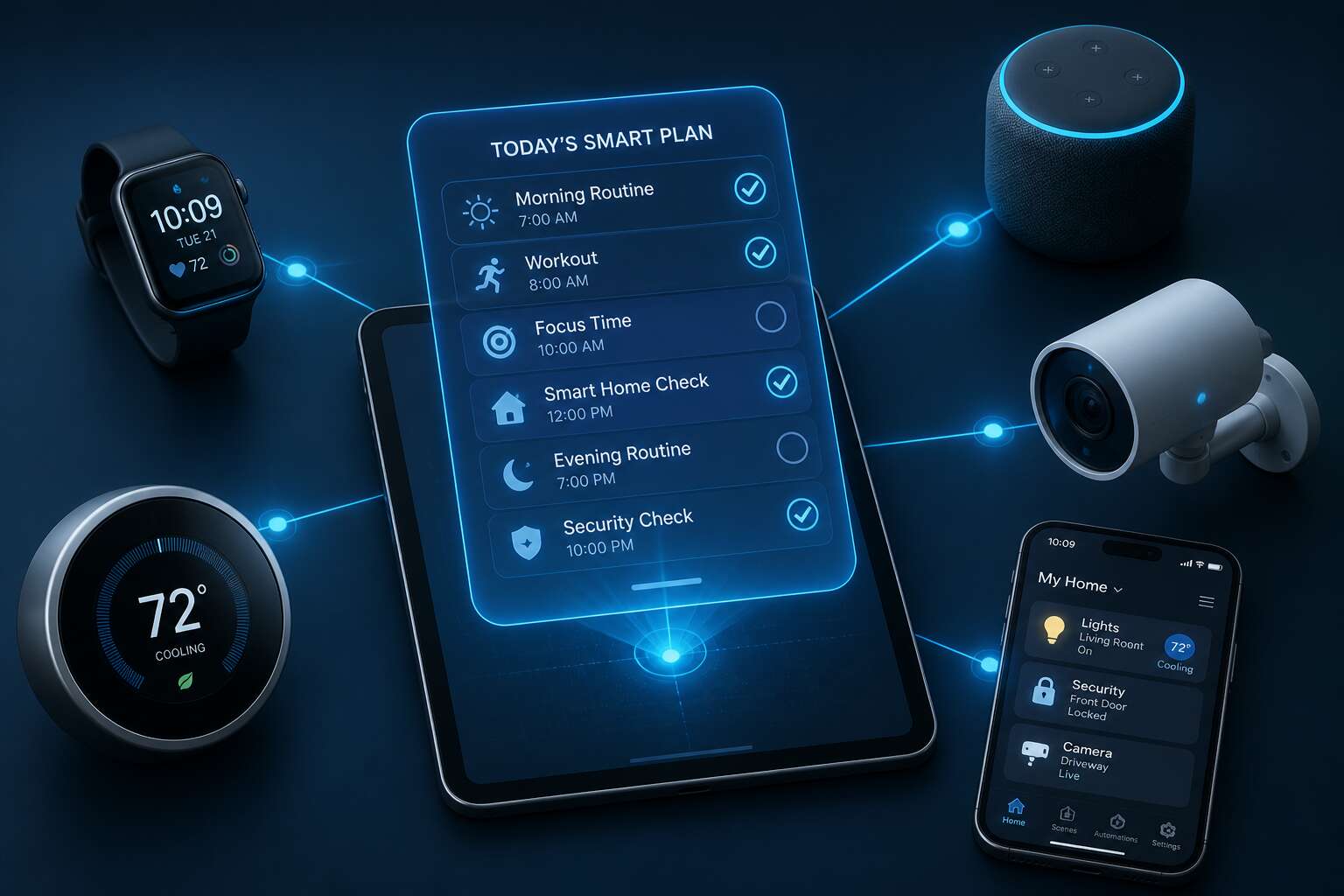
Smart Home IoT Devices
Smart Speakers and Displays
In 2024, sales of smart displays in South Africa grew by 33%. These devices have moved from novelty to necessity in many homes. I find that my own speaker handles the morning routine with quiet competence. It adjusts the kettle temperature and briefs me on traffic before I ask. What a relief.
A smart speaker belongs on any internet of things list because it acts as a voice controlled command center. Displays extend that power with visuals. This matters in a country where loadshedding schedules change daily. Users can glance at a screen to see when power returns.
Common capabilities include:
- Multi room audio synchronization
- Video calling through integrated cameras
- Energy monitoring for appliances
These tools have improved wake word detection for South African accents. Yet they remain simple enough for my grandmother to use without a manual, and that is a triumph!
Smart Lighting Systems
For any internet of things list focused on practical benefits, smart lighting earns its place early. Nothing ruins a braai like fumbling for a torch while Eskom tweaks the load shedding schedule. Smart lighting systems treat these outages as routine. A well set up system learns your habits. Motion sensors light the hallway when you shuffle to the kettle at night. Colour bulbs fade to amber in the evening, cueing your body to wind down. The practical benefits go beyond convenience:
- Lower energy consumption than conventional bulbs, which matters when every watt counts
- Geofencing that switches everything off once the last person leaves the house
- Battery backup options that keep essential lights alive during blackouts
Unlike some gadgets, this one does not require a manual the size of a phonebook. I have tested three brands and the difference is stark. Set it up once, then adjust everything from your phone. No need to reprogram after a power failure either, these systems remember their settings and resume normal operation when the grid returns!
Smart Thermostats and Climate Control
South Africa’s weather does not negotiate. It flips from sweltering to freezing with no apology. Smart thermostats accept this chaos as normal. They study your patterns and adjust the indoor temperature before discomfort registers. The device learns that winter mornings require a warm bathroom floor, while summer evenings shed heat by seven. This is control without fuss. No reprogramming, no manual, just steady adaptation!
A decent system provides:
- Monitoring each room’s energy demand
- Scheduling that works around load shedding stages
- Remote adjustments from your phone during a sudden change
The true merit of these sensors is their consistency. They remember household quirks, the afternoon naps, the late night movie sessions. Every internet of things list should feature them because they deliver comfortable living without ceremony.
Smart Security Cameras and Doorbells
The silence after load shedding is when residential streets feel most vulnerable. Smart security cameras and doorbells belong on any internet of things list because they address this specific anxiety. Their value lies in interpretation rather than raw resolution. These devices learn the neighbourhood’s rhythm, flagging anomalies without clogging your phone with alerts.
Here is what separates useful systems from noise:
- Person detection that filters out roaming cats and windblown branches
- Privacy zones that exclude your neighbour’s driveway from footage
- On device processing that works without constant cloud access
I appreciate a doorbell that tells me when my child returns from school, recording the voice and the posture. That is reliable observation, and it turns a camera feed into a genuine household comfort!
Smart Locks and Access Control
Smart locks have quietly upended the social contract of the front door. The internet of things list belongs to these devices because they reframe how we hand over access. Gone is the coded tap on the window for the spare key. Instead, a guest receives a temporary code, valid for one afternoon, expiring before the awkward question of returning it. For South African households, where security gates and burglar bars are standard, access control presents particular nuance. I appreciate a lock that knows when the dog walker arrives, logs the cleaner’s hours, and politely refuses the door to an unexpected visitor after dark.
Consider what distinguishes capable systems from gimmicks:
- Works offline during load shedding.
- Geo-fencing that unlocks as you approach.
- Audit trails that settle family disputes about who left the gate open.
That last feature alone deserves a place on any deliberate reading of the internet of things list.
Wearable IoT Technology
Fitness Trackers and Smartwatches
On the wrist, the internet of things list takes a deeply personal turn. Fitness trackers and smartwatches monitor heart rate, sleep cycles, and movement patterns with clinical precision. These devices transmit biometric data to smartphones and health platforms, creating a continuous feedback loop between body and network.
The sensor arrays in modern wearables measure:
- SpO2 levels for altitude acclimatisation
- Electrocardiogram readings for cardiac anomalies
- Skin temperature for early fever detection
South African users, particularly those in Johannesburg and Cape Town, increasingly rely on these wearables for lifestyle management and medical monitoring. The smartwatch has evolved from a notification hub into a device for daily wellbeing. Battery life, connectivity standards, and data privacy remain the primary considerations for local adoption. The trajectory is unmistakable.
Medical and Health Monitoring Wearables
Medical grade monitoring now extends beyond clinical walls. Wearable IoT technology places diagnostic tools on the body, enabling continuous observation of chronic conditions. For South African patients with diabetes, hypertension, or respiratory disorders, these devices offer a lifeline! Patch sensors measure glucose levels non-invasively, while chest straps track respiratory rate and detect arrhythmias. Clinicians in Cape Town use these tools to adjust prescriptions remotely.
Modern wearable monitors capture:
- Blood oxygen saturation trends
- Cardiac rhythm anomalies
- Electrolyte balance through sweat analysis
This data streams to electronic health records, allowing doctors to intervene before crises occur. Rural patients benefit most, as telehealth connects remote areas. The internet of things list transforms care delivery. Reliability remains paramount, and local networks must support real-time transmission without interruption. For communities in Limpopo or the Eastern Cape, timely alerts reduce hospital visits substantially.
Smart Clothing and Textiles
By 2027, smart textiles will be a $5 billion market. The real power lies in how fabric interprets the body. South African smart clothing captures physiological signals across the torso, measuring muscle fatigue, spinal load, and core temperature. For shift workers in Johannesburg mines or Durban factories, these garments flag dehydration before collapse.
Modern textiles integrate sensing elements directly into the weave:
- ECG electrodes knitted into compression shirts
- Capacitive sensors tracking posture shifts
- Piezoelectric fibers measuring respiratory effort
This feeds an internet of things list that grows daily. Unlike wrist worn devices, smart clothing covers more surface area, capturing nuanced biomechanics. Cape Town researchers are trialing swaddles that monitor infant breathing wirelessly, adding to another internet of things list. Rural clinics fit one garment instead of a kit of sensors, and the data flows into existing telehealth systems. The textile becomes the interface, an unobtrusive layer of clinical intelligence.
AR and VR Headsets
AR and VR headsets dominate any internet of things list. They demand a full face, both hands, and a tolerance for looking odd to anyone without a headset on. Yet the data they generate is reshaping how South African industries train people and inspect assets.
A mining company in Mpumalanga runs hazard simulations for new shaft workers. An architecture firm in Sandton walks clients through buildings that only exist as point clouds. The headsets track gaze direction, reaction time, and head micro-movements. All of it feeds into the broader internet of things list alongside the modest sensors hidden in machinery.
Some practical uses include:
- Virtual site walkthroughs for safety compliance audits
- Remote expert assistance through AR overlays on real equipment
- Training simulations for high risk maintenance procedures
Industrial and Enterprise IoT Solutions
Predictive Maintenance Sensors
Every unplanned machine failure costs a factory more than just lost hours. It unravels supply chains, strains worker morale, and quietly erodes the bottom line. Predictive maintenance sensors offer an elegant alternative. They monitor vibration, temperature, and acoustic signatures to flag wear before a breakdown occurs.
These sensors form a vital entry on any internet of things list for industrial enterprises. Unlike consumer gadgets, they operate in harsh environments, transmitting data to central platforms where algorithms detect anomalies. South African mines, ports, and manufacturing plants increasingly deploy them to extend equipment life.
- Reduce downtime by up to 50%
- Lower repair costs through early intervention
- Improve worker safety by preventing catastrophic failures
Implementation requires careful planning, but the payoff is tangible. A single sensor network can transform reactive maintenance into a precise, data-driven discipline.
Inventory and Asset Tracking
While predictive sensors guard machine health, another entry on the internet of things list guards the movement of physical assets. South African logistics operators and mining houses need real-time location of haul trucks, shipping containers, and high-value tools. Passive RFID tags cost pennies, while active GPS trackers provide continuous visibility across open-pit operations and port terminals.
The data flows into central inventory platforms, reconciling what the system thinks exists with what actually rests on the warehouse floor. A typical enterprise deployment might track:
- High-value machinery and attachments
- Spares distributed across multiple sites
- Returnable containers and pallets
Each tagged asset emits signals that fixed readers triangulate. Staff locate equipment in seconds rather than hours. This segment of the internet of things list directly addresses misplaced inventory, a silent drain on working capital. I have watched operators cut search time dramatically after adopting such systems!
Supply Chain Visibility Devices
The most expensive journey in any supply chain is the one taken by a truck that is running empty or waiting at a wrong gate. In South Africa, where distances between ports and industrial hubs are vast, visibility is not a luxury. It is the difference between profit and loss. A single sensing network, forming one crucial part of the internet of things list, now tracks cargo from the factory floor in Gauteng to the docks in Durban.
These systems rely on ruggedised gateways fitted to trailers and shipping containers. They do not simply record location. They measure vibration, temperature, and door status. This matters for pharmaceuticals moving through the heat of the Karoo, or delicate machinery heading to the Cape. Data is transmitted over cellular networks, often using low-power wide-area protocols, which means a battery can last for years without a recharge.
The value lies in the exceptions. When a truck deviates from its planned route, or a reefer container’s temperature spikes, the platform flags it immediately.
– Yard management at container terminals
– Cold chain monitoring for perishable exports
– Cross-border fleet tracking into neighbouring states
– Proof of delivery confirmation via geo-fencing
Each of these data points helps a logistics manager reroute a load before a delay turns into a contractual penalty. I have seen this shift the focus from reactive scrambling to proactive planning. The internet of things list grows as these devices become more affordable, but the business case has always been there. It is about knowing exactly where your capital is resting at any given moment.
Smart Factory Automation
A factory floor is a study in repetition, yet the most profound changes happen between the cycles. In South Africa, load shedding has forced plants to rethink every watt. Smart factory automation prioritises awareness over robotics. Machines now speak in data streams that reveal hidden inefficiencies.
During a visit to a Johannesburg metal plant, I watched sensors detect a misalignment that human eyes missed for months. That insight prevented a costly shutdown. The internet of things list expands with each new application.
- Real time machine health monitoring
- Energy consumption tracking across production shifts
- Automated quality control with vision sensors
- Predictive scheduling for maintenance windows
These systems do not replace judgment. They inform it, giving workers confidence to intervene early. That shift defines modern industrial technology.
Energy Management Systems
Energy management systems now govern how industrial sites consume power in South Africa. Load shedding schedules change without warning, and the cost of reactive decisions compounds quickly. These platforms aggregate consumption data from every substation, production line, and office block into one operations hub.
I have seen a Mpumalanga mining operation shave 18 percent off peak demand by shifting non-critical processes to lower tariff windows. The internet of things list grows with each new device type that feeds these systems.
Key capabilities include:
– Real time submetering for granular usage visibility
– Automated demand response triggers during grid stress
– Solar and battery orchestration across distributed sites
For enterprise teams, these systems convert energy from a fixed overhead into a controllable variable. Operations gain a sharper negotiation stance with utilities and greater resilience when the grid falters.
Connected Fleet Telematics
A vehicle idling in Johannesburg traffic burns more than fuel; it burns margin. For years, fleet managers treated this as an unavoidable cost of doing business in a country where the N3 and N1 arteries can turn into parking lots without warning. Connected fleet telematics has changed that calculus entirely. These systems now collect telemetry from every sensor, relay, and GPS unit on a truck, creating a precise portrait of driver behaviour, engine health, and route efficiency.
The internet of things list expands with every new device type that integrates into these platforms, from brake wear indicators to cargo temperature monitors. What makes these solutions indispensable in South Africa is their ability to operate when the physical grid fails. A fleet that communicates via satellite stays visible even when cellular towers lose power.
A modern telematics stack typically covers:
– Real time geofencing for high risk cargo zones
– Driver scoring based on harsh braking and over revving
– Predictive diagnostics that flag failures before they strand a driver
The strategic value extends beyond dispatch. Insurers now reward operators who share this data, and maintenance teams shift from reactive repairs to planned interventions, which cuts downtime meaningfully. For operations that span multiple provinces, this visibility converts a chaotic network into a manageable asset.
IoT in Healthcare and Agriculture
Remote Patient Monitoring
In South Africa, rural clinics now monitor hypertension patients through simple cellular devices. A nurse in Limpopo can see a spike in blood pressure before the patient arrives. Remote patient monitoring turns daily measurements into actionable alerts, reducing hospital visits.
Agriculture follows a similar path. Moisture sensors in Mpumalanga orchards send irrigation commands to a central hub. The internet of things list reflects this convergence, pairing human biometrics with crop health data.
- Portable ECG patches that work without WiFi
- Solar powered soil probes for off grid farms
- Smart pill bottles that remind patients to take medication
Each device contributes to a web of real time observations, connecting people to the land they live on.
Smart Pills and Ingestible Sensors
Of all the objects joining the ranks of the connected, the most intimate might be the one you swallow. We have moved from measuring the body’s exterior to soliciting a report from within. Ingestible sensors are the new houseguests, taking up residence for a brief period to observe digestion, verify medication intake, or measure core temperature with a level of accuracy that skin patches simply cannot match.
The technology relies on a simple galvanic battery, powered by stomach acid. Once activated, the sensor transmits a signal to a wearable patch before passing through the system naturally. This removes the guesswork from geriatric care, where swallowing a tablet is often a performative act. The clever part is the social contract; the clinician no longer asks if you took your medication, the body provides the receipt.
Beyond the clinical trial, the applications are starting to look wonderfully specific:
1. Core temperature pills for athletes training in Durban’s humidity, preventing heat stroke before the headache sets in.
2. Ingestible cameras for capsule endoscopy, offering a complete tour of the small intestine without invasive procedures.
3. Medication adherence trackers, which ping the family caregiver when a dose is missed, not as a rebuke, but as a gentle reminder.
Of course, this level of internal transparency requires a certain philosophical adjustment. We are used to guarding our data from the outside world, yet we are now inviting a silicon guest to report on our most private functions. The trade-off is the reduction of a hospital stay, replaced by a motile sensor that observes what a blood test might miss. It adds a distinct shade of meaning to the internet of things list, which now includes objects that become one with the host for a span of twenty-four hours.
Interestingly, the data from these internal probes is beginning to mirror the agricultural sensors we covered earlier. A soil probe measures hydration and nutrient uptake for a tree, while the ingestible sensor measures dissolution and uptake for a human. The correlation is not incidental. Both are concerned with absorption, efficiency, and the timing of delivery. A smart pill that releases its payload in the gut rather than the stomach, coupled with a sensor that confirms the release, creates a closed loop of care that was previously left to chance. In the northern cape, a veterinary trial using rumen sensors is monitoring herd health in exactly the same manner. The boundary between tending to livestock and tending to family grows thin, bound by the same silicon thread.
Precision Agriculture and Soil Sensors
In 2024, the global healthcare IoT market passed 60 billion dollars, but the more interesting growth is in the dirt. At a private hospital in Cape Town, the internet of things list now includes sanitizer stations that ping when used. The data is not a rebuke, it is a receipt, and it has reduced infection rates without a single memo.
Precision agriculture and soil sensors follow a similar logic. A vineyard in Stellenbosch measures sap flow and root zone salinity, then adjusts drip irrigation automatically. The farmer receives a summary, not a lecture.
- Capacitance probes track volumetric water content.
- LoRa gateways relay data over ten kilometers.
- Irrigation valves close when saturation reaches 95%.
Both sectors share one rule, measure consistently, intervene sparingly. The hospital uses the same dashboard language as the tractor cab, which should be no surprise, the principle is identical, whether the patient has a pulse or a root system.
Smart City and Infrastructure IoT
Smart Street Lighting
By 2030, nearly 70% of South Africans will live in urban areas, straining every municipal grid. Smart street lighting offers a practical response. These systems use motion sensors and ambient light detectors to dim or brighten automatically, cutting electricity use by up to 50% in some metros.
Within any internet of things list, this infrastructure application stands out because it touches daily life directly. Streetlights become nodes that report faults, monitor air quality, and guide emergency response.
Consider the operational benefits:
– Remote diagnostics reduce maintenance truck rolls.
– Adaptive scheduling matches traffic patterns.
– Solar hybrids ease load shedding pressure.
These features lower costs and improve safety for residents.
Traffic Management and Detection
Every weekday morning, Johannesburg’s highways clog with lines of brake lights. Behind that queue, inductive loops, cameras, and radar units feed a central brain that adjusts signal timing in real time. In pilot districts, that shaves 15% off average commute times.
Within any internet of things list, traffic detection earns its place. These sensors spot incidents before drivers feel them. They reroute emergency vehicles, compress congestion spikes, and keep data flowing to municipal dashboards.
- Queue detection triggers pre-emptive green waves.
- Magnetometer nodes replace fragile pneumatic tubes.
- Pedestrian pressure pads extend crossing windows for slower walkers.
The system even flags potholes through vibration sensors, which is more than most call centres manage. Acoustic detectors can already identify the rumble of a stalled taxi. That kind of detail turns raw data into useful action.
Waste Management Sensors
Waste bins equipped with ultrasonic fill sensors create a new layer of civic intelligence. Instead of sending trucks on fixed rounds, cities like Durban dispatch collection vehicles only when bins reach capacity. This cuts fuel use and street congestion.
An internet of things list for modern infrastructure would include these subtle devices. They operate in alleys, under freeways, and beside busy markets without drawing attention. Data flows to a central dashboard, revealing which neighbourhoods produce more waste and which bins are repeatedly abused. I find the granularity of that information astonishing.
- Compaction bins with pressure sensors signal when full
- Litter basket monitors with solar powered connectivity
- Underground container sensors that weigh load in real time
Some systems also detect illegal dumping or fires through heat sensors. The payoff is in prediction, not response!
Smart Parking Solutions
Cape Town drivers waste an estimated 20 minutes hunting for parking in the CBD during peak hours. Smart parking solutions change that pattern. Ground-mounted sensors detect vehicle presence in real time, pushing availability data to navigation apps and digital signage. The result is measurable: fewer circling cars, lower emissions, and shorter journey times.
An internet of things list gains another layer with these systems. The sensor nodes operate on low-power wide-area networks, transmitting signals for years without maintenance. They handle heavy traffic, weather extremes, and the occasional errant truck. Some deployments bundle additional functions:
- Geomagnetic detection that differentiates vehicle classes
- Automated payment enforcement through plate recognition
- Dynamic pricing that responds to occupancy patterns
Municipal planners study this stream of data to redesign curbside space entirely. Loading zones, delivery bays, and short-stay parking shift according to observed demand. The street becomes a responsive system.
Environmental and Air Quality Monitoring
Sensors mounted on lampposts and rooftops measure the city’s air hour by hour. They detect particulate matter, nitrogen dioxide, and ozone. The readings flow into municipal dashboards. Traffic signals adjust; public alerts go out. The internet of things list expands with each silent monitor.
Some deployments bundle additional functions:
- Real-time pollution mapping for residents
- Threshold triggers for health warnings
- Historical data for planning committees
Cape Town’s industrial zones already host such networks. The sensors capture rush hour spikes, winter thermal inversions that trap smoke, and the steady discharge from factories. They do not judge. They only record. City officials use these patterns to redirect truck routes or close certain streets during high pollution events.



0 Comments