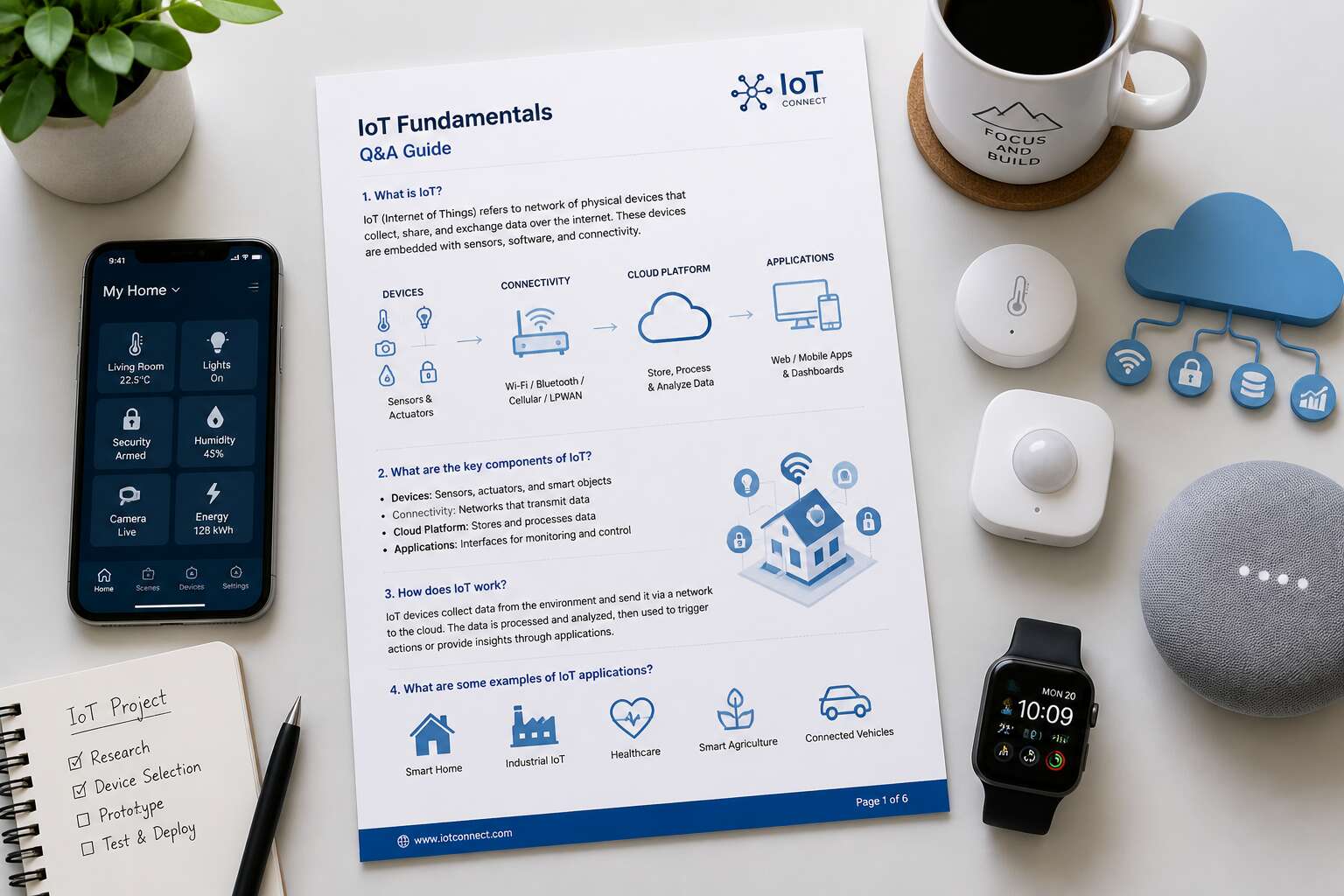
Core Concepts and Architecture
Defining the IoT Ecosystem
A single sensor is worthless without a system to interpret it. That system, the IoT architecture, operates across three tiers: edge, fog, and cloud. The edge captures raw signals. The fog, often a local gateway, filters and prioritizes data based on latency requirements. The cloud performs heavy analytics and orchestrates updates. This distribution prevents network congestion and keeps critical decisions close to the source!
Consider a typical deployment:
- Edge nodes handle real time control loops
- Gateways aggregate telemetry and enforce security policies
- Cloud services store historical patterns and train predictive models
An internet of things questions and answers pdf rarely explains these boundaries. Yet without them, the ecosystem loses coherence. I have watched teams assume all intelligence belongs in the cloud, only to suffer from response delays. The architecture defines the balance between speed and depth, and that balance must be explicit.
Understanding Device-to-Cloud Communication
Device to cloud communication defines the relationship between physical infrastructure and digital insight. The path from a sensor to a dashboard passes through protocol handshakes, payload formatting, and retransmission logic. MQTT dominates telemetry because its publish subscribe model handles intermittent connectivity well. HTTP works for request response patterns, though it carries more overhead per transaction.
The common failure I observe is treating all data as equal. A temperature reading every minute and an emergency alert are not the same packet. They demand different quality of service levels.
- Normal telemetry can tolerate delays.
- Alarm conditions require immediate delivery.
- Firmware updates need reliable chunked transfer.
An internet of things questions and answers pdf should clarify these distinctions. Most engineers default to one protocol, then wonder why their network degrades. Protocol selection is a business decision with technical consequences. A proper internet of things questions and answers pdf explains why device to cloud communication demands this level of intentionality.
Exploring Edge vs. Cloud Computing
In South Africa, load shedding has taught engineers that connectivity is a privilege, not a guarantee. The cloud stores vast archives, but the edge processes immediate truths. Architectural decisions cannot rest on preference. An internet of things questions and answers pdf must map where computation belongs. A sensor in a Johannesburg substation measures current flow every hundred milliseconds. Sending each reading to a distant data centre creates a delay that corrupts the moment.
Certain burdens belong to the edge, and they demand particular attention:
- Response time, measured in milliseconds, not seconds.
- Data reduction, filtering noise before transmission.
- Autonomy, functioning without external connectivity.
The same internet of things questions and answers pdf should warn against absolute positions. Edge and cloud are not rivals. They serve different intervals of truth. The edge handles the moment; the cloud handles the memory.
Connectivity and Protocols
Comparing MQTT and HTTP
MQTT and HTTP approach connectivity from different angles. MQTT uses a broker to manage topics, allowing devices to publish and subscribe without knowing each other. HTTP relies on direct client-server requests, which suits fetching web pages but struggles with always-on sensor streams. When bandwidth costs money, as it does on many cellular IoT plans in South Africa, MQTT’s smaller packet size wins.
The practical differences surface during deployment:
- MQTT maintains persistent connections, which suits low-power devices.
- HTTP opens a new connection per request, which adds overhead.
For anyone compiling an internet of things questions and answers pdf, this distinction explains why many deployments choose MQTT for telemetry. They reserve HTTP for configuration and firmware retrieval.
The Role of CoAP in Constrained Networks
On a dusty South African farm, a soil sensor wakes every fifteen minutes, transmits 40 bytes, and returns to sleep. It will run for years on two AA batteries. CoAP, the Constrained Application Protocol, makes that possible with its lightweight design over UDP.
Where HTTP piles overhead onto every request, CoAP uses a binary format that fits meaning into a handful of bytes. It also supports observation, which lets devices subscribe to changes rather than polling endlessly. That single feature reduces network chatter dramatically.
– It manages retransmission with simple timers.
– It maps to HTTP for bridging.
– It runs on microcontrollers with limited memory.
Anyone compiling an internet of things questions and answers pdf will recognize this protocol as essential for constrained networks.
Managing Network Latency
Every millisecond of network delay carries a cost. In a connected factory, that cost shows up as damaged parts and stopped lines. I have watched engineers blame the hardware when the real culprit was a chatty protocol!
Most latency hides in the network stack, not in the physical signal. Queuing at busy gateways, TCP backoff after a dropped packet, and verbose headers all add up. The fix often comes from reducing round trips, not from upgrading the radio. Persistent sessions and asynchronous message flows let data move without waiting for handshakes.
Keep these principles in mind:
- Use binary payloads instead of text-heavy JSON.
- Keep connections alive with heartbeat intervals tuned to the network.
- Measure latency under real load, not in the lab.
A millisecond saved in a control loop can mean the difference between a smooth stop and a collision. That is the kind of tradeoff that belongs in an internet of things questions and answers pdf. A good internet of things questions and answers pdf should cover these choices with real numbers, not abstract theory.
Security Protocols in IoT
Security in IoT is less about encryption and more about identity. A strong cipher means nothing if the device authenticating is a stranger. I have watched teams chase brute force attacks when the real hole was a certificate that never expired. These tradeoffs belong in an internet of things questions and answers pdf because engineers need to see the real consequences of protocol choices.
TLS works well on TCP, while DTLS handles UDP without losing the datagram model. Both rely on certificates that expire and rotate. In practice, many failures come from poor certificate lifecycle management, not from broken cryptography. A device with a valid key can still be a liability if it talks to the wrong server.
Here is what to document:
- how keys are provisioned at manufacturing time
- whether the device supports mutual authentication
- what happens when a certificate is revoked
An internet of things questions and answers pdf should explain these details with concrete scenarios, not just protocol names. That is what helps a team survive a real deployment.
Data Management and Analytics
Handling Streaming Data
A river of sensor readings, a torrent of telemetry, this is the raw heartbeat of a modern deployment. The velocity is startling; every second yields thousands of data points from a single factory floor. Storing all of it for later analysis is a fool’s errand, a costly graveyard of unused bits. The true craft lies in making decisions at the speed of the stream itself. We must process the data as it flows past, capturing only the essential anomalies and patterns for deeper inspection.
This reality changes the architecture of our data platforms entirely. A traditional database, with its rows and columns, struggles with the sheer volume. We need a different approach, one that treats data as a fluid. This is where stream processing engines come into play, acting as filters and routers for the constant flow. They allow us to perform calculations on the fly, calculating averages, detecting sudden spikes, or triggering alerts the moment a threshold is crossed.
For those seeking a foundational grasp of these concepts, an internet of things questions and answers pdf can be an invaluable tool, offering a structured overview of the ecosystem. However, the practical application involves two distinct phases:
– The first phase is immediate action. This is the realm of real-time analytics, where a response is needed in milliseconds.
– The second phase is about deep reflection. This involves moving filtered, high-value data into a data lake for historical analysis and machine learning model training.
The result is a dual-tier system. The first tier is lean and fast, dedicated to the now. The second tier is vast and patient, building a picture of the past. Both are essential, but they serve different masters. Without this division, your network becomes a bottleneck, and your insight remains buried under a mountain of raw noise. Managing this flow is the quiet art that separates a demonstration project from a truly intelligent operation.
Storing Time-Series Data
Time-series data arrives with a timestamp and a value. That simplicity hides a challenge. Storage efficiency depends on acknowledging that data’s value decays with age. A reading from five minutes ago may be critical. A reading from five years ago is likely a statistical echo.
We must decide what to keep and how to keep it. In South Africa, where bandwidth is costly, this selectivity matters for operational budgets. Consider these storage principles:
- Retention policies that define the lifespan of raw data
- Downsampling to reduce resolution over time
- Compression algorithms tuned for numeric sequences
Query speed depends entirely on storage structure. Relational databases struggle with billions of time-stamped records. Time-series databases index by time, not by row. That difference shapes everything downstream. An internet of things questions and answers pdf clarifies these storage models for teams making architectural decisions.
Extracting Insights with Machine Learning
In the Karoo, a single sensor array on a farm can generate thousands of readings daily. That raw data means nothing until we shape it. Machine learning finds the patterns we cannot see by hand. It predicts water shortages before they arrive. It flags faulty equipment while it still works.
An internet of things questions and answers pdf helps teams understand these workflows. It explains how to structure data pipelines and where analytics fits in the broader system. Teams often consult an internet of things questions and answers pdf when deciding which models to trust.
What we extract from data depends on what we ask. Common questions include:
- Which devices fail most often?
- When does energy usage spike?
- Which readings predict downtime?
Answers come from clean, well-labelled data. Without that foundation, models fail quietly.
Data Governance and Privacy
Three out of five IoT initiatives stall because data ownership is unclear. Every sensor reading is a liability until it is labelled, versioned, and secured. Governance turns raw telemetry into a defensible asset. An internet of things questions and answers pdf often clarifies who owns the data, how long it persists, and which systems may access it.
Privacy adds another layer. South African teams must reconcile operational needs with POPIA obligations. Consent, anonymisation, and audit trails shape analytics from the ground up!
- What data do we collect and why?
- Who can reidentify a device or person?
- How do we purge obsolete records?
These questions force clarity before deployment. When analytics stumble, the cause is rarely compute power. It is poor lineage and murky permissions.
Real-Time Analytics Pipelines
A real time analytics pipeline moves IoT data from edge sensors to decision engines within moments. The pipeline must tolerate network interruptions, out of order messages, and fluctuating loads. A common internet of things questions and answers pdf addresses pipeline failures, but the deeper issue is often schema drift. Sensor firmware updates can introduce fields that break downstream transformations.
South African deployments, from mining shafts to municipal water meters, push data through these pipelines under unstable power conditions. Buffer management matters. So does idempotent processing, because a retried message should not distort a rolling average. Teams need observability into every stage.
Consider the order of pipeline components:
- ingest raw telemetry,
- normalise timestamps,
- validate payloads,
- enrich with device metadata
Each step hides a failure mode. A malfunctioning gateway can inundate the ingress, a stale time zone can scramble ordering, and a missing lookup table can produce empty enrichment fields. The pipeline is only as reliable as its weakest transformation, not its fastest processor.
Security and Privacy Concerns
Common Attack Vectors
Security flaws in IoT ecosystems often follow predictable patterns. I have watched attackers succeed simply by scanning for devices with default credentials or exposed debug ports. Common attack vectors include:
- Botnet recruitment via Telnet or SSH brute forcing
- Packet sniffing on unencrypted MQTT channels
- Dependency confusion attacks on firmware update pipelines
Every vector exploits the tension between usability and verification. Many devices ship with convenience prioritised over security, leaving quiet pathways into corporate networks. Privacy erosion follows quickly. An internet of things questions and answers pdf frequently catalogues these risks, yet organisations still underestimate the damage a compromised sensor can unleash.
Encryption Strategies
Encryption is the final barrier when every other control fails. I have watched compromised sensors leak metadata while the payload stayed unreadable, and that distinction matters more than most architects realise.
Privacy concerns in IoT are not abstract. A smart meter reveals when a home is empty. A fleet tracker exposes delivery routes. The internet of things questions and answers pdf often frames these as technical problems, but they are fundamentally human ones.
Consider the encryption strategies that actually hold up:
- End to end encryption at the application layer, not just TLS in transit
- Key rotation schedules that outlive device lifespans
- Hardware backed secure elements for certificate storage
Without these, encryption fails where it matters most. The data is protected in motion but exposed at rest, or worse, the keys sit in plaintext firmware waiting for extraction. An internet of things questions and answers pdf rarely captures that failure mode.
Device Authentication Methods
Most privacy failures trace back to weak device identity, not exotic hacking. When a cheap sensor authenticates itself with a hardcoded credential, it exposes the entire network. The internet of things questions and answers pdf often covers this superficially, but the practicalities are messier!
Effective authentication methods vary by device capability. For constrained devices, consider:
- Mutual authentication using pre-shared keys
- Certificate based authentication with short lived tokens
- Device identity bound to a secure element
Each method changes the risk profile. A fleet of metering devices in South Africa faces different threats than home assistants. Load shedding complicates certificate renewal, forcing engineers to design for offline authentication. I have watched systems fail because a vendor reused one private key across thousands of units. The core question is whether the authentication method survives physical compromise. If the key is extractable, the privacy benefit disappears. A generic internet of things questions and answers pdf will not tell you which method suits your deployment, so examine your threat model first.
Compliance with GDPR and Other Regulations
GDPR compliance grows complicated when your devices span multiple jurisdictions. A sensor in Johannesburg transmitting to a server in Frankfurt triggers both POPIA and GDPR obligations. The internet of things questions and answers pdf rarely addresses this dual compliance burden. Data minimisation, purpose limitation, and breach notification timelines shift depending on where data lands. For South African deployments, POPIA adds its own layer. Consent must be explicit, and cross-border transfers require careful documentation.
Consider what changes when a device is sold secondhand or decommissioned. The data lifecycle does not end at the device. Regulators expect you to track every byte. I have seen projects stumble here. They design for functionality first and compliance second. That order creates risk. A compliance-first approach changes procurement, architecture, and vendor contracts. The paperwork is tedious, but the alternative is worse.
Real-World Use Cases and Problem Solving
Smart Home Implementation Quandaries
In Soweto, we often see a smart irrigation controller misbehave in direct sun. The midday heat collapses the sensor’s voltage, tricking the valve into flooding the lawn. The fix is not a bigger battery but a scheduled ping from the hub during peak irradiance. This patterned nudge keeps the device reliable.
Neighbouring networks add another layer of interference. A street lined with twenty smart meters can reduce the bandwidth available to a new driveway camera. Switching the camera to the five gigahertz band clears the congestion.
When troubleshooting a failing actuator, try these steps in order:
- Confirm the last firmware update did not reset the timeout.
- Test the controller with a temporary hardwire connection.
- Watch for unexpected spikes during load shedding.
Many engineers keep an internet of things questions and answers pdf on hand to match these symptoms against field tested fixes. It saves hours of guesswork!
Industrial IoT Troubleshooting Scenarios
Industrial settings in South Africa present their own failure patterns. A conveyor belt sensor in a Rustenburg mine may report false jams when dust accumulates on its optical lens. The controller receives the error, halts production, and loses thousands of rand per hour. The remedy involves scheduled cleaning, not replacement. A single internet of things questions and answers pdf often captures these recurring faults and their field tested fixes!
Consider a water treatment plant in Cape Town. Its pH probes drift after each chlorination cycle. Technicians work through a short sequence:
- Verify the probe calibration log against the maintenance schedule.
- Inspect the reference junction for salt buildup.
- Re-run the baseline test after rinsing with distilled water.
When I visit operations, engineers who keep such checklists cut their response time in half. The internet of things questions and answers pdf becomes the team’s reference tool, turning isolated incidents into repeatable procedures.
Wearable Device Data Accuracy
A worker’s wristband in a Johannesburg logistics hub kept flagging cardiac stress during routine forklift operation. The data stream said one thing, the worker’s actual condition said another. These phantom alerts erode trust in the entire monitoring ecosystem. I have seen operators disable such wearables entirely when false positives persist.
The culprit was often the optical heart rate sensor struggling against dark skin tones and ambient warehouse lighting. The fix had nothing to do with the hardware itself. It involved adjusting the signal processing threshold in the gateway configuration. A well maintained internet of things questions and answers pdf contains this exact troubleshooting path.
– First, cross reference the device’s raw photoplethysmography signal against a manual pulse check.
– Next, examine the wear position and strap tension for movement artifacts.
– Finally, verify the firmware version handles the specific lighting conditions of that facility.
Technicians who consulted that reference document resolved the data integrity issue within hours, not days. The wearable returned to service and the alerts became trustworthy again. Isolated problems become documented procedures, and that documentation becomes the team’s collective memory. When a new intern faces the same strange readings, they open that same internet of things questions and answers pdf and find the answer waiting for them.
Agricultural Sensor Network Issues
A vineyard in Stellenbosch deployed a mesh of soil probes to automate irrigation. Within two weeks, the system began opening valves during the night, saturating the root zone before dawn. The sensor network reported consistent moisture deficits, but the physical samples told a far different story. This kind of contradiction is why a dependable internet of things questions and answers pdf becomes an essential tool for field technicians.
The primary failure mode involved the proprietary capacitance probes drifting from their baseline calibration. Temperature swings between the valley floor and the mountain slopes caused the readings to skew. A simple remediation sequence solved the dilemma:
– Map the affected nodes against the local topography.
– Recalibrate the probes using the gravimetric method for three consecutive mornings.
– Flash the updated soil moisture algorithm to the local gateway.
After this intervention, the irrigation cycles aligned with the actual evapotranspiration rates. The maintenance team logged the entire process in their reference document, ensuring the intern team would not repeat the same cycle of guesswork. That collective reference remains the cheapest insurance for any sensor deployment.
Smart City Infrastructure Challenges
A city running on sensors is a city running on assumptions. In Tshwane, we watched bus priority signals work beautifully until load shedding exposed a gap in the backup power chain. The routers survived, the fibre switches did not, and the morning commute became a parking lot. That failure mode now lives in a shared internet of things questions and answers pdf, one that field crews consult before touching any cabinet.
Streetlight networks follow the same pattern. The mesh looks stable during the day, then drifts at night when the temperature drops and radio retries pile up. A technician with a proper internet of things questions and answers pdf spots the signature within minutes.
Common failures include:
- Switch misconfiguration after firmware updates
- Sensors returning stale values after power events
- Backhaul saturation during peak pedestrian hours
Scalability Problems in Production
When a municipality in Gauteng scaled its water metering from 200 devices to 20,000, the backhaul collapsed first. The internet of things questions and answers pdf noted the symptom: a burst of stale readings every morning when the offices powered on. The fix was not more bandwidth. It was a staggered wake-up schedule.
Scalability problems usually surface as small anomalies. A technician who has seen a one thousand device deployment break can spot the pattern in a production environment before the dashboard turns red.
Common production scaling pitfalls:
– Assuming gateway CPU is idle when it is polling
– Firmware update storms that rebuild the entire mesh
– Queue buffers that fill silently during load shedding
The internet of things questions and answers pdf logs each case with the exact signature, so the next engineer does not have to invent the cure.
Exam Preparation and Career Guidance
Frequently Asked Interview Questions
A recent industry survey indicated that over 60% of IoT deployments stall during the integration phase, a stark reality for engineers entering the field. As such, your preparation for technical interviews must move past simple definitions and into the realm of operational failure modes. I tell candidates to expect scenario-based questions that probe how you handle brownouts, certificate expiry, or protocol mismatches. The practical nuance often separates a promising applicant from a seasoned practitioner.
Your foundational knowledge is a given, but your approach to ambiguity is what we assess. If you have not organized your study materials, I strongly suggest consolidating your notes into a single, searchable document. Many professionals now use an internet of things questions and answers pdf to structure their revision, ensuring they review diverse topics from hardware constraints to data lifecycle management.
For those looking to sharpen their edge, consider what an interviewer is actually probing with a basic query. They are listening for your mental models regarding system resilience and data fidelity. You might find it helpful to structure your thinking around these core areas:
– The operational lifecycle of a connected device from provisioning to decommissioning.
– Strategies for handling intermittent connectivity in remote deployments.
– Methods for validating sensor data integrity at the point of ingestion.
The psychological weight of an interview often hinges on your ability to articulate complex tradeoffs clearly. When discussing career growth, do not merely list the certifications you hold. Instead, discuss a specific instance where you diagnosed a particularly gnarly issue that was not documented in the manual. That narrative of discovery is worth more than a thousand memorized facts. Building a portfolio of such stories is the most effective way to demonstrate your value, far more persuasive than quoting specifications. It shows you can navigate the messy reality of the field. This narrative depth is what recruiters in Johannesburg and Cape Town are actively seeking, and it is what ultimately secures the role.
Certification Pathways
When preparing for IoT certification exams, I notice many candidates overvalue memorization and undervalue scenario analysis. The CompTIA IoT+ and vendor tracks from Cisco or AWS test your ability to reason through deployment tradeoffs. Building a curated internet of things questions and answers pdf from your own project failures carries more weight than any official study guide.
Certification pathways should follow experience, not precede it. South African employers in tech hubs value practical diagnosis over paper credentials. The most effective revision habits are rarely glamorous:
- Hands-on lab work, not flashcard review, drives pass rates.
- Vendor practice exams expose weak areas faster than rereading manuals.
- Peer-reviewed project postmortems mirror the interview format.
That archive becomes your interview narrative, proof of resilience rather than a list of facts.
Building a Home Lab for Practice
Most candidates I meet have never watched a device fail in person. A home lab changes that. Start with a Raspberry Pi, a few sensors, and a secondhand router. That is enough to break things on purpose! When you troubleshoot a failing MQTT broker at 2am, you learn more than any internet of things questions and answers pdf can teach you.
Document everything. Note what broke, why it broke, and how you fixed it. Build small projects that fail. Then rebuild them properly. Your lab becomes the place where real deployment scenarios unfold.
Keep these habits:
- Start small and expand gradually
- Break devices deliberately to practice recovery
- Log every failure in a personal archive
That archive is what South African employers want to see. It proves you understand tradeoffs. A curated internet of things questions and answers pdf built from your own notes will carry more weight than any official guide.
Resources for Continuous Learning
Exam preparation in this field is less about memorisation and more about building a mental map. A focused internet of things questions and answers pdf helps you test that map, but only if you use it to find gaps. Read each answer aloud. If you cannot explain it in plain language, you have not learned it yet.
South African employers value candidates who keep learning. The IoT landscape shifts quickly, so your study materials should shift too. Revisit your notes quarterly. Update them with new protocols, new failures, and new solutions.
For career guidance, follow local engineering forums and vendor webinars. They show which skills actually get used in production. Pair those insights with your own lab log. That combination beats any static study guide.
Resume and Portfolio Tips
An exam pass alone will not open doors in South Africa’s IoT market. The internet of things questions and answers pdf is useful for recall, but your resume must show what you built. Employers want proof of hands-on work. They look for projects where you wrestled with real hardware, not textbook scenarios.
Your portfolio should contain evidence of troubleshooting and iteration. Include a few items that show your process:
- A sensor node you repaired and calibrated
- A network capture that exposed a faulty handshake
- A short write-up of a security patch you applied
Each item should name the protocol and the constraint you worked around. This beats a list of technologies. When updating your resume, revisit the internet of things questions and answers pdf to check which concepts you actually mastered. Employers notice candidates who refresh their portfolio quarterly in a field where skills age quickly.




0 Comments