Decoding the Hardware and Sensors
Main Control Hub and Connectivity
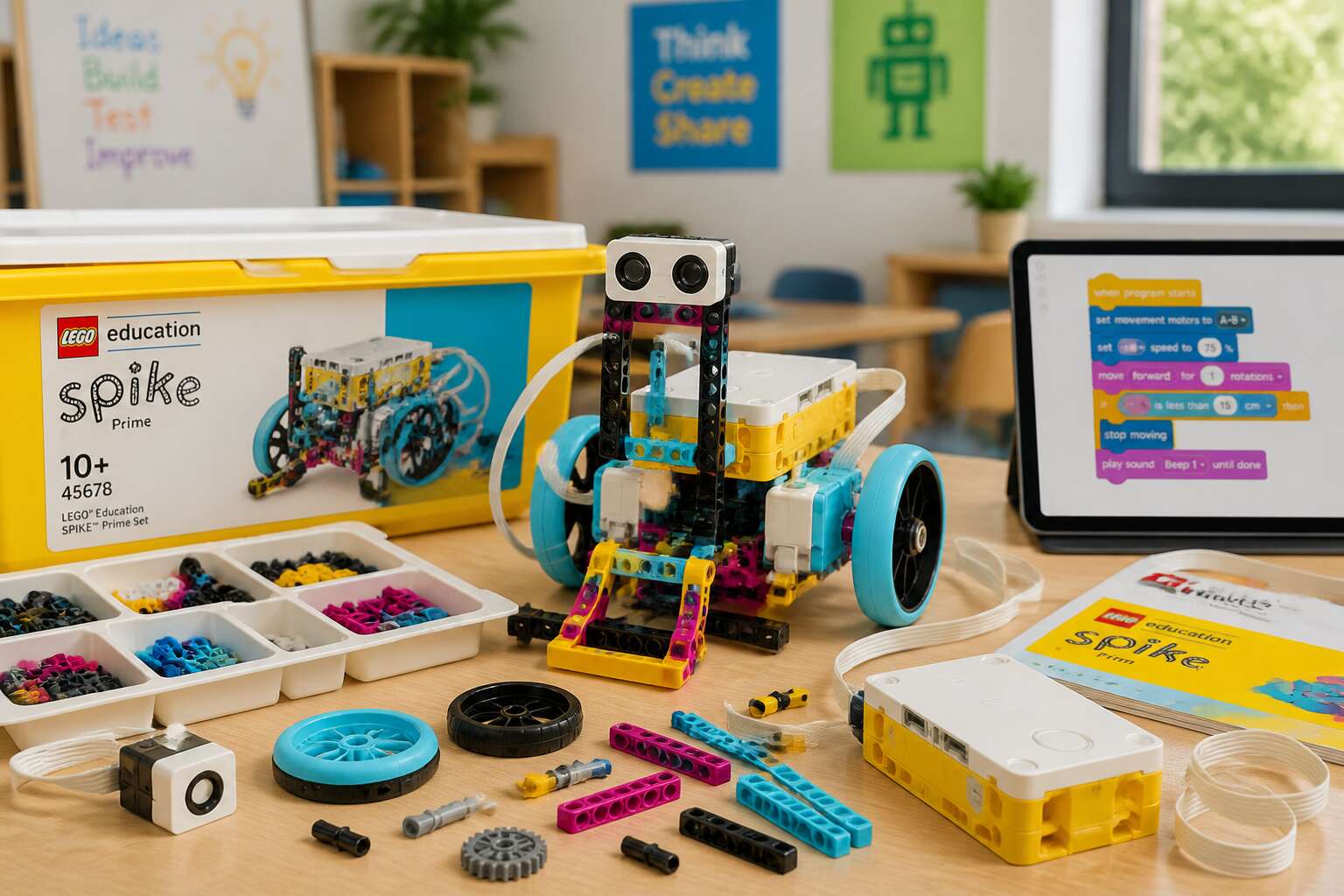
There is a comforting clatter when you open a fresh Spike Prime robotics kit, a sound that promises something tangible. What stood out for me, however, was the central processing unit, the main control hub. It feels like the nervous system of the entire build, a sturdy brick with a 5×5 light matrix that acts as a literal window into the machine’s logic. The matrix can convey a scrolling message or a simple, flashing pattern, offering immediate feedback that feels almost personal. It is not just a holder for wires; it is the pulse you will learn to read.
The hub’s connectivity options are straightforward, much like the modest infrastructure of a farm’s main power line. This system relies on solid, dependable links to its six input and output ports. These ports are cleverly designed with a directionless connector, meaning you no longer have to wrestle with teaching a child which side is up. Connecting motors and sensors is as simple as pushing a cable in, and the included wires are surprisingly robust, designed to withstand the enthusiastic tugs of a curious mind.
Here is a quick look at the core connectivity options that define the system’s flexibility:
– Bluetooth connectivity to pair with tablets or computers.
– A USB port for direct, wired communication and charging.
– Six general-purpose ports that auto-detect the connected component.
Through this hub, you can manage motor power and read sensor data without a tangled mess of adapters. For those of us who value motion, the integrated 6-axis gyro sensor is a quiet marvel, measuring the robot’s orientation and acceleration to keep it balanced. Furthermore, this same Spike Prime robotics kit hub supports a speaker output for sound, which adds another layer of feedback to your debugging process. The architecture is built to be tinkered with, and the connection points feel secure and logical, allowing for a level of experiment that mirrors the trial and error of cultivating a new field.
Motor and Wheel Assembly
Every pivot begins with the wheels. The spike prime robotics kit includes wheels with a soft rubber rim that grips classroom floors without leaving marks. The motors inside each hub connect directly to these wheels via splined axles, and the connection feels solid. I gave the wheel a spin, and the smoothness surprised me!
Beyond the wheels, the sensor set adds perception. A distance sensor uses infrared light to read objects up to 200 centimeters away. A color sensor distinguishes eight colors, and a force sensor detects three pressure levels. These sensors mount easily on any beam.
- Integrated encoders track every half-degree of rotation
- Dual motors allow differential steering
- Sensor ports accept all three sensor types
Sensor Suite for Real-Time Feedback
Twenty times per second, the spike prime robotics kit refreshes every connected sensor value. I watched this happen during a hands-on test. A hand moved toward the distance sensor, and the on-screen reading shifted instantly, no lag, no stutter.
That responsiveness comes from the firmware’s decoding layer. Raw voltages enter the hub and emerge as calibrated numbers. The software applies smoothing and offset adjustments automatically. A colour sensor reads the same hue under sunlight and fluorescent light alike.
- Sensors connect to dedicated ports with automatic identification
- Calibration offsets adjust for ambient conditions
- Values refresh on every program cycle
Real-time feedback means your program always sees current conditions. You write code against live data, not stale readings.
Building Elements and Design Flexibility
Sensors and motors get the applause. A humble beam rarely draws any. Yet the quiet confidence of any Spike Prime robotics kit comes from these overlooked elements. The studless beams, pins, and connectors follow a precise geometric grid inherited from the classic Technic system. That measured spacing lets you graft pieces from other kits.
Consider the quiet contributions of each element:
- The studless beam supports clean side mounted structures.
- The friction pin holds a joint firmly under load.
- The angle connector shapes frames for turrets, arms, or stabilisers.
Design flexibility means nothing remains permanent. A claw becomes a fork lift in minutes. A wheeled rover transforms into a walking mechanism with fresh axles. One afternoon I rebuilt the same robot three times. Each reincarnation shifted its centre of gravity, turning circle, and temperament. The sensors handle the seeing, the motors handle the moving, and the beams decide whether the whole contraption holds together with grace. Honestly, that is where the magic lives.
Mastering the Programming Environment
Block-Based Coding for Beginners
Coding a beginner project on the LEGO Education Spike Prime robotics kit starts with a single block. The programming environment uses colour coded tiles that connect on a virtual canvas. You click an orange event block, then add yellow action blocks underneath. The robot executes in that exact order.
For a novice, the intuitive layout reduces frustration. You can see the entire sequence as a clear list. Build a simple movement sequence this way:
1. Start block to trigger the program
2. Motor block to drive forwards
3. Wait block to pause for a set time
Each block is one instruction. The arrangement defines the logic. As you experiment, you learn to debug by rearranging blocks rather than rewriting code. The Spike Prime robotics kit turns abstraction into something tangible.
Text-Based Python Integration
Python’s syntax demands precision, but the spike prime robotics kit turns that rigor into a direct interaction with hardware. Once you master the block environment, text based Python integration opens a deeper layer of control.
The programming interface lets you switch between block and text modes in the same project. This means you can prototype a sequence visually, then inspect the generated Python code. The correspondence is direct! A loop in blocks becomes a while loop in text, and the robot behaves identically.
- Live console output for debugging
- Variable inspection during execution
- Access to sensor calibration routines
For South African educators, this dual approach supports a gradual progression from visual logic to industry standard syntax. I see learners grasp the same motor commands expressed two ways, which demystifies abstraction without sacrificing practical engagement.
Firmware Updates and Compatibility
Firmware updates arrive through the SPIKE app, and they reshape how the hardware interprets your commands. The spike prime robotics kit depends on this periodic refresh to keep sensors, motors and the hub functioning correctly, and LEGO Education releases these updates regularly.
Before you begin an update, several conditions matter:
- A stable internet connection on the host device
- A hub charged to at least half capacity
- The latest version of the SPIKE app for your operating system
Compatibility extends beyond the app itself. The software runs on Windows, macOS, iOS, ChromeOS and Android devices, which gives South African schools flexibility when choosing hardware. I have seen institutions pair the spike prime robotics kit with older classroom laptops without issue, provided those machines meet the published minimum specifications. LEGO Education maintains a compatibility chart on its support page, and schools frequently reference it during procurement planning.
Bringing Robotics into the Classroom
Curriculum Alignment and Lesson Plans
In South Africa, the demand for computational thinkers far outstrips the number of graduates entering the field. The spike prime robotics kit offers a practical response to this gap, allowing teachers to embed authentic problem solving within the existing curriculum. Each unit can be mapped directly to CAPS requirements, turning abstract concepts into tangible challenges that meet assessment standards without disrupting the term plan.
Lesson plans built around this kit benefit from a clear progression. Students move from guided exploration to open ended design tasks, which supports differentiated instruction. For effective implementation, consider the following alignment points:
- Technology outcomes require iterative testing and documentation.
- Mathematics goals benefit from measurement and geometry challenges.
- Natural sciences link to motion, force, and energy investigations.
The result is a coherent learning pathway that respects teaching time while delivering measurable skills. Schools can adopt these frameworks incrementally, starting with a single grade and expanding as confidence grows.
Assessing Student Progress with Projects
Tests reveal what students memorised the night before. Projects reveal what they can actually build, break, debug and improve. When South African classrooms adopt the spike prime robotics kit, assessment shifts from final marks to ongoing evidence of growth.
During a build cycle, I watch students make choices. Do they revise the mechanism after a failed run? Can they explain the logic behind a sensor reading? These moments carry more diagnostic weight than a static answer sheet. To structure this observation, I track specific evidence across the build:
- How the student iterates after a design failure.
- Whether error analysis leads to a corrected approach.
- Which troubleshooting strategies emerge without prompting.
This evidence becomes the basis for feedback that speaks directly to the learner’s next step.
Managing Group Work and Resource Sharing
In my classroom, the spike prime robotics kit becomes a shared tool. Group work reveals thinking that tests cannot. One student assembles while another tests sensor angles. A third records what the code does. Resource sharing requires a rotation system. I set a timer and change roles every fifteen minutes. This keeps hands occupied and minds focused. To manage without chaos, I use a simple structure:
- One builder, one coder, one scribe.
- Rotate roles each time the alarm sounds.
- End with a group explanation of one failure.
That explanation becomes shared evidence. The spike prime robotics kit supports this division of labour because its components are modular. The same kit can serve two teams in a single period if teams alternate building steps. Managing group work is about timing, patience, and clear expectations.
Teacher Training and Ongoing Support
Between load shedding and limited budgets, the real obstacle in South African classrooms is teacher confidence. A spike prime robotics kit arrives, but without proper training, it stays boxed. I have learned that training must be practical and ongoing. A single session is useless. Instead, schools need a support loop.
My preferred model includes:
- Weekly code clinics where teachers troubleshoot together
- An online repository of tested activities
- Peer observation with a trained facilitator
This support network turns fear into familiarity. Training matters more than hardware.
Cost-Effectiveness for School Budgets
When I first saw the price tag on a spike prime robotics kit, I flinched. But the real cost is not the hardware. It is the unused kit sitting in a cupboard. A school that plans its budget around sustained use gets value. A school that buys one kit per class without a plan wastes its money.
Start small! Buy one kit, master it, then expand. The modular design means you do not need to replace parts every year. The same motors, sensors, and bricks survive multiple seasons if stored properly. A single kit can support a full year of lessons if the timetable rotates classes through a dedicated robotics period.
Consider a phased purchasing plan:
- One kit for the senior class in the first term
- A second kit for the junior class the following term
- Spare sensors and wheels for replacements
Beyond the Basics: Advanced Applications
Building Complex Mechanisms
Once students master the fundamentals, the spike prime robotics kit enables advanced mechanical exploration. Complex mechanisms emerge from layered gear trains and four-bar linkages, where torque and speed shift in opposite directions. I have watched teams assemble planetary gearboxes from the spike prime robotics kit to lift heavy loads, then rebuild the same components to launch lightweight projectiles across a room.
Advanced builds demand attention to friction and structural rigidity. The frame elements allow triangulated reinforcement, preventing flex during high-speed operation. Some educators introduce mechanisms that demonstrate intermittent motion:
- cam followers translating rotation into reciprocating movement
- ratchet systems permitting motion in one direction only
- differential gears distributing torque between two outputs
Others challenge learners to design walking robots with synchronized leg pairs. These applications extend beyond physical assembly. Programming complex mechanisms requires precise coordination of multiple motors and sensors, pushing students into sophisticated logic and systematic debugging.
Integrating Artificial Intelligence Features
A robot that learns feels more like science fiction than a classroom exercise, yet the spike prime robotics kit makes this tangible. Once students have mastered mechanical builds, artificial intelligence introduces a new layer of behaviour. Instead of simply reacting to a sensor trigger, a model can be trained to recognise patterns and make decisions.
Consider the range of AI projects:
- Gesture recognition using the colour sensor to interpret hand movements
- Predictive routines that identify wheel slippage before a crash
- Adaptive logic that changes robot speed based on surface reflection
These tasks push learners to gather data, clean it, and refine their own algorithms. The spike prime robotics kit transforms into a sandbox for machine learning, where patience and observation lead to genuinely intelligent machines.
Participating in Robotics Competitions
Competitions strip away the comfort of a classroom. The spike prime robotics kit becomes a tool of endurance, a thing that must survive the chaos of a crowded arena. I have watched teams sit in quiet dread while their robot re-evaluates a strategy mid-match, the sensors whispering warnings that only the coder understands.
In this landscape, the kit offers hidden strengths:
- Rapid reprogramming between rounds
- Robust hardware that withstands sudden shoves
- Modular design that allows quick repairs
The challenge is not the build; it is the interpretation. Every match is a story told in seconds. The spike prime robotics kit writes that story with precise, ruthless logic. South African teams find themselves in this arena, learning that victory is a discipline, not a reward.
Exploring the Online Community and Resources
Victory in the arena fades quickly. The spike prime robotics kit rewards those who continue after the final whistle. Advanced users push past standard builds, studying sensor fusion and sharing scripts that interpret raw data streams. The hardware survives the chaos; the code evolves with each iteration.
The online community becomes the archive of that evolution. I keep returning to a few resources:
- Official LEGO Education forums where engineers answer architecture questions
- GitHub repositories with community developed Python libraries for the hub
- South African teacher networks sharing classroom tested debugging methods
These online spaces turn isolated frustration into collective progress. A problem that stalls one team for hours gets solved by a stranger in another province within minutes! The spike prime robotics kit itself remains unchanged. The community around it does the changing.
Evaluating Against Other STEM Kits
Comparing Price and Value
The real question isn’t the sticker price. It’s what your learners gain over a full year. I’ve watched classrooms choose cheaper alternatives, only to discover limited sensors or fragile pieces that break mid-project. The spike prime robotics kit changes that equation. Its durable motors, precise feedback systems, and integrated software justify the initial cost. Consider the breakdown:
- Replacement parts cost less than rival systems.
- One kit supports multiple curriculum units.
- Free firmware updates extend its lifespan.
That’s value you can measure in student engagement, not just rand. Buyers often overlook these long-term factors when comparing kits side by side. The real comparison happens in week ten, not at checkout.
Hardware Durability and Expansion Options
When I evaluate STEM kits side by side, hardware durability comes first. Other systems often show worn gears or broken clips within months. The spike prime robotics kit handles rough treatment without losing calibration.
Expansion options matter just as much. I can integrate third-party components or add official extras. Consider what grows with your classroom:
- Extra motors and sensors plug in without extra adapters.
- Structural pieces allow taller, more complex machines.
That means one kit scales from basic builds to advanced projects. Few rivals offer this range without replacing the whole set.
Software Ease of Use
Software ease of use often separates a kit that gets used from one that gathers dust. The spike prime robotics kit keeps the learning curve gentle without dumbing down the experience. Other platforms force teachers to juggle multiple apps or deal with clunky installers. Here, the coding environment loads fast and behaves predictably, even on older school laptops in South African classrooms.
Students move between block-based coding and text-based Python without switching software. That continuity matters in a busy term.
- Drag and drop blocks snap together logically.
- Live output shows sensor readings instantly.
- Switching to Python keeps the same hardware workflow.
Few rivals offer this smooth transition. The result is less time troubleshooting and more time building with the spike prime robotics kit.
Technical Support and Documentation
Comparing STEM kits reveals that technical support often decides whether hardware gets used at all. The spike prime robotics kit keeps documentation current and searchable. South African teachers find troubleshooting guides that match the exact hardware version they own. Competitors often leave outdated manuals online, or bury answers in scattered forum threads.
A support response usually arrives within one working day. Help files cover sensor calibration, motor faults, and connectivity errors clearly. Several rival vendors expect teachers to rely on community forums where questions sit unanswered for weeks.
Documentation for the spike prime robotics kit prioritises real problem solving:
- Separate manuals for each hardware component
- Plain language troubleshooting steps
- Example programs that actually run
- A search function that finds relevant results
That proves more valuable than glossy marketing brochures. A teacher can resolve most issues during a lunch break.



0 Comments