The Conceptual Precursors and Ancient Foundations
Mythology, Automata, and the Ancient Dream of Artificial Life
The question of who created AI often leads to modern labs, yet the dream is far older. In Greek myth, Hephaestus forged Talos, a bronze giant, to patrol the shores of Crete. Ancient records also describe the mythical sculptor Pygmalion, whose carved statue Galatea was said to come alive. These stories blurred the boundary between craft and creation.
Long before any circuit existed, inventors built mechanical wonders. Hero of Alexandria designed automated theatre doors and self-moving statues in the first century CE. His works required no magic, only pressure, steam, and clever gears. Still, they stirred the same awe as myth.
- Sacred statues in Egyptian temples had hidden levers operated by priests.
- Yan Shi, a Chinese engineer, reportedly presented a life-sized mechanical figure to King Mu of Zhou.
These creations were not true minds, but they prove the deep human urge to manufacture life. So when we ask who created AI, remember that the answer begins with mythmakers and ancient engineers, not just coders.
Enlightenment-Era Philosophers and the Thinking Machine
When philosophers stopped asking whether statues could walk and started asking whether thought could be calculated, the story took a sharp turn. René Descartes suggested animals were clockwork, Blaise Pascal built a mechanical calculator in 1642 to help his father collect taxes, and Gottfried Leibniz imagined a universal language of reason that machines could process.
These Enlightenment thinkers laid the groundwork for who created AI, even without using the term. They treated logic as a set of operations. If thought follows rules, a machine could follow them too. The critical shift was simple:
- Mind as mechanism
- Reason as calculation
- Knowledge as symbols
That shift turned myth into mathematics. The question who created ai starts with these bold philosophers, long before twentieth century labs entered the scene.
Ada Lovelace and the First Vision of a Programmable Machine
By the 1840s, the question of who created ai was still premature. Ada Lovelace, an English mathematician, saw what others overlooked in Charles Babbage’s Analytical Engine. That machine, all gears and steam, never left the drawing board. Lovelace recognised its true purpose. Numbers were not its limit. The engine could manipulate any symbols, from musical notes to letters, if those symbols obeyed rules. Her 1843 notes introduced the first published algorithm. She wrote instructions for computing Bernoulli numbers. Babbage designed hardware, but Lovelace envisioned software. She speculated about machines composing music or generating graphics. She asked if the engine could think, and answered that it could only follow our commands. Yet her vision defined the relationship between instruction and execution. Who created ai? Lovelace never used the term, but she located its soul. Her insights turned a calculating machine into a general-purpose device. That shift gave computer science its earliest blueprint.
The Founding Fathers of Modern Artificial Intelligence
Alan Turing and the Imitation Game
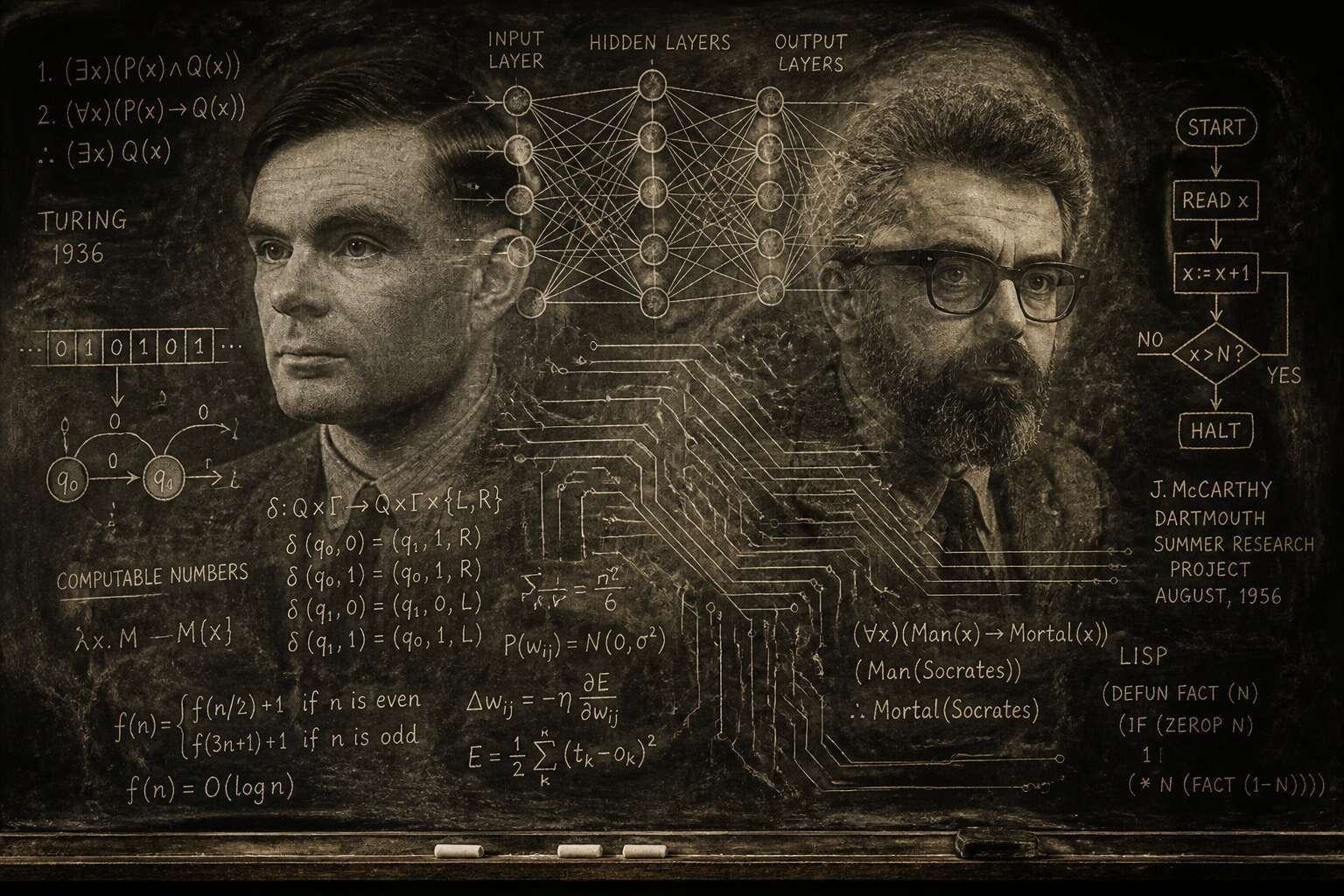
Alan Turing never built a machine that thought. He built something more enduring: a question. In 1950, his paper “Computing Machinery and Intelligence” made the boldest move in computer science. He discarded the impossible question “Can machines think?” and replaced it with a practical game.
The Imitation Game works like this. A human interrogator communicates with two unseen participants.
- One is a machine
- The other is a human
After a series of typed questions, the interrogator must decide which respondent is human. If the machine fools the interrogator, Turing argued, then it is thinking. This simple reframing turned philosophy into engineering.
When modern technologists ask who created ai, they rarely name a single inventor. They point to Turing, because his test supplied the first workable definition of machine intelligence. The question of who created ai becomes, in Turing’s shadow, a question of measurement. That definition still anchors how South African researchers evaluate conversational agents today.
John McCarthy and the Coining of the Field’s Name
John McCarthy gave the field its name in 1956. He organized the Dartmouth Summer Research Project and called the proposed study “artificial intelligence.” The term stuck! McCarthy did not claim to have invented thinking machines. He defined a research agenda. That agenda asked how machines might use language, form abstractions, and improve themselves.
When I ask South African engineers who created ai, they often name McCarthy. Turing measured intelligence; McCarthy named the pursuit. That distinction matters. Turing gave us a test. McCarthy gave us a discipline. His coinage transformed scattered experiments into a recognised field.
Marvin Minsky and the Rise of the MIT AI Lab
Marvin Minsky arrived at MIT in 1958, two years after McCarthy coined the term. To understand who created ai, you must look beyond naming ceremonies. Minsky built the Artificial Intelligence Laboratory with McCarthy, though McCarthy left for Stanford in 1963. Minsky remained and turned MIT into the epicenter of AI research.
Minsky believed intelligence emerged from many interacting mechanisms. He rejected the idea of a single master algorithm. His work on neural networks and frames shaped how researchers thought about knowledge representation.
At the MIT AI Lab, Minsky mentored a generation of pioneers. The lab produced early robotics, computer vision, and natural language systems. Students like Patrick Winston and Gerald Sussman carried the work forward.
The answer to who created ai includes Minsky as much as Turing or McCarthy. Turing measured intelligence. McCarthy named the pursuit. Minsky built the institutions. His 1969 Turing Award recognized contributions that remain foundational.
Claude Shannon and the Logic of Intelligent Machines
Shannon never claimed he was building AI, yet his theories gave the field its foundation. In 1937, his master’s thesis showed how electrical relays could solve Boolean algebra, effectively turning switches into logic. This single insight transformed telephone routing circuits into the conceptual ancestors of the modern computer.
He formalized the idea of information as quantifiable bits, not vague meanings. Intelligence, in Shannon’s view, relied on the practical transmission and processing of these discrete signals. His principles embedded themselves into every subsequent machine that would learn or reason:
– He equated computing with clear, binary states of “off and on.”
– He measured information independent of content.
– He designed physical machines that solved logic puzzles.
One could argue that to understand who created AI, you must credit the man who taught machines to speak in ones and zeros. His information theory gave other pioneers the raw vocabulary. Without Shannon’s groundwork, McCarthy’s naming ceremony would have had nothing to preside over. He handed the nascent field its mechanical grammar.
Norbert Wiener and the Birth of Cybernetics
Norbert Wiener gave the field a name for the machinery of control. In 1948 he published Cybernetics, a book that treated human nerves and machine circuits as two versions of the same feedback system. He called it the science of control and communication in animals and machines.
Wiener studied anti-aircraft predictors during the Second World War. He noticed that a gunner corrected a shot by observing the error and adjusting the next attempt. The action, the error, the correction. That loop became his central idea. It also became the basis for adaptive systems.
So when people ask who created ai, Wiener’s work matters because he explained how machines could correct themselves. His cybernetics influenced robotics, control theory, and early neural networks. He gave artificial intelligence a way to adjust based on outcomes, which remains central to machine learning.
The Dartmouth Summer Research Project of 1956
The 1955 Proposal and Its Ambitious Organizers
Ten researchers gathered at Dartmouth College in the summer of 1956. They came to settle a bold question. Who created ai? The answer is not a single inventor; it is a community with a shared ambition. The true origin lies a year earlier. In August 1955, four men drafted a proposal. That document introduced the phrase “artificial intelligence” to the world.
The proposal authors were:
– John McCarthy, a Dartmouth professor
– Marvin Minsky, a promising young mathematician
– Nathaniel Rochester, an IBM computer designer
– Claude Shannon, the father of information theory
They argued that machines could simulate every aspect of learning. They requested a summer of focused study. Ten people attended the workshop in 1956. Sessions were unstructured and often heated. No major breakthrough occurred on site. Yet the gathering gave the field its name and its purpose. Anyone who asks who created ai must credit this group. They built the foundation for every thinking machine that followed.
The Six-Week Workshop in Hanover That Changed Everything
The Dartmouth Summer Research Project lasted six weeks in Hanover, New Hampshire. It was less a conference and more a series of heated arguments among ten brilliant minds. They had no agenda, no formal papers, and no shortage of stubbornness. Yet from that raw friction, something extraordinary emerged: a shared conviction that machines could learn.
What actually happened on site defies simple summary. Consider the outcomes:
– A collective belief that intelligence was a mechanical process
– A network of researchers who continued collaborating for decades
– A stamp of legitimacy for a field that had been purely theoretical
For anyone wondering who created ai, those six weeks offer a clear answer. It was not a single flash of genius. It was a group of people who refused to let the idea die. That workshop turned a proposal into a movement, and the world has not been the same since!
The Key Attendees and Their Contributions to Early AI
The true deliverable of the Dartmouth Summer Research Project was not a finished machine, but a fellowship of ambitious theorists. The ten attendees who shaped early AI each brought a distinct obsession, and their subsequent careers defined the field’s initial architecture.
These men did not agree on methodology. Allen Newell and Herbert Simon arrived with a working program called the Logic Theorist. Marvin Minsky pushed for a more mechanical view of the mind, while John McCarthy advocated for formal logic. The friction between their approaches created a productive tension that outlasted the workshop.
The major contributions that followed are well documented:
– McCarthy invented the Lisp programming language, the dominant tool for AI research for decades
– Minsky built the first neural network machine, a cluster of vacuum tubes and motors
– Newell and Simon developed the General Problem Solver, an attempt to replicate human reasoning
– Claude Shannon formalised the use of Boolean algebra for circuit design
Each attendee left Hanover with a blueprint for the next decade. The group’s collective output, rather than a single invention, answers the question of who created ai. They were not all in one room for a single spark of insight. They departed as nodes in a sprawling network, and their collaborations built every branch of the discipline.
In this sense, the answer to who created ai is a committee, one that still shapes how researchers pose questions about cognition. The field was not born from a laboratory experiment or a corporate directive. It emerged from the stubborn refusal of ten people to accept that thought was beyond the reach of machines. That refusal persists in every modern algorithm.
Why Dartmouth Is Recognized as the Official Birthplace of AI
The answer to who created ai often points to one institution: Dartmouth College. The 1956 summer project held there gave the field its name, its founding questions, and its first shared agenda. No single machine emerged from those six weeks. What emerged was a consensus that thinking itself could be studied as a computational process.
Dartmouth’s recognition as the birthplace rests on this shift. Before 1956, the study of intelligent machines was scattered across disciplines like cybernetics and logic. After Dartmouth, it became a unified pursuit with a clear label.
The organizers made two bold claims that anchored the entire enterprise:
- Every aspect of learning could be described precisely enough for a machine to simulate it
- A machine could be built to actually do this
Those claims, first presented at Dartmouth, define the field to this day. When I ask who created ai, the honest answer is the collective effort that began on that campus.
The Immediate Impact and Lasting Legacy of the Gathering
The Dartmouth Summer Research Project of 1956 ended without a single working machine. Yet its immediate impact was a sudden alignment of minds. Researchers returned to their institutions carrying shared questions and a shared vocabulary. Within a decade, laboratories at MIT, Stanford, and Carnegie Mellon emerged directly from this convergence.
Its lasting legacy is less about specific inventions and more about perspective. I find it remarkable that the gathering established intelligence could be decomposed into symbolic operations. This framing guided decades of research and still shapes modern systems.
- It funded early explorations into problem solving and language
- It connected mathematicians, engineers, and psychologists
- It created a community where the question of who created ai became a collective story
That community persists. Honestly, the 1956 project did not answer every question, but it made them answerable!
The Institutional and Corporate Creators of AI
IBM and the Commercial Push for Intelligent Machines
IBM’s hand in the genesis of artificial intelligence is often overshadowed by the academic theatrics of Dartmouth, yet the corporation’s methods were arguably more tangible. While the philosophers and mathematicians wrestled with theory, IBM was wrestling with the commercial viability of machines that could think, a pursuit that required a particular kind of corporate courage. The question of who created ai does not have a single answer, but the archivists at Armonk, New York, unearthed a history that is both meticulous and slightly unsettling in its clarity. They showed a willingness to fund ambitious ideas and to build the physical infrastructure for a future that most could not yet see. This commercial push was a counterpoint to pure academia, grounding the field in the tangible world of cost, profit, and industrial problem solving.
Thomas J. Watson Sr. famously predicted a world market for maybe five computers, a quiet prophecy that suggested a tool designed for the few, not the many. Yet his company pursued the challenge with a singular focus, viewing intelligent machines not as an abstract curiosity but as a logical extension of their tabulation and data processing empire. This corporate appetite for intelligent machines drove research into pattern recognition and language translation, long before the public understood the potential of such things.
– IBM’s 701 mainframe, created in 1952, was not just a business machine; it was a research vessel for early AI experimentation.
– The company’s investment in Arthur Samuel’s checkers program during the 1950s proved that a computer could learn from its own mistakes, a form of machine learning decades ahead of its time.
– Deep Blue, the chess-playing supercomputer that defeated Garry Kasparov in 1997, was not a sudden creation, but the culmination of this long corporate obsession.
These efforts created a strange duality, where the prescient warnings of a thinking machine’s dangers were heard in the halls of academia, while the practical realities of creating one were being hammered out in the labs of industry. The answer to who created ai is thus not a single name but a confluence of forces. IBM showed that a corporation, with its resources and insistence on utility, could drive the field forward with a different kind of urgency. It was not the poetry of the mind, but the prose of the balance sheet that helped build the machine.
DARPA and the Military Funding That Turbocharged AI
While corporate labs pursued profit, the military pursued strategic advantage. ARPA, later renamed DARPA, poured millions into artificial intelligence research during the 1960s and 1970s. This funding answered who created ai in a practical sense: the defense establishment accelerated the field by decades.
The agency financed projects that seemed speculative to civilian investors. Machine translation, speech recognition, and autonomous vehicles all trace their lineage to DARPA contracts.
- DARPA funded the ARPANET, the precursor to the internet, enabling collaborative AI research across universities.
- The Strategic Computing Initiative in the 1980s injected billions into expert systems and neural network research.
- DARPA’s autonomous vehicle challenges in the 2000s directly shaped modern self-driving technology.
The question of who created ai cannot be separated from this military patronage. Academic genius required funding to flourish, and DARPA supplied it.
DeepMind, OpenAI, and the Modern Corporate AI Giants
Silicon Valley’s private labs turned artificial intelligence into a market force. DeepMind emerged in 2010, focusing on neural networks and reinforcement learning. Google acquired it in 2014. OpenAI followed in 2015, structured as a nonprofit to counterbalance corporate power. These competitors defined who created ai in the modern era.
They did not simply commercialise existing work. They invented new architectures and trained models at scales academia could not match. Large language models and game-playing algorithms arose from this environment. Corporate milestones now answer who created ai with precision.
- AlphaGo defeated a world champion through self-play in 2016.
- GPT series showed that billions of parameters produce surprising abilities.
Both firms employ hundreds of researchers, yet breakthroughs depend on engineering and data centres. Corporate incentives shape the field.
The Role of Global Collaborations in Advancing Artificial Intelligence
Global collaborations complicate the answer to who created ai. Research papers often carry authors from multiple countries. Universities share models across borders, and joint projects blur institutional boundaries.
Institutions such as the Allen Institute for AI and Mila in Montreal contribute openly. Their work complements corporate labs. Open source frameworks allow developers in Nairobi or Pretoria to fine tune systems built in Beijing.
- Academic consortia pool computing resources.
- Government agencies fund fundamental research in China, Europe, and South Africa.
- Independent researchers shape corporate roadmaps through published findings.
These efforts form a distributed ecosystem. The question of who created ai has no single answer, and that is a strength. Corporate giants dominate headlines, but scientific credit belongs to contributors across many time zones.
The Overlooked Creators and the Collective Human Effort
The Unsung Women Pioneers of Artificial Intelligence
According to the 2023 AI Index Report, women account for only 22% of AI researchers globally. That figure hides a more profound erasure. The standard answer to the question of who created ai remains a procession of men in university labs, but that narrative omits the foundational work of women who literally wrote the code and defined the logic.
Grace Hopper, for instance, created the first compiler in 1952, a necessary bridge between human intention and machine execution. Her work made programming a practical discipline rather than an engineering accident. Then consider Cynthia Solomon, who co-designed Logo in the 1960s, pioneering the very concept of teaching children through computational thinking. These creators did not just support the field; they established its pedagogical and operational foundations. Karen Spärck Jones further formalised the mathematical weighting of search terms, a principle that powers modern information retrieval systems. Their contributions were not auxiliary; they were structural.
– Dorothy Vaughan analysed early satellite trajectories at NASA, applying algorithmic precision to orbital mechanics.
– Margaret Hamilton developed the onboard flight software for the Apollo missions, creating the concept of robust, fault-tolerant computing.
– These women worked within teams, yet their individual authorship is often segregated to historical footnotes.
The collective effort behind AI is broader still. It includes anonymous data labelers in Nairobi and rural India who train modern algorithms, and the Eastern European mathematicians whose statistical theories underpinned machine learning decades ago. To ask who created ai is to confront a vast, distributed network of minds. The lab directors are the visible tip; the hidden workforce and the women pioneers form the silent, essential mass beneath the surface. Their intellectual labour is the substrate upon which the entire field stands.
The Mathematicians and Statisticians Who Built Machine Learning
The question who created ai obscures a quieter lineage: the statisticians who formalised learning itself. Andrey Markov devised stochastic processes to model sequential probabilities, a framework that now powers predictive text. Later, Vladimir Vapnik and Alexey Chervonenkis developed statistical learning theory, giving machines a principled way to generalise from data. These mathematicians worked without fanfare, often behind the Iron Curtain, where computing resources were scarce and intellectual credit was difficult to claim. Their insights were not abstract exercises. They were practical tools for handling uncertainty.
- Andrey Kolmogorov axiomatised probability theory, enabling rigorous error analysis.
- Richard Bellman created dynamic programming, a core of reinforcement learning.
- Leonid Kantorovich applied linear programming to resource allocation, a method used in modern logistics optimisation.
Their contributions, alongside the anonymous annotators who label datasets in Johannesburg and beyond, remind us that who created ai is a question without a singular answer. The visible pioneers stand on a vast statistical foundation, built by minds whose names rarely appear in the headlines.
The Open Source Movement and the Global Community of Coders
More than 50 million developers contribute to open source repositories each year. The question of who created ai finds an answer in this vast community. No single lab owns the intellectual roots of modern intelligence. A coder in Nairobi debugging a neural network library, a maintainer in São Paulo reviewing a pull request, a hobbyist in Seoul documenting a new algorithm. These contributors assemble the infrastructure that corporations rely on.
The open source movement transformed artificial intelligence from a guarded secret into a shared project. Tools like PyTorch and TensorFlow began as internal experiments. They became public utilities through collective effort.
A realistic answer to who created ai must include:
- The maintainers who sustain critical libraries
- The reviewers who catch subtle errors
- The documenters who make systems usable
Their unpaid labour drives the entire field. That is a remarkable outcome!
The Data Workers and Crowdsourced Human Intelligence
Data workers are the invisible hands of machine intelligence. They scrub noisy datasets, identify faces in photographs, and transcribe garbled voice notes. Their effort is tedious and precise. Anyone asking who created ai must consider these contributors, not just the engineers holding the credit.
Crowdsourced human intelligence scales beyond what any single lab could hire. Ordinary people answer questions, flag errors, and teach models to recognise sarcasm. This annotation work is uneven, sometimes undervalued, often repetitive. Yet it remains absolutely essential to every breakthrough we celebrate.
- Labeling medical images for diagnostic tools
- Rating content relevance for search systems
- Correcting grammar and tone in language models
The truth is uncomfortable. The more we automate, the more we rely on human judgement. So when we ask who created ai, the answer points back to us, to the quiet, anonymous labour that shapes every intelligent system we use today.
Why AI Was Ultimately Created by Thousands, Not One
No single creator surfaces from the fog. I have searched the records of machine intelligence, and I found a chain of anonymous hands instead. Somewhere, a laboratory assistant typed strings of code that never earned a byline. Somewhere, a linguist annotated thousands of sentences for a project whose credit went elsewhere. These workers shaped who created ai without expecting recognition.
Consider the overlooked ranks:
- The reviewers who checked every line of published research
- The engineers who documented systems for future generations
- The philosophers who asked uncomfortable questions about machine consciousness
This collective effort is the quiet machinery behind every innovation. We chase the legendary names, yet the true structure of AI was built by thousands of people whose labour remains invisible. Their efforts remain a nameless congregation! When someone asks who created ai, the answer should echo with that unseen multitude.




0 Comments