Understanding Robotics
The Anatomy of a Robot
Understanding the anatomy of a robot is essential for grasping what is robotics and coding at a fundamental level. Every robot relies on a precise arrangement of hardware and software. The physical structure, or chassis, is only the beginning. Within that frame, you find actuators that create movement, sensors that gather data from the environment, and a central processing unit that acts as the brain.
The true elegance lies in how these parts communicate. The brain issues commands, but without coding, those commands are just voltage. The code translates raw data into decisions, which is the real magic behind what is robotics and coding. A robot’s ability to perceive, plan, and act depends entirely on this synergy.
A typical breakdown includes:
– Actuators (motors, servos)
– Sensors (LIDAR, cameras)
– Controller (microprocessor)
– Power supply
Each element has a specific job. The controller executes the program, while the sensors feed it real-world variables. I find that examining these components clarifies how robotics and coding intertwine. Understanding the structure helps you appreciate the code that brings the machine to life.
Types of Robots Across Industries
Take one look at a grape-picking robot alongside a bomb-disposal unit and you might think they belong to different universes. Yet both depend on the same three elements: sensors to see, actuators to move, and code to decide. That common structure is what is robotics and coding in practice, and South African industries are applying it in different ways.
Mines use automated drill rigs that cut tunnels without endangering human crews. Port terminals in Durban stack shipping containers with robotic cranes that never tire. Hospitals deploy surgical assistants that filter out hand tremors. Each machine carries a different body, but the underlying discipline stays the same. Ask what is robotics and coding across these sectors and you will get a different answer every time, which is exactly the point.
Broad categories include:
- Articulated arms for welding and assembly
- Autonomous mobile robots for warehousing
- Agricultural units for weeding and harvesting
- Medical platforms for diagnostics and surgery
Key Components and Sensors
One sensor can mean the difference between picking a ripe fruit and crushing it. That single component turns raw voltage into a usable signal! Sensors detect light, pressure, temperature, and proximity. They convert these physical states into data streams that code interprets. In South Africa, agri-robots rely on spectral sensors to judge ripeness. Mining rigs use tilt sensors to stay vertical underground.
- Capacitive proximity sensors for touchless detection
- Encoders for rotational speed
- Strain gauges for mechanical load
Each unit produces a continuous signal. The coding layer decides what matters and what to ignore. That collaboration is what is robotics and coding in every deployed system.
Coding Essentials for Beginners
What Programming Languages Are Used
Ask a layperson what is robotics and coding and you will picture soldering irons and energy drinks. The reality involves debugging more often than driving. Programming languages are the tools. Python dominates because it reads like plain English. That quality helps when you are already swamped with sensor data. C++ suits microcontrollers where milliseconds matter. Scratch uses visual blocks that snap together, ideal for teaching sequence without syntax tantrums.
So what is robotics and coding once you remove the jargon? It is a human giving instructions to a machine.
- Python for quick iterations.
- C++ for direct hardware control.
- Block languages for accessible entry points.
Language choice depends on the robot’s task, not on what impresses strangers online. Wander into any robotics meetup in Johannesburg and you will hear the same argument. The process involves failure, correction, and repetition.
Logical Thinking and Algorithms
Before controlling a single motor, you must learn to think in sequences. Every movement a robot makes traces back to an algorithm, a precise set of instructions the machine cannot interpret unless you define each one clearly. This foundation is the essence of what is robotics and coding.
Beginners often confuse writing code with solving problems. Logical thinking means breaking a task into instructions so exact that ambiguity disappears. I find that most first attempts fail not because the syntax broke, but because the reasoning skipped a step!
- State the expected outcome first
- Order every action chronologically
- Test each condition before advancing
Learners in Johannesburg who persist through this process discover that debugging sharpens their own reasoning faster than any manual. This experience defines what is robotics and coding for those entering the field: a discipline where thought structures matter as much as hardware.
Control Flow and Loops
Control flow gives a robot permission to decide. Without it, the machine runs the same routine whether it faces a brick wall or an open corridor.
Conditional statements, the if-else logic of code, let the robot evaluate sensor readings on the fly. Loops then manage the repetition. For a robot navigating Johannesburg’s uneven pavements:
- Check the distance sensor
- If an obstacle appears within 30 cm, halt
- Otherwise, proceed forward
- Repeat this cycle automatically
This is what is robotics and coding at its core: responsive decision-making. Beginners often overcomplicate by writing endless instructions, yet a single while loop handles a thousand sensor readings. The result is a robot that behaves with purpose!
Debugging and Problem Solving
Debugging is where beginners discover the true nature of what is robotics and coding. A robot does not fail silently. It twitches, stalls, or spins in circles. The error message is often misleading. The real culprit could be a loose wire, a miscalibrated sensor, or a variable that never updates.
When a robot misbehaves, follow this sequence:
- Replicate the fault consistently
- Isolate the subsystem responsible
- Read the error log line by line
- Change one variable at a time
I once spent an hour chasing a logic bug, only to find the battery voltage had dipped below the sensor threshold. That experience taught me to check the physical system before blaming the code. Debugging forces you to question every assumption. It is the discipline that separates a machine that merely runs from one that actually works. And it is at the heart of what is robotics and coding.
The Intersection of Robotics and Programming
How Software Drives Hardware
Twelve lines of code can change a robot’s entire behaviour! That is the essence of what is robotics and coding: software writes the intentions, hardware executes them. Without code, a manipulator is just bearings and steel.
Consider a palletising robot in a Johannesburg warehouse. Its servos and encoders feed data to a controller running a compiled program. The program decides when to lift, where to place, and how fast to move. Alter a threshold constant, and the same unit handles crates or cartons with equal ease. This is why system integrators in South Africa prioritise software logic over mechanical tweaks.
Hardware provides constraints. Software provides choices. A firmware patch can add a new picking pattern without any physical modification. For anyone entering the field, mastering code is what separates the capable from the guessers.
Embedded Systems and Firmware
Pleasing robots are simple enough. The true alchemy of what is robotics and coding is buried in the firmware, a silent layer of instruction between lofty logic and mortal metal. This is where the intersection of robotics and programming gets intimate.
Embedded systems act as the robot’s nervous system, a collection of specialized microcontrollers that interpret raw electrical signals. Firmware is the permanence of that system, the hardcoded rituals that ensure a servo stops precisely or a sensor reports without hesitation. It is not a place for high-level abstractions. It is a matter of strict timing and resource allocation.
When you explore what is robotics and coding, you realize the conversation between the main processor and the motor driver is a negotiation of tolerances. In South Africa, where dust and heat impact hardware reliability, a good engineer knows the firmware must compensate for physical reality. The layers of communication are distinct:
1. The application layer decides the strategic goal.
2. The embedded OS manages task scheduling.
3. The firmware sits atop the silicon, translating bytes to voltage.
These layers ensure that the logic of the palletising robot in the warehouse translates directly to motor torque. Ultimately, coding for embedded systems is about trust. You trust the compiler, the clock cycle, and the silicon. It is less about flair and more about precision, a discipline that proves what is robotics and coding at its most fundamental level.
Real-Time Processing and Sensor Data
In real time, the robot does not have the luxury of reflection. Sensor data arrives as a continuous stream, each reading voltage and noise. The intersection of robotics and programming reveals itself here, where processing must happen within milliseconds or the machine stumbles. What is robotics and coding if not the art of making decisions inside a narrowing window? The controller must filter, fuse, and act on signals from encoders, gyroscopes, and proximity sensors.
A South African engineer managing heat and dust faces this familiar tension. The hardware degrades, yet the software must hold the line.
A typical real-time loop might include:
- Reading raw sensor values
- Filtering electrical noise
- Updating the robot’s state model
- Sending commands to actuators
Each step competes for a clock cycle. I have seen robots stumble on a missed cycle. That is the brutal poetry of the craft!
Autonomous Decision Making
Autonomous decision making requires a robot to act on incomplete information. The machine weighs options against its current state and its intended goal. This is where programming handles the noise of a real factory floor in Gauteng or a farm in the Free State.
I once watched a robot in a South African citrus packhouse decide to reroute a soft piece of fruit. No human intervened. The software ranked speed against damage risk. That moment captures what is robotics and coding: setting up rules that let a machine choose under pressure.
Such decisions rely on:
- Priority rules that resolve conflicts
- Cost functions that assign value to outcomes
- Finite state machines that change behaviour as conditions shift
These mechanisms turn raw information into a measured response. The result is a robot that acts decisively without waiting for a command.
Communication Protocols
Communication protocols are the silent syntax of robotic cooperation. Without them, sensors and controllers speak past each other, and a factory floor in Gauteng falls into chaos. Every message, from a torque reading to a stop command, follows a prescribed format. This is what is robotics and coding at its most fundamental level: defining the rules of exchange.
Programming sets who speaks first, how fast, and what happens when a signal drops. A robust protocol manages latency and error checking without burdening the system.
- TCP/IP for high-level command streams
- CAN bus for real-time control loops
- MQTT for lightweight sensor telemetry
In practice, a robot’s decision to reroute a soft fruit rests on these quiet negotiations. The code behind what is robotics and coding must anticipate partial failures, because a missing packet, not a broken motor, often halts production on a Free State farm.
Getting Started with Robotics and Coding
Beginner-Friendly Kits and Boards
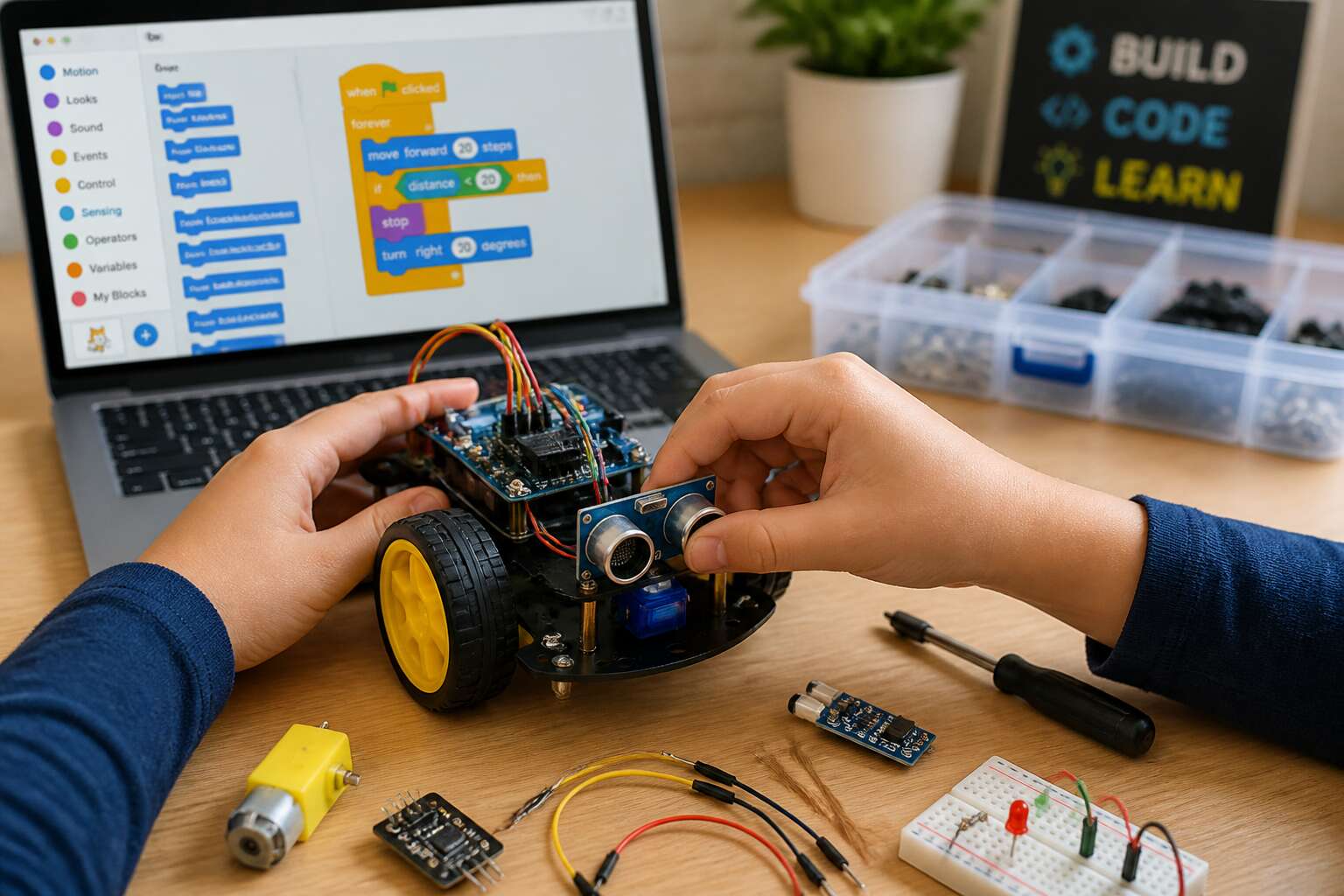
The first robot you build will likely wobble. It may not move at all. That is exactly where learning begins. For anyone exploring what is robotics and coding, a beginner friendly kit offers the fastest way to turn theory into motion. These kits bundle sensors, motors, and a microcontroller into one package.
In South Africa, popular boards include the Arduino Uno and the Raspberry Pi Pico. Both have strong community support. You write simple code, upload it, and watch your creation respond! A micro:bit works well for younger learners.
- Start with an LED blinking exercise.
- Add a button to control it.
- Mount a motor and test direction.
This sequence teaches input, output, and logic without overwhelming detail.
Visual Programming vs Text-Based Code
Every beginner faces this choice in the first week: drag blocks or type text? It shapes how they understand what is robotics and coding. Visual tools like Scratch or Blockly let colour-coded blocks snap together. Each block holds one command. No syntax errors, so a learner focuses on structure. Text-based code such as Python or C++ demands exact typing. The computer reads each line literally, and a missing colon halts everything!
South African learners often start with visual blocks on a micro:bit, then shift to text for finer control. Visual programming teaches sequence and logic. Text-based code teaches precision and grammar. Both build the same underlying reasoning.
Consider one task executed two ways:
- A visual block waits for a button press before triggering a motor.
- Python checks that condition with an if statement.
- The result matches, yet the mental process diverges.
One method reveals the shape of a program. The other exposes its exact mechanics, the core of what is robotics and coding.
Online Courses and Communities
Online learning now connects learners in Johannesburg, Cape Town, and smaller towns. Free courses from universities and platforms like edX or Coursera reach students in every province. I have watched beginners join Discord servers and WhatsApp groups where mentors share project builds and debugging tips. These communities matter as much as the lessons!
A structured path often combines three elements:
- A short course on Python for robotics or embedded systems
- A community challenge, such as building a sensor-driven rover
- A mentor who reviews code and circuit diagrams
This blend of formal instruction and peer support clarifies what is robotics and coding in practice. The definition forms through shared failures and the motor’s first response to your command.
Building Your First Project
Your first robot does not need to be impressive. A wheeled platform with an ultrasonic sensor is enough. Learners in Gauteng and the Western Cape often start with kits under R1,500. Start smaller. Cheaper. A single motor and a switch teach more than an unused advanced board.
Build something that moves a few centimetres. The point is to feel the connection between code and motion. This is what is robotics and coding in its most honest form. You write a few lines, upload them, and watch the result. Trial and error replaces theory. The motor stalls. The sensor reads incorrectly. You adjust the code and the hardware. That loop of fixing is the real curriculum.
To begin, follow this sequence:
1. Choose a basic microcontroller board with built-in LEDs.
2. Connect one motor to a motor driver.
3. Write a script that makes the motor spin forward and reverse.
4. Add a switch or button to trigger the action.
Each step teaches a distinct skill. Solder joints, wiring polarity, and power limits become obvious problems. Troubleshooting these components builds a working knowledge that no slideshow can provide. After the motor spins, add a distance sensor to stop it before a wall. Now you have a behaviour, not just motion. Share the result with an online group. The feedback from strangers in other provinces speeds up your learning. Their questions expose weak assumptions in your build.
This is how you learn what is robotics and coding by doing. The process matters more than the parts. Your first project should be small enough to finish in a weekend. Then you iterate. Your second robot will have better cable management. Your third will include a remote control. Each version teaches something the previous one hid from you. The motor’s response to your command is the definition you will remember.
Career Paths and Future Innovations
Jobs in Automation and AI
By 2030, South Africa’s mining sector will rely heavily on autonomous haul trucks and predictive maintenance systems. This reality explains why so many professionals are asking what is robotics and coding. The answer unlocks a range of careers you might not expect. A robotics engineer might program a sorting arm, while an AI operations specialist tunes machine vision models. New roles emerge constantly. Here are three paths worth considering!
- Robotics fleet coordinator for warehouse logistics
- Automation safety auditor for chemical plants
- AI data curator for agricultural drones
Each path demands a blend of software and hardware knowledge. I have seen this blend begin with a solid understanding of these fundamentals.
Robotics in Healthcare and Manufacturing
Healthcare and manufacturing demonstrate what is robotics and coding in the real world. Surgical robots need technicians who understand both the scalpel and the software. A biomedical robotics specialist might maintain a da Vinci system, while a manufacturing automation engineer configures collaborative robots along an assembly line.
Future innovations depend on people who can bridge both domains. In hospitals, robots now deliver linens and medications. In factories, they handle welding and palletising. Each system requires human oversight, and those roles open new career paths.
- Robotic process analyst for hospital inventory
- Industrial cobot programmer for assembly lines
Understanding what is robotics and coding grounds you in the core principles, from sensor feedback to actuator control, that keep these machines safe and effective across both sectors.
Ethics and Safety Considerations
Automation displaces rote tasks, yet it creates roles like robot ethicist and safety compliance auditor. These professionals shape how machines behave, making them essential to any organisation adopting robotics. Their work begins with a practical grasp of what is robotics and coding.
Future innovations, including swarming drones and soft actuators, introduce ethical friction. Consider accountability when an autonomous system harms someone. Examine bias in training data. Safety likewise extends beyond physical guarding:
- Cybersecurity protocols for connected robots
- Clear shutdown procedures during unexpected behavior
Balancing these concerns requires the same technical fluency that builds the robot itself, a discipline that merges engineering with judgment.
Emerging Trends in Robot Learning
With demand for automation specialists growing across South African industries, from mining to agritech, the career landscape for those who understand what is robotics and coding is expanding rapidly. The modern robotics professional is not merely a programmer, but a continuous learner. The field evolves too quickly for static knowledge to suffice.
Emerging trends in robot learning are shifting focus away from rigid, pre-programmed instructions. We are seeing a rise in reinforcement learning, where machines discover optimal behaviours through trial and error in simulated environments. This allows robots to develop strategies for unpredictable settings. Another significant movement is the use of generative AI to create synthetic training data, which accelerates the learning process without requiring physical prototypes.
For those entering this space, the practical application of these technologies is becoming clearer. The career path now includes:
– Specialists in imitation learning, who programme robots by demonstrating tasks rather than writing manual code.
– Data curators who refine the datasets used to train deep learning models for vision and manipulation.
– Simulation engineers who build the virtual worlds where robots practice and hone their skills.
With these developments, the demarcation between software and hardware expertise blurs. The most successful professionals will likely be those who can bridge the gap between machine learning algorithms and physical actuator control. A deep comprehension of what is robotics and coding serves as the foundation, but the future belongs to those who can teach machines to teach themselves.
Preparing for a Tech-Driven Future
For the South African professional, understanding what is robotics and coding opens doors to roles that did not exist five years ago. The fusion of AI with mechanical design is creating demand for systems thinkers who can orchestrate entire production lines, not isolated machines.
Future innovations will likely centre on human-robot collaboration, where safety systems and adaptive behaviour reduce barriers to entry. I see a shift toward edge computing, allowing robots to process sensor data locally instead of relying on cloud latency.
- Integration specialists who connect robotic fleets to enterprise software
- Ethics officers who audit algorithmic bias in automated decisions
- Robotic process automation consultants who redesign workflows around machine capabilities
Preparing for this future means embracing continuous upskilling. What is robotics and coding today will evolve, but the foundational logic remains a constant asset. That is a bright prospect for South Africa!



0 Comments